Swiss-type CNC lathes have become a cornerstone of modern precision manufacturing. Across industries such as medical devices, electronics, aerospace, and precision engineering, manufacturers increasingly depend on these machines to meet strict dimensional and quality requirements. However, while the sliding headstock structure defines the Swiss-type concept, multi-axis control determines its real manufacturing value. Without advanced axis coordination, even the most rigid mechanical design cannot meet today’s production demands.
In traditional turning systems, machining relied on limited linear motion combined with spindle rotation. Although this approach handled simple geometries effectively, it imposed clear restrictions on part complexity and productivity. As component designs evolved, manufacturers faced rising costs from multiple setups, secondary operations, and extended cycle times. Consequently, the industry required a more integrated solution. Multi-axis control emerged as that solution, transforming Swiss-type CNC lathes from specialized turning machines into complete manufacturing platforms.
Multi-axis control allows several machine axes to move simultaneously under precise numerical control. Instead of executing operations sequentially, the machine coordinates turning, milling, drilling, and contouring within a single machining cycle. As a result, complex geometries become achievable without sacrificing accuracy or efficiency. This capability fundamentally changes how manufacturers approach part design, process planning, and production scalability.
Understanding the Swiss-Type CNC Lathe Structure
The defining feature of Swiss-type CNC lathes is the sliding headstock combined with a guide bushing. This configuration supports the workpiece very close to the cutting point. Because of this short unsupported length, the machine maintains exceptional rigidity during machining. Consequently, Swiss-type CNC lathes excel at producing long, slender, and small-diameter components.
However, mechanical rigidity alone does not ensure consistent performance. Precision machining also depends on how accurately and efficiently the machine controls motion. This is where multi-axis control becomes essential. When the sliding headstock system works in combination with synchronized axis movement, the machine achieves both stability and flexibility. Therefore, Swiss-type CNC lathes equipped with multi-axis control deliver results that conventional lathes cannot match.
What Multi-Axis Control Means in Swiss-Type CNC Lathes
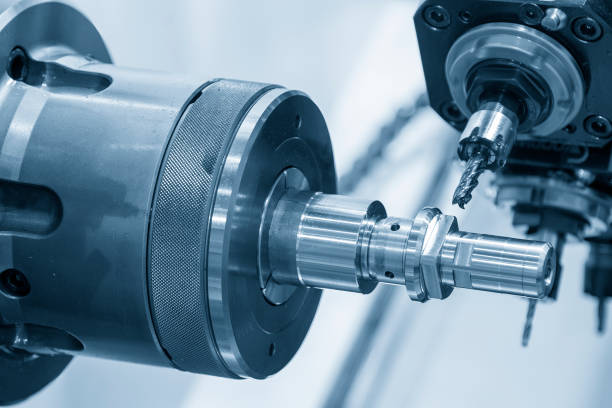
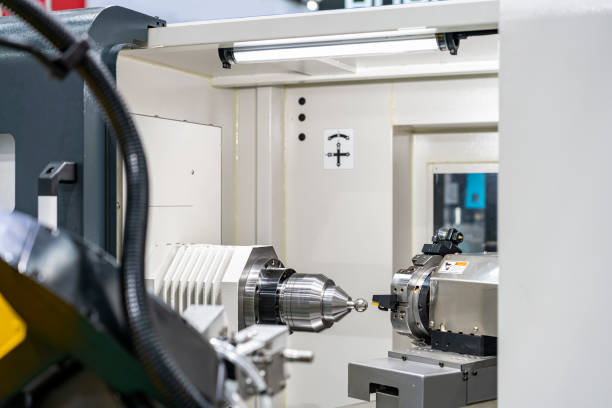
In the context of Swiss-type CNC lathes, multi-axis control refers to the simultaneous coordination of multiple linear and rotational axes. These typically include X and Z axes for turning, Y-axis for off-center machining, C-axis for spindle indexing, and additional axes for sub-spindles or live tooling. Each axis operates independently, yet the CNC controller synchronizes them precisely.
Unlike basic CNC systems that complete one movement at a time, multi-axis control enables overlapping motions. For example, while the main spindle performs turning operations, live tools can mill features at the same time. Similarly, back-working operations can proceed concurrently with front machining. As a result, production time decreases while machining complexity increases.
Why Multi-Axis Control Became Essential in Modern Manufacturing
Product designs have grown increasingly complex over the past decade. Components now incorporate cross holes, angled features, complex contours, and micro-scale details. At the same time, manufacturers face pressure to reduce lead times and maintain consistent quality at high volumes. Traditional machining approaches struggle under these combined demands.
Multi-axis control addresses these challenges directly. By reducing the need for multiple setups, it minimizes alignment errors and handling risks. Additionally, it shortens machining paths and enables continuous cutting motion. Consequently, manufacturers achieve higher productivity without compromising precision. For Swiss-type CNC lathes, multi-axis control is no longer optional. Instead, it represents a baseline requirement for competitive production.
Axis Configurations and Their Functional Roles
Modern Swiss-type CNC lathes typically feature a sophisticated axis layout. The Z-axis controls longitudinal feed along the part length, while the X-axis manages radial cutting depth. Together, these axes support core turning operations. However, the addition of the Y-axis significantly expands machining capability by allowing lateral tool movement. As a result, off-center milling, slotting, and drilling become possible without repositioning the workpiece.
The C-axis further enhances flexibility by controlling spindle indexing. This rotational control enables precise angular positioning, which is essential for cross-hole drilling and complex milling patterns. Many Swiss-type CNC lathes also include a sub-spindle with its own controlled axes. This configuration supports back-side machining and allows complete part processing in a single cycle.
The Importance of Axis Synchronization
Although axis quantity matters, synchronization defines true multi-axis performance. Advanced CNC controllers calculate motion paths dynamically and adjust feed rates in real time. Therefore, each axis moves in harmony with the others. This coordination ensures consistent tool engagement and stable cutting forces throughout the machining process.
Effective synchronization reduces vibration and minimizes tool wear. Additionally, it allows overlapping operations, such as simultaneous front and back machining. As a result, machine utilization increases while idle time decreases. For manufacturers focused on efficiency, synchronized multi-axis control directly translates into measurable productivity gains.
Accuracy Improvements Through Multi-Axis Control
Precision remains a critical factor in Swiss-type CNC machining. Multi-axis control improves accuracy by reducing cumulative errors. When the machine completes complex features within a single setup, it eliminates the need for re-clamping and re-referencing. Consequently, dimensional consistency improves across production batches.
Moreover, the guide bushing system works together with coordinated axis motion to enhance rigidity. Stable cutting conditions prevent deflection, even during aggressive machining. Therefore, Swiss-type CNC lathes with multi-axis control maintain tight tolerances reliably, even at high spindle speeds.
Surface Finish and Toolpath Optimization
Surface finish plays a crucial role in both functional performance and product aesthetics. Multi-axis control enhances surface quality by enabling smooth, continuous tool motion. Instead of abrupt stops and starts, the machine transitions seamlessly between cutting paths. As a result, surface marks and inconsistencies decrease significantly.
Advanced CNC systems also optimize tool engagement angles and cutting loads. By maintaining consistent contact between the tool and the material, the machine reduces chatter and vibration. Consequently, tools last longer, and surfaces remain uniform. This combination of quality and efficiency provides a clear advantage in high-precision manufacturing.
Eliminating Secondary Operations
Traditional machining often relies on multiple machines to complete a single component. Each transfer introduces additional handling, alignment errors, and time delays. In contrast, Swiss-type CNC lathes with multi-axis control consolidate operations into one platform.
Turning, milling, drilling, and back-working occur within a single cycle. Therefore, secondary operations become unnecessary. This consolidation simplifies production planning, reduces labor requirements, and improves overall quality control. Finished parts exit the machine ready for inspection or assembly.
Cycle Time Reduction and Productivity Gains
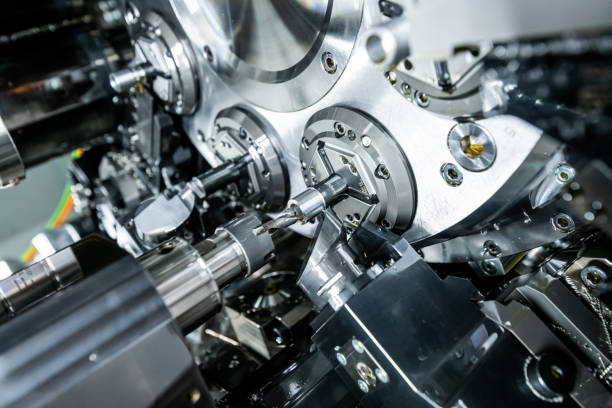
Cycle time directly influences manufacturing cost and delivery speed. Multi-axis control significantly reduces cycle time by enabling simultaneous operations. For instance, while the main spindle continues turning, the sub-spindle can perform back-side machining. Similarly, live tools can mill features during turning operations.
This overlapping approach maximizes spindle utilization and minimizes non-cutting time. Additionally, optimized axis movement reduces unnecessary repositioning. As a result, each machining cycle delivers more value within the same timeframe. For high-volume production, these savings accumulate rapidly.
Material Flexibility and Machining Stability
Swiss-type CNC lathes process a wide range of materials, including stainless steel, titanium, aluminum, brass, and engineering plastics. Multi-axis control enhances this versatility by maintaining stable cutting conditions across different material properties. Balanced forces and optimized cutting angles reduce heat buildup and tool stress.
This stability proves especially important when machining hard or heat-sensitive materials. By minimizing deflection and vibration, the machine preserves surface integrity and dimensional accuracy. Therefore, manufacturers can expand material options without sacrificing performance.
Supporting Complex Geometry and Micro-Component Production
As products become smaller and more complex, machining requirements intensify. Swiss-type CNC lathes with multi-axis control excel in producing micro-components with intricate geometry. Precise axis coordination supports tiny tools and delicate features without compromising accuracy.
Cross drilling, angled slots, and contoured profiles become standard operations rather than special cases. Consequently, designers gain greater freedom to innovate without manufacturing constraints. This capability positions Swiss-type CNC lathes as essential tools for advanced industries.
Programming Efficiency and CAM Integration
Multi-axis machining requires sophisticated programming. Modern Swiss-type CNC lathes integrate seamlessly with advanced CAM software. This integration allows programmers to create complex toolpaths with confidence and precision.
CAM systems simulate full-axis movement and detect potential collisions before machining begins. Therefore, setup risks decrease and commissioning time shortens. Optimized programs also ensure smoother machine motion, resulting in consistent real-world performance that matches simulation results.
Automation Compatibility and Future Scalability
Automation has become a strategic priority in modern manufacturing. Swiss-type CNC lathes with multi-axis control support automated loading, unloading, and part transfer. Sub-spindle coordination enables continuous production with minimal human intervention.
Furthermore, scalable axis configurations allow machines to adapt to future product requirements. As part designs evolve, manufacturers can leverage existing capabilities rather than replacing equipment. This scalability increases long-term investment value and operational flexibility.
Energy Efficiency and Resource Optimization
Efficient motion control contributes to lower energy consumption. Multi-axis synchronization eliminates unnecessary movement and reduces idle time. Consequently, power usage stabilizes during production.
Shorter cycle times also reduce coolant consumption and extend tool life. These factors lower operational costs and support sustainable manufacturing practices. Therefore, efficiency improvements align with both economic and environmental goals.
Quality Consistency in High-Volume Production
Consistency defines success in high-volume manufacturing. Multi-axis Swiss-type CNC lathes deliver repeatable results by following identical toolpaths for every part. Advanced controllers continuously refine motion accuracy, reducing variation over time.
Predictable output simplifies quality monitoring and statistical process control. As a result, manufacturers maintain tighter quality standards while meeting demanding production schedules. Customer confidence increases accordingly.
Conclusion: Multi-Axis Control as a Competitive Advantage
Multi-axis control has reshaped the role of Swiss-type CNC lathes in modern manufacturing. It transforms these machines from precision turning tools into comprehensive machining solutions. By enabling complex geometry, reducing cycle time, and improving accuracy, multi-axis control addresses the core challenges of today’s production environment.
For manufacturers seeking efficiency, flexibility, and scalability, Swiss-type CNC lathes with advanced multi-axis control represent a strategic investment. As product complexity continues to grow, this technology will remain central to precision machining success.