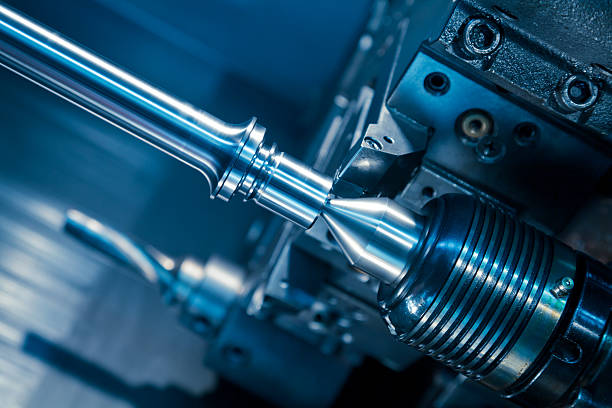
In the traditional landscape of precision manufacturing, the production of complex components often resembles a fragmented relay race. A part starts on a lathe for turning, moves to a machining center for milling, and perhaps visits a third station for delicate tapping or off-center drilling. Each transition requires “Secondary Setup”—a process that consumes valuable time, introduces human error, and, most critically, compromises the geometric tolerances of the workpiece.
However, the emergence of the advanced CNC turning center machine has rewritten this narrative. By integrating dual spindles, multi-channel control, and full B-axis milling capabilities, these machines perform a “One-Stop Symphony.” They allow manufacturers to complete five-axis machining in a single setup. This article explores the mechanical synergy behind these “super-taskers” and how they eliminate the inefficiencies of traditional multi-stage production.
1. The Curse of Secondary Setup: Precision’s Silent Killer
To understand the value of a modern CNC turning center machine, one must first recognise the hidden costs of moving a part between machines.
The Tolerance Accumulation Problem
When an operator removes a partially machined component—such as a turbocharger housing—from a lathe and remounts it on a milling machine, the “datum” or reference point shifts. Even with high-precision jigs, microscopic misalignments occur. These cumulative errors directly impact position tolerances and concentricity.
The Throughput Bottleneck
Beyond quality, secondary setups create massive logistical drag.
-
Queue Time: Parts sit in bins waiting for the next available machine.
-
Labor Costs: Each setup requires a skilled technician to calibrate the workholding and touch off tools.
-
Work-in-Progress (WIP): Large batches of unfinished parts tie up capital and floor space.
2. The Mechanical Synergy: Dual Spindles and Live Tooling
The modern CNC turning center machine solves these issues by evolving from a simple 2-axis lathe into a multi-functional mill-turn powerhouse.
Dual-Spindle Synchronization
The integration of a main spindle and a sub-spindle (counter-spindle) allows for “seamless handovers.” After the front-side machining is complete, the sub-spindle moves forward, grips the part while it is still rotating, and pulls it back for back-side processing.
-
Action: This “flying hand-off” happens in seconds.
-
Result: The machine finishes the part—front and back—without a human hand ever touching the metal.
Live Tooling and the Y-Axis
Standard lathes only move in the X and Z axes. However, a high-end CNC turning center machine incorporates a Y-axis and driven (live) tools. This allows the machine to perform off-center drilling and flat-milling. By combining rotation with Y-axis movement, the lathe functions as a 4-axis machining center, capable of milling hex shapes, keyways, and complex pockets on the circumference of the part.
3. The B-Axis Revolution: True Five-Axis Capability
For parts with complex internal geometries or angled holes, the Y-axis alone is insufficient. This is where the B-axis tilting head transforms the machine into a 5-axis mill-turn center.
Angled Machining at Any Degree
The B-axis allows the milling spindle to tilt, typically from -30 to +210 degrees.
-
Application: Imagine a complex hydraulic valve or a medical implant. The B-axis allows the tool to reach “hidden” corners and drill holes at any compound angle.
-
Surface Quality: By angling the tool, the machine can use the “sweet spot” of a ball-nose end mill, resulting in superior surface finishes that would be impossible on a rigid 3-axis setup.
Contouring and Full 5-Axis Interpolation
High-end channels allow for simultaneous 5-axis movement. This means the spindles, the X-Y-Z axes, and the B-axis move in perfect harmony. This “Symphony” enables the machining of impellers, turbine blades, and spiral gears that previously required dedicated, ultra-expensive specialised equipment.
4. Multi-Channel Control: Parallel Processing for Speed
A “Multi-Channel” CNC turning center machine uses a sophisticated controller that can run multiple programs simultaneously.
Cutting Cycle Times in Half
In a twin-turret, twin-spindle configuration, Channel 1 can control Turret A to machine the main spindle, while Channel 2 directs Turret B to work on the sub-spindle.
-
Pinch Turning: Both turrets can work on the same long shaft simultaneously to prevent deflection and double the metal removal rate.
-
Parallel Tasks: While the sub-spindle is finishing the back side of Part A, the main spindle is already roughing out the front-side of Part B. This “overlapping” of cycles effectively doubles the production tempo.
5. Redefining ROI: The Economics of One-Stop Machining
While a multi-spindle CNC turning centre machine requires a higher initial investment than a basic lathe, the Return on Investment (ROI) is realised through the “Total Cost per Part.”
-
Reduced Floor Space: One mill-turn centre replaces two or three standalone machines.
-
Lower Labour Input: One operator can manage multiple automated cells, as the machine handles the complex transitions internally.
-
Near-Zero Scrap: Because the part never leaves the chuck until it is finished, the risk of “setup error” scrap is virtually eliminated.
-
Faster Market Response: Reducing “Lead Time” from weeks to days allows manufacturers to win high-value contracts that require rapid delivery.
6. Conclusion: The Future is Finished in One
The era of moving parts from machine to machine is rapidly closing. The modern CNC turning center machine represents the peak of subtractive manufacturing efficiency. By combining the raw power of a lathe with the precision of a 5-axis machining centre, these units allow for a “One-Stop Symphony” of production.
Whether you are machining aerospace components, automotive turbine housings, or complex medical devices, the integration of dual spindles, Y-axes, and B-axis milling heads ensures that your production remains competitive. In the race for precision and speed, the winner is no longer the one with the most machines, but the one who can finish the part in a single, perfect setup.