In the pinnacle of modern manufacturing—specifically within the aerospace, medical, and energy sectors—the materials of choice are no longer simple steels. Instead, engineers rely on “Superalloys” like Titanium (Ti-6Al-4V) and Inconel (Nickel-chromium alloys). These materials offer extraordinary strength-to-weight ratios and heat resistance, but they present a brutal challenge to conventional machining equipment. They are notoriously “difficult-to-cut” due to their low thermal conductivity and high work-hardening rates.
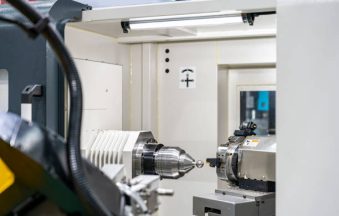
To conquer these advanced materials, the machine tool must possess more than just power; it requires a superior structural philosophy. This is where the CNC slant bed lathe becomes an indispensable asset. By leveraging a triangular rigidity reserve and an optimized thermal dissipation path, the slant bed architecture provides the mechanical “stamina” required to maintain micron-level precision under the extreme cutting forces generated by superalloys.
1. The Superalloy Challenge: Why Standard Machines Fail
Before examining the machine’s architecture, we must understand the “enemy.” Titanium and Inconel are physically aggressive toward cutting tools and machine structures.
The Heat Trap
Titanium has extremely low thermal conductivity. Unlike aluminum or steel, where the heat generated by friction is carried away by the chips, Titanium retains heat at the cutting edge. This creates a localized “furnace” that can cause tool deformation and thermal expansion in the machine’s spindle and turret.
Extreme Cutting Forces and Vibration
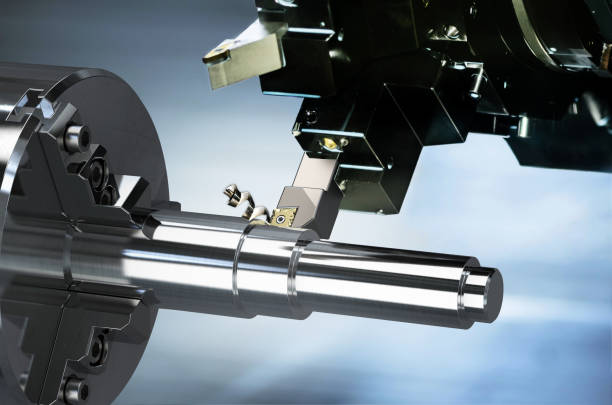
Inconel maintains its high strength even at temperatures where other metals soften. Cutting it requires a massive force. This force translates into high-frequency vibrations (chatter). On a traditional flat-bed machine, these vibrations can resonate through the bed, leading to poor surface finishes and shattered carbide inserts. The CNC slant bed lathe is specifically designed to absorb and neutralize these forces.
2. The Triangular Advantage: Rigidity Reserves of the Slant Bed
The defining characteristic of a CNC slant bed lathe is its , , or inclined bed structure. This is not an aesthetic choice; it is a fundamental shift in physics.
Optimized Force Transmission Path
In a slant bed configuration, the cross-section of the bed is significantly larger than that of a flat bed of the same footprint. This creates a “Triangular Box” structure.
-
The Physics: When the tool engages a tough Inconel workpiece, the resulting cutting force acts downward. In a slant bed design, this force is directed vertically through the massive casting of the bed rather than trying to “twist” the carriage.
-
The Result: This alignment minimizes the bending moment on the guide rails, ensuring that the tool remains perfectly stationary even during heavy, interrupted cuts.
Anti-Vibration Dampening
Advanced slant bed lathes utilize high-grade Mehanite cast iron with internal ribbing. The inclined angle allows for a more robust casting at the base, which acts as a natural dampener for the harmonic vibrations generated by high-speed titanium turning. This “Rigidity Reserve” allows operators to push higher feed rates without risking the structural integrity of the part.
3. Thermal Management: Turning Heat into an Asset
As previously noted, Titanium machining creates immense heat. A machine’s ability to manage this thermal energy dictates its long-term accuracy.
Natural Chip Evacuation
In a flat-bed lathe, hot metallic chips often accumulate on the ways or near the spindle, transferring their heat directly into the machine’s “bones.” This causes thermal growth, shifting the X and Z axes by several microns over the course of an hour.
-
The Slant Advantage: The CNC slant bed lathe utilizes gravity. Hot chips fall directly into the chip conveyor without ever lingering on the precision guide rails.
-
Coolant Flow: The inclined bed allows for high-pressure coolant systems to flush the work area more effectively, ensuring the heat is moved away from the workpiece and the tool tip instantly.
Symmetrical Thermal Expansion
Because the slant bed is a more unified, heavy casting, it exhibits better thermal symmetry. Even if the machine warms up during a 24-hour production cycle, the expansion occurs in a predictable, linear fashion that the CNC controller can easily compensate for, maintaining the tight tolerances required for aerospace engine components.
4. Precision Interaction: Tooling and Spindle Performance
Machining advanced materials requires a high-torque, high-stability spindle that works in perfect harmony with the slant bed.
-
Higher Spindle Speeds with Stability: Because the center of gravity of a CNC slant-bed lathe is lower and more centered than a flat-bed equivalent, the spindle can achieve higher RPMs with less oscillation.
-
Live Tooling Integration: Most slant bed lathes are equipped with robust 12 or 24-station turrets. When machining complex Inconel parts that require both turning and milling (C-axis and Y-axis), the rigidity of the slant bed ensures that the milling tool doesn’t “wander” when it strikes the work-hardened surface of the material.
5. Economic ROI: Efficiency in the “Unmachinable.”
While a CNC slant-bed lathe represents a higher initial investment than a basic flat-bed machine, the Return on Investment (ROI) when processing Titanium and Inconel is indisputable.
-
Reduced Tool Costs: By minimizing vibration, the lathe extends the life of expensive ceramic or PCD (Polycrystalline Diamond) inserts.
-
Lower Scrap Rates: Enhanced rigidity leads to superior surface finishes, which is vital for medical implants where any surface imperfection can lead to product rejection.
-
Faster Cycle Times: The ability to take deeper “heavy-duty” cuts in a single pass—rather than multiple light passes—significantly reduces the time the part spends on the machine.
6. Conclusion: The Foundation of Modern Aerospace
The shift to superalloys defines 21st-century engineering. However, only physics-driven equipment can tame these materials. The CNC slant bed lathe is no luxury. It is a prerequisite for aerospace and energy manufacturing.
The slant bed’s triangular frame provides unmatched rigidity. Its architecture uses gravity to manage heat and chips effectively. Furthermore, superior vibration-dampening makes Titanium and Inconel manageable. These materials are no longer “unmachinable.” Instead, they become predictable and profitable.
The slant bed lathe empowers the next generation of jet engines. It also enables the creation of advanced surgical tools. Ultimately, this stable foundation drives modern industrial innovation.