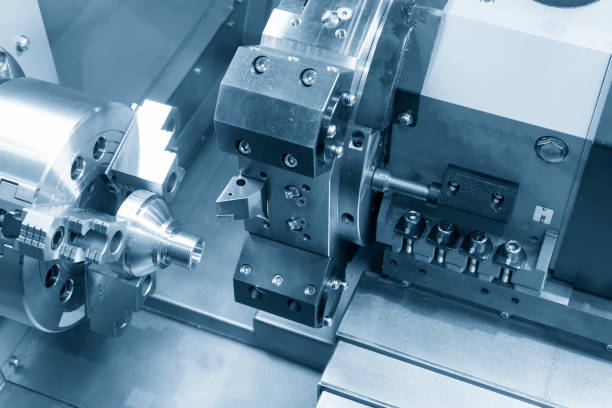
For over a century, the horizontal flat-bed lathe ruled metalworking. As manufacturing advances toward ultra-precision and automation, factory designs evolve. Today’s factory floors feature a distinct geometric shift: the slanted axis. The rise of the slant bed CNC lathe is more than a design trend.
This incline, often set at 30°, 45°, or 60°, solves key machining challenges. It improves chip management, rigidity, and heat dissipation for high-speed machining. The “slant” design embodies manufacturing values of integration, complexity, and intelligence. Choosing a slant bed isn’t just an upgrade; it’s a strategic move toward efficiency.
1. The Gravity Advantage: Revolutionizing Chip Management
In high-speed CNC turning, the “chip” is the enemy. When a machine is cutting aerospace-grade alloys or high-tensile steel at thousands of revolutions per minute, it generates a massive volume of hot, sharp metal shavings.
The Flat Bed Struggle
On a traditional flat-bed lathe, chips often accumulate on the horizontal ways and around the tool turret. This accumulation leads to several critical issues:
-
Thermal Deformation: Hot chips transfer heat to the machine bed, causing microscopic expansions that ruin micron-level tolerances.
-
Tool Damage: Entangled chips can scratch the workpiece or interfere with the tool-changing mechanism.
The Slant Bed Solution
The geometry of a slant bed CNC lathe utilizes the most reliable force in nature: gravity.
-
Self-Cleaning Design: Because the bed is inclined, chips and coolant fall directly onto the chip conveyor or the base of the machine. They do not linger on the precision guide rails.
-
Increased Uptime: By eliminating manual chip cleaning and preventing chip-related jams, the machine maintains a much higher “Active Cutting Time,” which is the ultimate metric of profitability.
2. Structural Rigidity: The Physics of the “Box” Section
Precision starts with stability. The “slant” design allows for a significantly more robust mechanical structure compared to flat-bed alternatives.
Optimized Cross-Section
A slant bed lathe typically features a larger cross-sectional area for its base. This “box-like” structure is inherently more resistant to torsion and bending.
-
Better Force Distribution: During heavy-duty cutting, the resultant forces are directed more efficiently into the massive machine base. This minimizes vibration (chatter), allowing for a superior surface finish (Ra < 0.4) even during aggressive material removal.
-
Extended Tool Life: Rigidity is the best friend of the cutting tool. By eliminating vibration, the slant bed ensures that the tool edge remains sharp for longer, reducing the “Cost Per Part” over long production runs.
3. Thermal Stability: Preserving the “Micron.”
In the world of precision manufacturing, heat is a ghost that haunts every measurement. As the spindle and motors work, they generate heat that can shift the machine’s zero-point.
-
Heat Isolation: In a slant bed CNC lathe, the heat sources (chips and coolant) are physically separated from the precision components. The “slanted” architecture allows for better air circulation and more effective use of high-pressure cooling systems.
-
Consistent Accuracy: Because the bed doesn’t absorb as much heat from the chips, the machine reaches its “thermal equilibrium” faster and stays there. This means the first part of the morning shift is just as accurate as the last part of the night shift.
4. The Automation Gateway: Designed for the Unmanned Factory
The modern manufacturing pulse is beating toward “Lights-Out” operation. The slant bed architecture is the natural habitat for automation and robotics.
Ergonomics and Accessibility
The incline of the bed brings the spindle and the workpiece closer to the operator—and, more importantly, closer to the robot arm.
-
Integrated Loading: Whether using a bar feeder or a gantry robot, the slant bed provides a clearer “work envelope.” There is more space for the robot to maneuver without colliding with the machine’s protective doors or the tailstock.
-
Smart Monitoring: Most slant bed machines are designed for modern sensor integration. Tool breakage detection and automatic part probing are easier to install and maintain in the clean, chip-free environment of a slanted carriage.
5. Integration and Complexity: The Multi-Tasking Powerhouse
Today’s manufacturers no longer want just a “lathe”; they want a “turning center.” The slant bed provides the physical space required for multi-functional integration.
-
Live Tooling & Y-Axis: The slant bed design provides the necessary room to add a Y-axis and live tooling turrets. This allows for milling, drilling, and tapping on the same machine, transforming it into a “Done-In-One” solution.
-
Compact Footprint: Despite its massive internal rigidity, the slant bed design is often more space-efficient on the factory floor, allowing for a higher density of machines in a smaller area.
6. Conclusion: Choosing the Incline is Choosing the Future
The manufacturing industry is at a crossroads where “good enough” is no longer an option. The demand for tighter tolerances, faster cycle times, and lower labor costs is relentless.
The slant bed CNC lathe is the industry’s answer to these challenges. It is a design that respects the laws of physics, understands the reality of high-volume production, and anticipates the requirements of the AI-driven, automated future. To look “at an angle” is not just to see a machine—it is to see a more efficient, cleaner, and more profitable way of creating the physical world. For the top-tier manufacturer, the slant bed isn’t a luxury; it is the fundamental infrastructure for the next chapter of precision.