In the world of large-scale manufacturing, “5-axis” is a popular term. However, many buyers do not realize that two distinct technologies exist. You might hear people discuss “True 5-Axis” versus “Fake 5-Axis” setups. Understanding this difference is vital for your investment. This guide clarifies the mechanics of the CNC gantry-type machining center. We help you choose the right motion control for your specific parts.
1. The Technical Heart: 3+2 Axis vs. 5-Axis Simultaneous
The primary difference lies in how the axes move together. Both systems use five physical axes, but their “brain” logic differs.
5-Face Machining (3+2 Axis)
We often call 5-axis machining “positional” 5-axis. In this setup, the machine uses three linear axes for cutting. Meanwhile, two rotary axes tilt the tool to a fixed angle. Once the tool reaches the position, the rotary axes lock firmly. Consequently, the tool stays perpendicular to the specific face during the cut. This method is incredibly stable for box-type parts. Therefore, it excels at drilling and tapping on multiple sides.
5-Axis Simultaneous: The “True” 5-Axis
In a “True 5-Axis” system, all five axes move at once. The tool tip follows a continuous, complex path in 3D space. The controller constantly calculates the tool’s orientation relative to the surface. Consequently, the machine can carve smooth, flowing curves without stopping. This fluidity is essential for parts with organic or aerodynamic shapes.
2. Performance Profile: Rigidity vs. Flexibility
Each configuration offers a different “personality” for your production line.
The Gantry Advantage for 5-Face Work
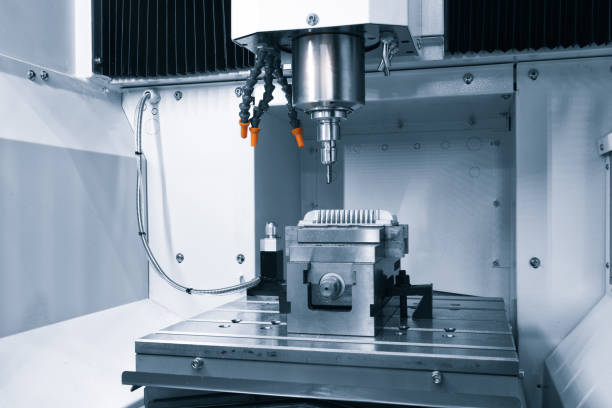
For large molds, a CNC gantry-type machining center with 5-face capability is often enough. Because the rotary axes lock during the cut, the machine maintains high rigidity. You can take deeper cuts and remove material much faster. Furthermore, the programming for 3+2-axis work is much simpler. Therefore, you reduce the risk of crashes and shorten your setup time. It is a workhorse for heavy-duty industrial applications.
The Precision of Simultaneous Motion
Aerospace structural parts require a different level of finesse. These components often feature deep pockets and twisted walls. Consequently, you must tilt the tool continuously to avoid collisions. A 5-axis simultaneous gantry machine provides this extreme flexibility. While the setup is more complex, it eliminates the need for multiple fixtures. You finish the entire part in a single operation. This ensures perfect accuracy and superior surface finishes.
3. Application Guide: Matching the Machine to the Job
How do you decide which CNC gantry-type machining center fits your workshop? Consider your primary product line.
-
Large Molds and Dies: Choose 5-face (3+2) machining. You gain better surface quality and lower machine costs. The high rigidity handles tough tool steels with ease.
-
Aerospace and Energy: Choose 5-axis simultaneous motion. Blisks, impellers, and wing spars demand continuous tool orientation. It is the only way to reach complex internal geometries.
-
Heavy Machinery Bases: Stick to 5-face configurations. You only need to reach the sides of a massive block. Simultaneous motion adds unnecessary cost for these simple geometries.
Conclusion: Investing in the Right Motion
Choosing between 5-axis and 5-face simultaneous motion is a strategic decision. Do not pay for “True 5-Axis” if your parts only have flat faces. Conversely, do not limit your shop if you plan to enter the aerospace market.
A high-quality CNC gantry-type machining center is a massive long-term asset. Ensure the controller and spindle head match your future growth plans. We help you navigate these technical waters with absolute clarity. Pick the motion that drives your profits, not just the trend. The right machine turns complex blueprints into perfect reality every day.