A shop gave its new robot cell a job its machinists had run for thirty years and left it going overnight for the first time. By morning there were steel chips all over the floor, because nobody had emptied the bin under the CNC chip conveyor. The conveyor had done its job. The cart under it simply couldn’t hold a night’s chips.
Which conveyor you need, how big the cart should be and how fine the coolant has to be filtered all depend on the job. This guide starts with the four conveyor types, then goes through five common jobs with the numbers for each.
CNC chip conveyor types: what each one does
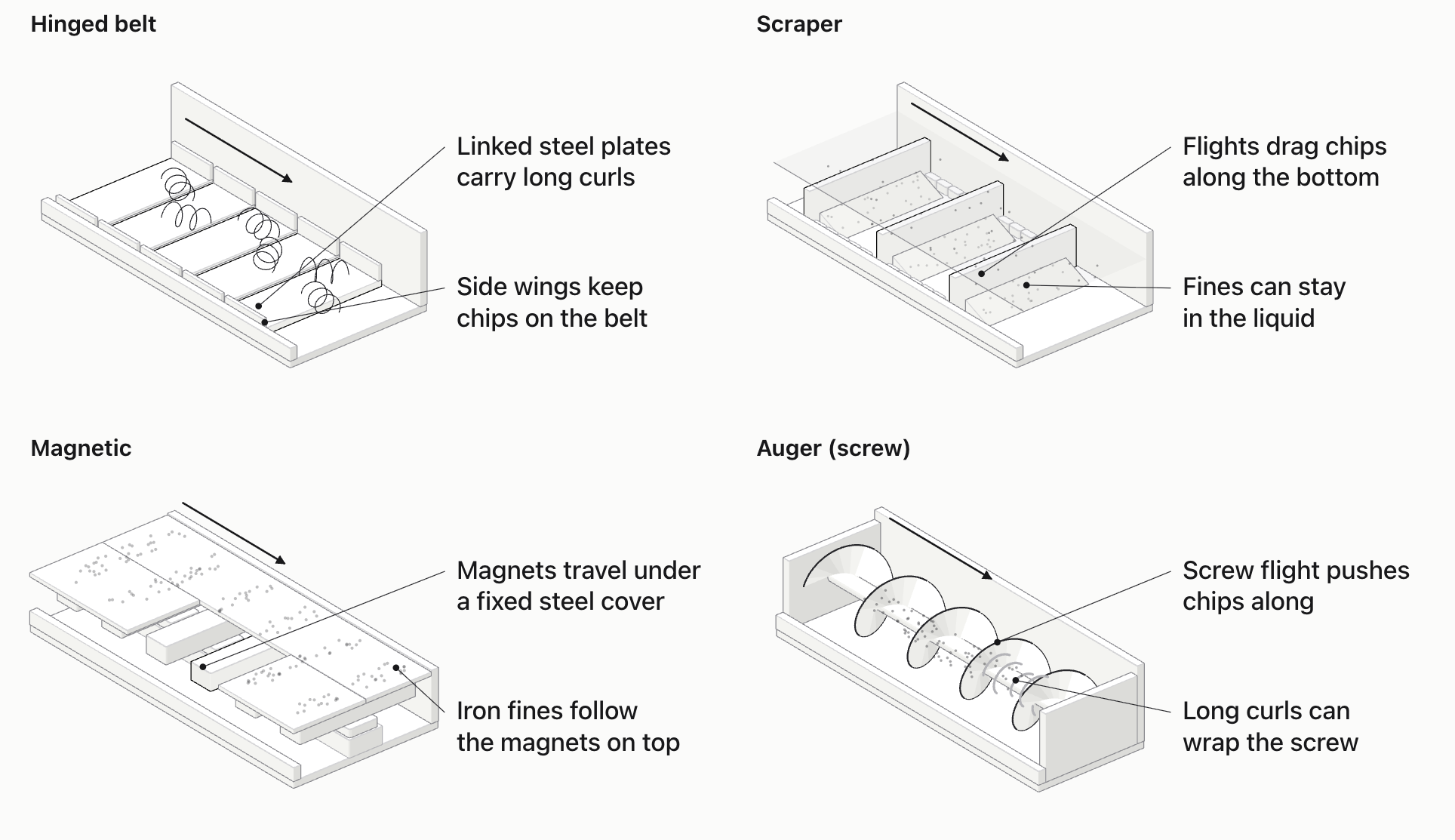
There are four common types of chip conveyor. Each moves chips in its own way, so each suits different chips. The ratings for hinged belts and scrapers come from Mayfran’s conveyor selection guide.
- Hinged belt. Linked steel plates carry chips up and out of the machine. Mayfran rates it good for long turnings and nests (tangled balls of long chips).
- Scraper. Flights on a chain drag chips along the floor of a trough. Mayfran rates it good for short steel chips, but doesn’t recommend it for turnings or nests.
- Magnetic. Magnets moving under a fixed stainless cover pull iron and steel chips along it. PRAB describes this type as built for very small particles and sludge, such as cast iron fines (very small chips and powder), and it can’t move aluminum.
- Auger. A turning screw pushes chips along a low trough. It gathers chips along a machine and usually hands them to another conveyor that lifts them out.
A hinged belt can also carry a screen box, a perforated box under the belt that strains chips out of the coolant. A drum filter, a turning mesh drum, filters finer still. These add-ons decide how clean the coolant gets.
Pick a CNC chip conveyor by the job you run
Mayfran’s guide grades each conveyor type for each material and chip form. Mayfran counts a chip as short when it is under about 50 mm long and doesn’t ball up.
| Your job and its chips | Start with | Rated lower or not recommended |
|---|---|---|
| Steel shafts on a lathe, flood coolant: long turnings and nests | Hinged belt, ideally with a screen box | Scraper, magnetic |
| Aluminum parts on a vertical machining center: long strings plus short chips and fines | Hinged belt with screen box, or a drum-filter conveyor | Magnetic |
| Cast iron housings: short chips, powder and sludge | Magnetic, or a drum-filter conveyor | Plain hinged belt or scraper (rated fair) |
| Stainless parts: long, tough curls | Hinged belt | Magnetic |
| Long parts on a gantry: chips spread along a long table | Augers along the table feeding a hinged belt | A single conveyor at one end |
Chip conveyor for steel shafts on a lathe
For steel turnings, start with a hinged belt. Long turnings and nests ride on the plates, and Mayfran’s guide rates it good for them, or better with a screen box that strains the coolant on the way through. Leave scrapers and magnetic conveyors out of this job. PRAB warns against drag conveyors for masses of curly, stringy turnings, and describes magnetic conveyors as built for very small particles and sludge.
Hennig’s standard hinged-belt pitch is 1.5 in (38 mm), with a 2.5 in (63.5 mm) belt for heavier duty. If your turnings come off in big nests, consider the larger pitch, meaning longer belt plates, and check the channel height and outlet size as well.
The bigger question is the cart, which we work through below with a turned shaft. On that job, unbroken turnings fill a 160-liter cart in under three hours.
Chip conveyor for aluminum parts on a vertical machining center
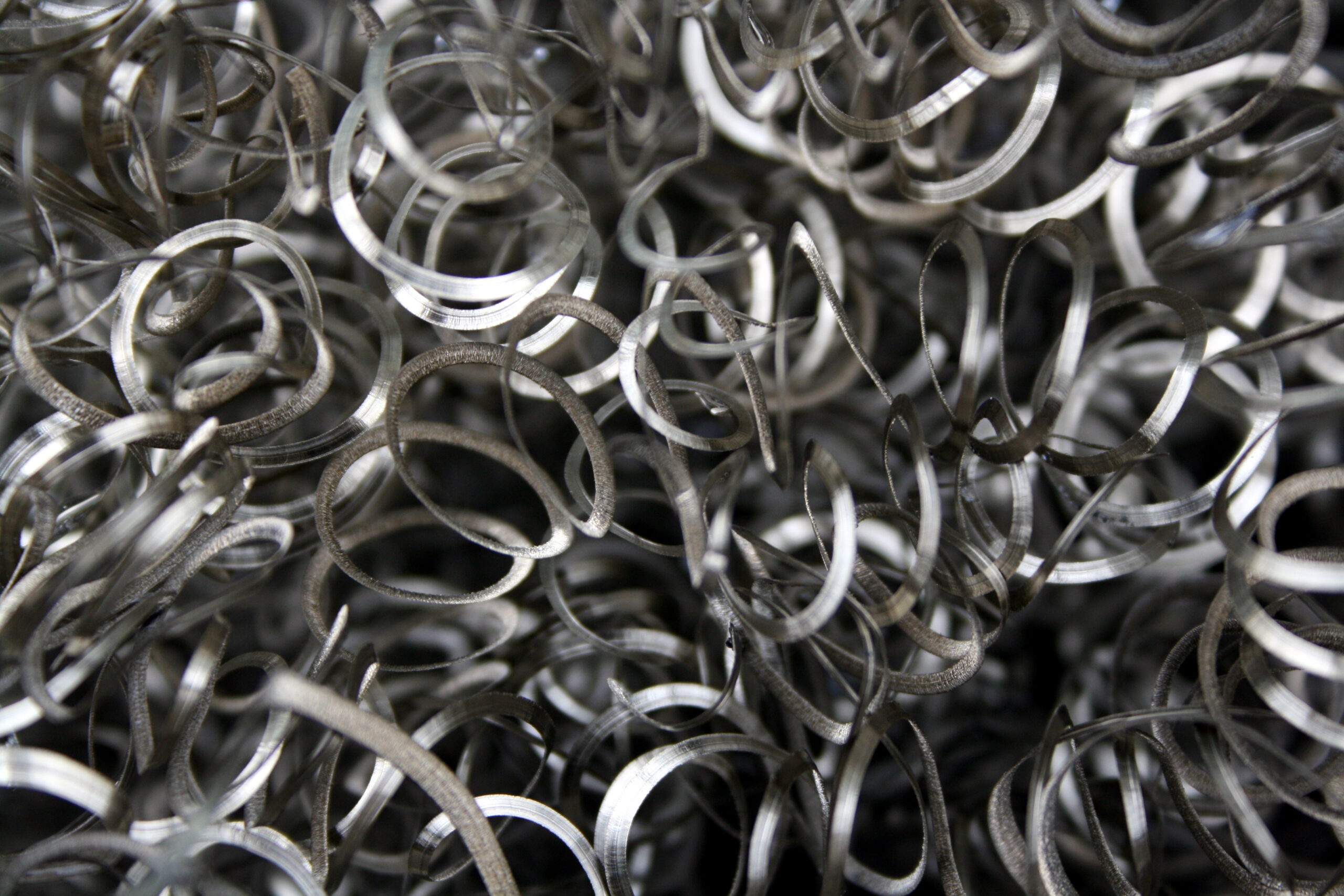
When an aluminum job mixes long strings, short chips and fines, a bare belt isn’t enough. A hinged belt carries the strings well but the short chips only fairly, by Mayfran’s rating. A screen box under the belt helps with both, and a conveyor with a 50-micron (0.05 mm) drum filter handles the mix best. Magnetic conveyors are out, since aluminum isn’t magnetic.
If the machine has through-spindle coolant (coolant fed through the spindle and out of holes in the tool), filtration matters more. One machine builder sells a bag filter that keeps coolant free of particles down to 25 microns, as an add-on for its machines with through-spindle coolant.
Fines that pass a coarse screen risk blocking or wearing the spindle and the tool’s coolant holes, so set the filter rating by what the machine and tool makers require.
Dry aluminum chips up to about 12 mm are light, about 110–240 kg/m³ loose (what one cubic meter of loose chips weighs). By weight there isn’t much, but by volume they fill a cart quickly.
Chip conveyor for cast iron housings
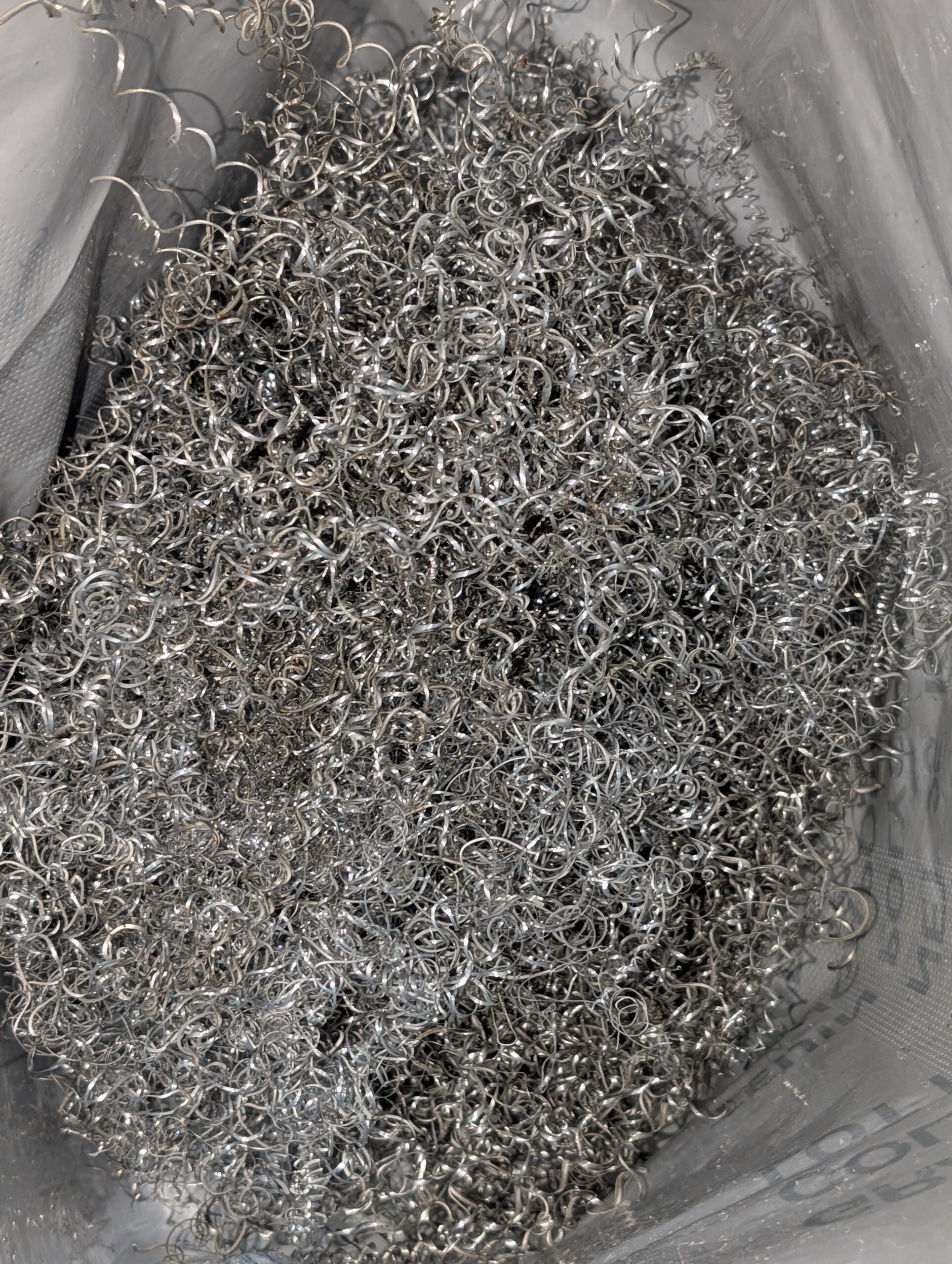
Cast iron is the job where a magnetic conveyor earns its place. The chips break short, and the powder turns the coolant into sludge. Magnets running under a fixed stainless cover pull the iron fines out of the coolant.
Mayfran’s own magnetic design, which pairs a magnetic bed with a scraper belt, is the one it rates best for short cast iron chips. A plain hinged belt or a scraper only rates fair, because the powder slips through and settles in the tank. With through-spindle coolant, check the filter rating the machine maker requires.
Cast iron chips are heavy, about 960–1,600 kg/m³ loose. A cart holding 160 liters of them carries roughly 150–260 kg, so check the cart’s load rating and how it will be lifted or tipped. For milling cast iron in particular, see our guide to chip and coolant requirements in gray cast iron milling.
Stainless parts
Where stainless comes off in long, tough curls like steel turnings, the choice is the same: a hinged belt, with the larger pitch for big nests.
The one trap is a magnetic conveyor. The common austenitic grades, the standard chromium-nickel stainless steels such as 304 and 316, are essentially non-magnetic when annealed, although cold working, such as the deformation during cutting, can make some chips respond weakly (Australian Stainless Steel Development Association). Mayfran groups steel and stainless together and does not recommend magnetic conveyors for either.
Long parts on a gantry
On a gantry machining center (a large machine with the spindle on a bridge over a long table), chips land along the whole length of a long table. A single CNC chip conveyor at one end may not reach them all. The usual layout puts augers in troughs along the table to gather the chips and feed them to a hinged belt that lifts them out to the cart.
Size the chip cart and the coolant tank
CNC chip conveyor sizing: a worked example
Chips take up far more room than the metal they came from. These published loose densities show how much:
| Chips | Loose bulk density | Source |
|---|---|---|
| Long, bushy steel turnings | 80–320 kg/m³ (5–20 lb/ft³) | PRAB |
| Broken steel chips, up to about 50–75 mm | 320–1,600 kg/m³ (20–100 lb/ft³) | PRAB |
| Aluminum chips | 110–240 kg/m³ (7–15 lb/ft³) | CEMA-based conveyor table |
| Cast iron chips | 960–1,600 kg/m³ (60–100 lb/ft³) | PRAB |
Solid steel is about 7,850 kg/m³, so one liter of steel can turn into roughly 25 to 100 liters of bushy turnings.
Take a steel shaft turned from 60 mm bar down to 50 mm over a 150 mm length. That removes about 0.13 liters of steel, about 1.0 kg, per part. At 20 parts an hour the lathe makes about 20 kg of chips an hour. With a 200-liter cart filled to 80%, you have 160 usable liters.
| If the chips come off as | Volume per hour | The cart lasts |
|---|---|---|
| Long, bushy turnings | about 63–250 liters | about 0.6–2.6 hours |
| Broken chips | about 13–63 liters | about 2.6–13 hours |
Same part, same lathe, same cart. The difference is whether the chips break, which is why it’s worth getting the chips to break at the tool before an overnight run.
Making one chip cart last longer
If the chips won’t break, you need a bigger cart, a second cart, or a way to pack them tighter. A chip crusher helps: it breaks the chips so they pack tighter. PRAB notes that bushy turnings passed through a crusher usually come out as broken chips no more than 2–3 in (50–75 mm) long, the much denser row in the table above.
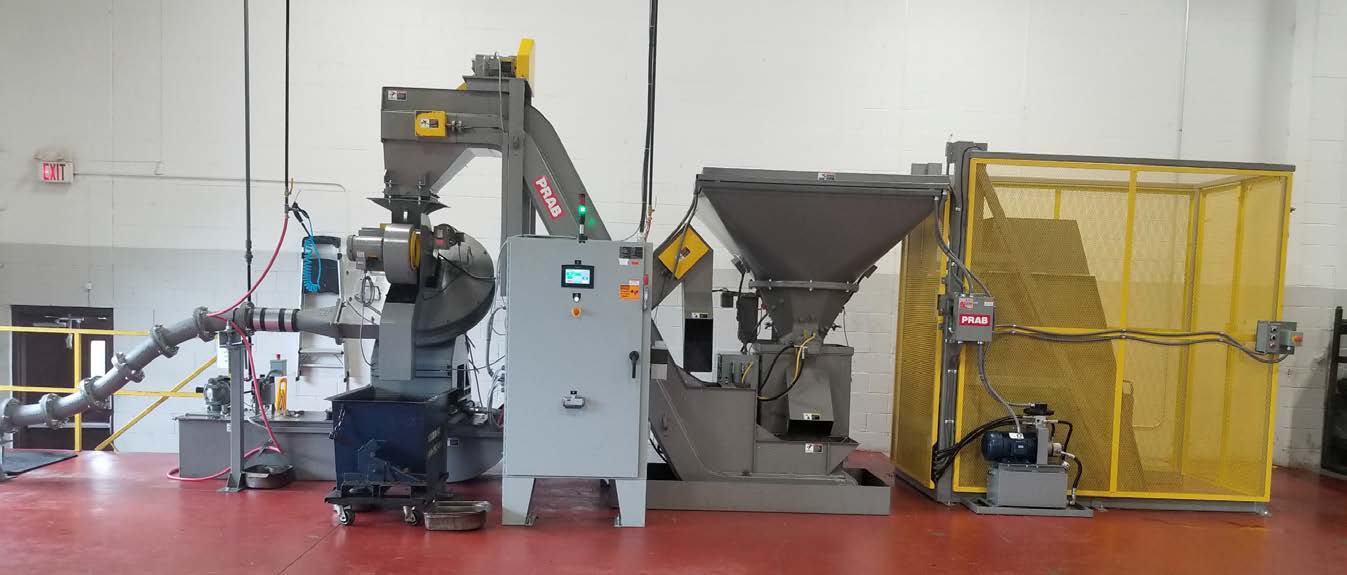
One shop that ran weekends found that the right dumping hopper (a tipping chip cart) nearly doubled its unattended time. It also tried a cone-shaped deflector under the outlet to spread chips across the cart. Another put a turntable turning under one revolution a minute under the outlet, so the chips didn’t pile up in one corner and spill.
Coolant flow and tank size
The coolant side follows the spindle power. Master Fluid Solutions’ sizing bulletin plans 1 to 1.5 US gallons per minute per horsepower at the cut for heavy chip machining, which works out to about 5–7.6 liters per minute per kW. Assuming 11 kW at the cut, that is about 56–84 liters a minute, before any wash-down lines.
The same bulletin puts typical tanks at three to ten times the pump’s flow per minute, so for that pump roughly 170–840 liters.
The bulletin divides the tank roughly 25/75. The pump sits on the small side, and the dirty return comes into the large side, as far from the pump as possible, discharging below the fluid level to reduce foaming.
A baffle (a plate dividing the two sides) rising from the floor to about 70% of the fluid depth keeps chips from reaching the pump. A second baffle just upstream hangs down from the top to about 70% of the tank depth and catches floating oil. The pump intake sits low, but not on the tank floor, where it would pick up settled chips.
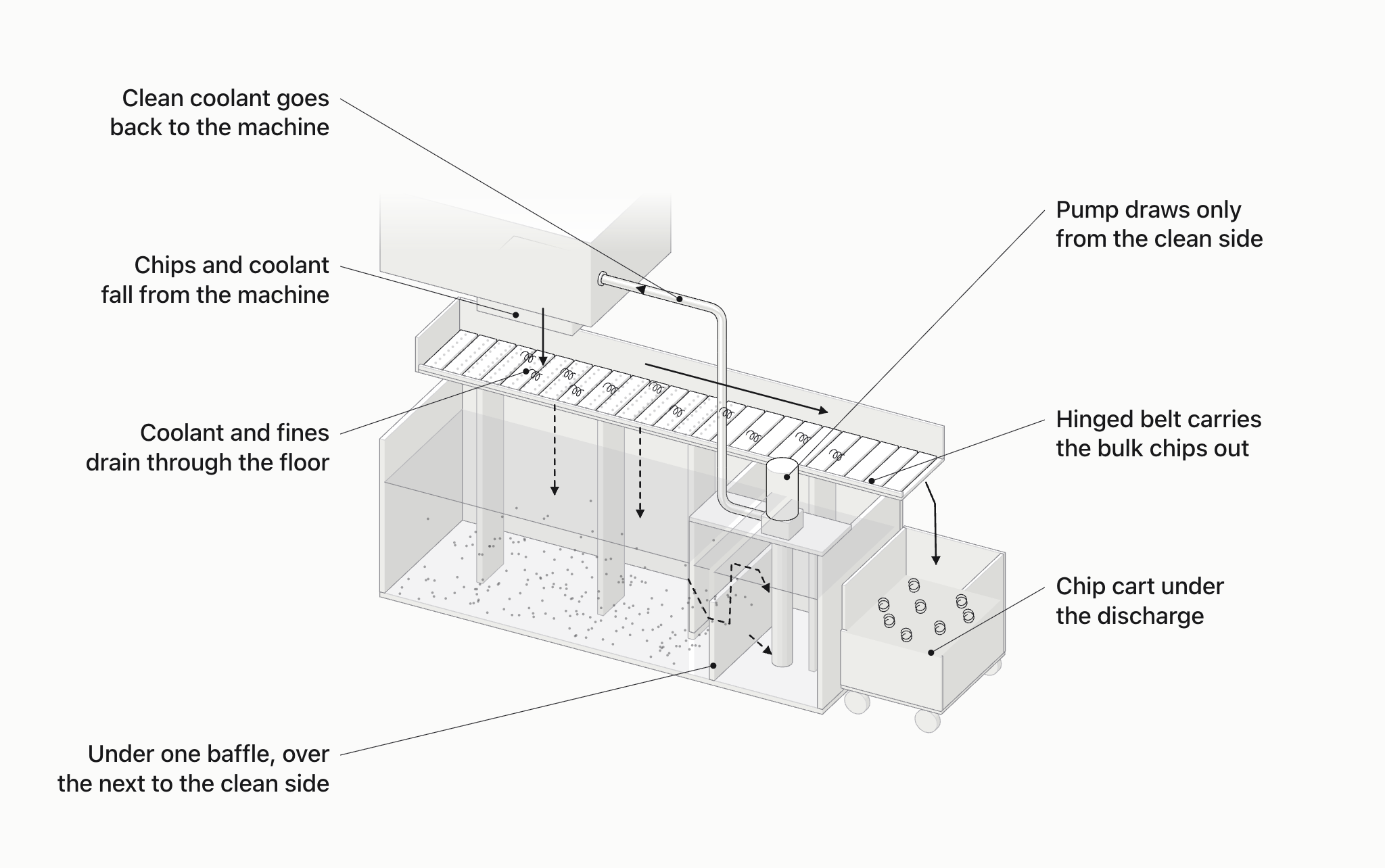
Mayfran’s filtration figures give a sense of scale. A hinged belt with a screen box filters to a nominal 250 microns. A drum-filter conveyor gets to 50 microns. Its paper-media filters go to about 20–50 microns and vacuum filters to 10–30 microns, for fines such as grinding sludge. Match the stage to the finest passage the coolant has to get through.
Lay out the CNC chip conveyor outlet and the cart
The discharge height has to clear the top of the cart you actually own, and there has to be room to swap a full cart for an empty one. Ask the conveyor maker how to change carts safely without chips spilling. Put a drip tray under the outlet, since wet chips keep dripping coolant. If several machines feed one transfer line (a shared conveyor that carries chips away), decide where each conveyor hands off before the machines are placed.
Before the first night shift
An automation specialist who discussed that first overnight run gave this advice. Before the lights go off, run the job with the lights on and a rule that nobody touches the machine. Each time someone has to step in, write it down, because at night each of those is a stopped machine.
During that run, note when the cart fills and compare it with your estimate. In the shaft example, unbroken turnings would fill it in about 2.6 hours or less.
Also check what happens at an alarm stop, with the supplier and following the machine’s safe test procedure. At another shop, a timed coolant top-up still started on schedule after a machine had stopped on an alarm, and flooded the floor. The top-up has to respond to a stop on its own, separately from the conveyor.
Chip handling on the machine you’re quoting
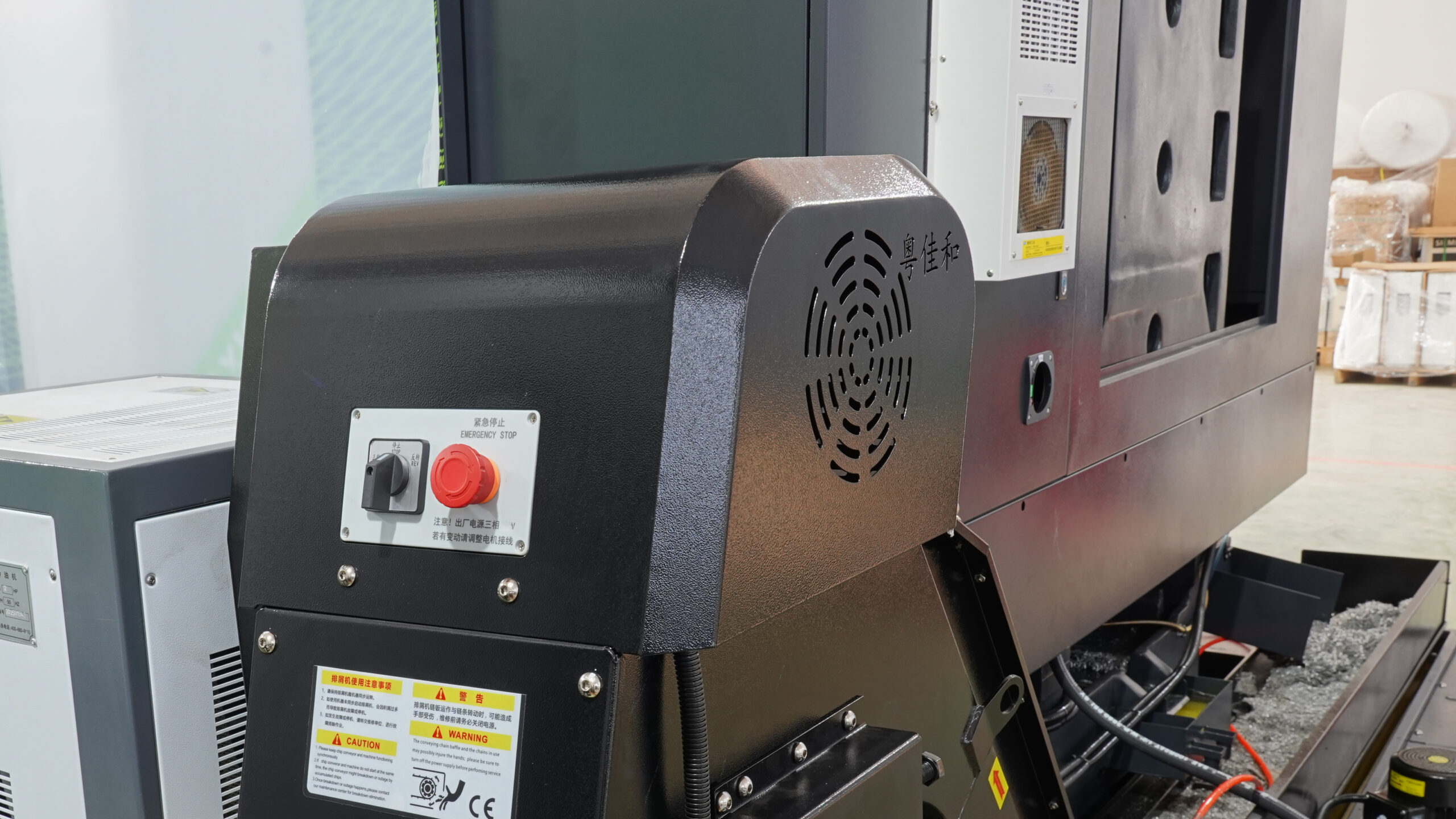
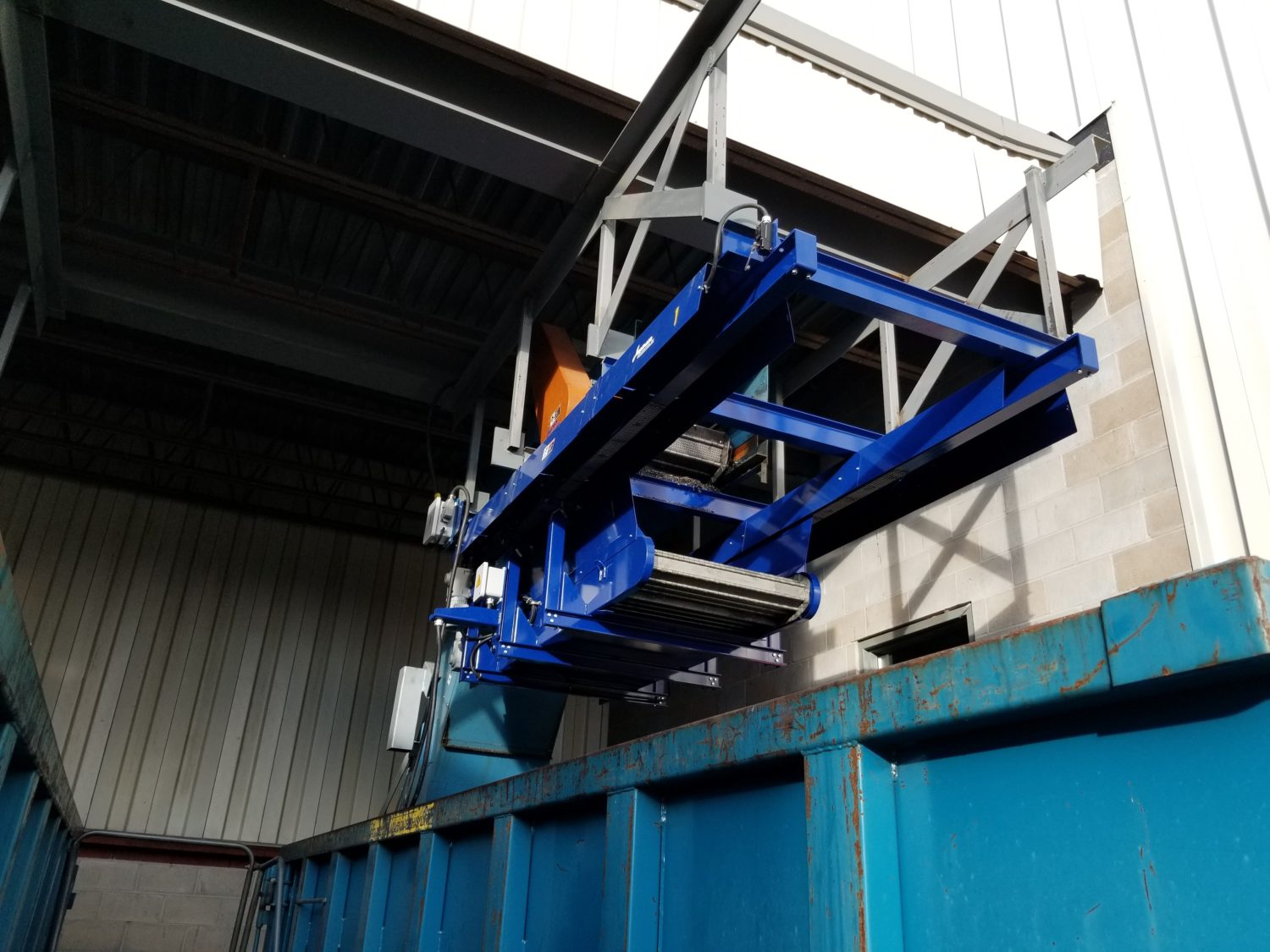
When you tell us the job, we match it against the chip handling we can fit on the machine you’re considering. On our gantry machining centers we’d set up the combination described above, a hinged-belt conveyor with augers to gather the chips. For our slant-bed CNC lathes we’d fit a chip conveyor like the one below, and confirm its position and outlet at quotation.
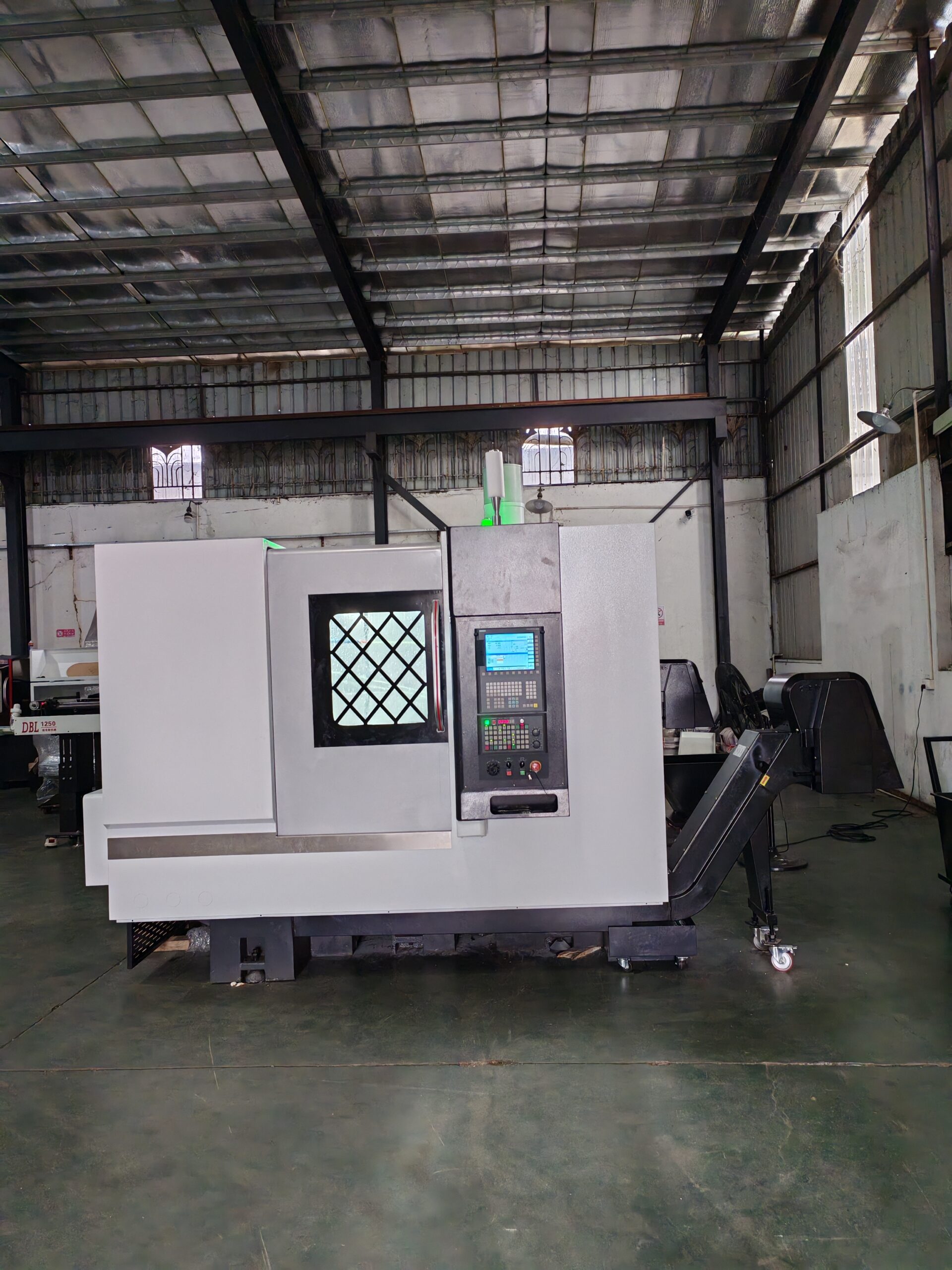
Send us your part drawing with the material, the operation, the metal removed per part, parts per hour, the coolant method and how many hours you want to run unattended. Add a photo of the worst chips next to a ruler. We’ll suggest a conveyor and cart setup, estimate the cycle time and prepare a quote.
FAQ
Will a magnetic conveyor handle stainless steel chips?
Not reliably. Common austenitic grades such as 304 and 316 are essentially non-magnetic, and Mayfran doesn’t recommend magnetic conveyors for steel or stainless turnings. Use a hinged belt.
How fine should the coolant filter be?
It depends on the finest passage the coolant goes through. A hinged belt with a screen box filters to about 250 microns and a drum-filter conveyor to 50. With through-spindle coolant, use the rating the machine and tool makers require; one builder’s add-on filter works to 25.
Can an auger lift chips straight into a bin?
An auger is usually a gathering conveyor in a low trough. If the cart is higher than the auger outlet, add a hinged belt or another lifting conveyor after it.
Why does the supplier need my coolant flow as well as chip volume?
Chip volume sizes the conveyor and the cart. Coolant flow sizes the tank and the filter, at roughly three to ten times the pump’s flow per minute for the tank.