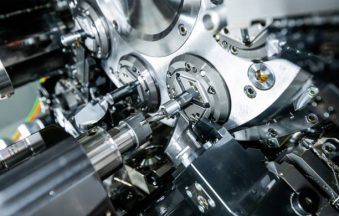
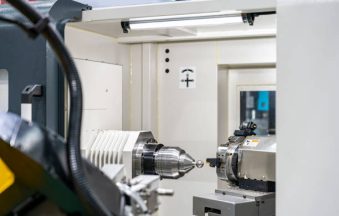
In the traditional landscape of precision engineering, the production of complex components—such as aero-engine blades, medical implants, or intricate automotive drive shafts—resembled a relay race. A workpiece would travel from a CNC metal lathe machine to a milling center, then perhaps to a secondary drilling station, and finally to a grinding unit. Each transition introduced a “danger zone” where human error, clamping misalignments, and cumulative tolerances could compromise the final quality.
However, the emergence of the 5-axis CNC turn-mill centers has fundamentally shattered this fragmented workflow. By integrating multi-axis motion and multi-functional spindles into a single environment, these machines achieve the “One-Hit” manufacturing philosophy. This article explores how modern turn-mill technology redefines the logic of manufacturing, moving away from segmented processes toward a unified, high-precision, and hyper-efficient “One Machine, One Line” reality.
1. The Paradox of Segmented Production: Efficiency vs. Accuracy
For decades, manufacturers accepted a trade-off. To achieve complex geometries, they utilized specialized machines for specific tasks. A CNC metal lathe machine handled the rotational symmetry, while a 4-axis mill handled the prismatic features.
The Hidden Costs of Re-clamping
Every time an operator moves a part from a lathe to a milling machine, they must “re-find” the zero point. Even with high-precision jigs, microscopic deviations occur.
-
Cumulative Errors: If a part requires four separate setups, the geometric tolerances of each setup stack upon one another, often leading to a high scrap rate for aerospace-grade components.
-
Logistical Bottlenecks: Parts sitting in bins waiting for the “next machine” represent dead capital and extended lead times.
The 5-axis CNC turn-mill centers solve this by performing all operations—turning, milling, drilling, tapping, and even hobbing—under a single coordinate system.
2. Architectural Synergy: The Mechanics of “One-Hit” Machining
What allows 5-axis turn-mill centers to act as an entire production line? The answer lies in its structural hybridization. Unlike a standard CNC metal lathe machine that primarily uses a turret, the turn-mill center features a high-speed milling spindle capable of full B-axis rotation and Y-axis travel.
Simultaneous 5-Axis Linkage
The “5-axis linked” designation means the machine can move the X, Y, and Z linear axes simultaneously with the B (milling head) and C (main spindle) rotational axes.
-
Complex Surface Continuity: For an aero-engine blade, the machine can rotate the workpiece (C-axis) while the milling head (B-axis) swivels to maintain a perfect perpendicularity to the blade’s varying curvature.
-
Dynamic Tool Path Optimization: Continuous motion allows for shorter tool lengths and higher cutting speeds, which improves surface finish and reduces tool wear.
3. Redefining Workflow: The Case of the Aero-Engine Blade
To understand the power of this technology, we must look at its application in the most demanding sector: aerospace. An aero-engine blade features complex non-linear surfaces and high-strength alloys like Inconel or Titanium.
The Turn-Mill Advantage
-
Phase 1: Turning the Base: The machine uses its turning capability to shape the root and the tip of the blank with high-torque rotational power.
-
Phase 2: Milling the Airfoil: Without releasing the part, the machine switches to its high-frequency milling spindle. Using a 5-axis linkage, it carves the complex aerodynamic profile.
-
Phase 3: Fine Finishing: The same machine can then perform micro-drilling for cooling holes or precision deburring.
By completing these steps in one clamping, the machine ensures that the relationship between the blade root and the airfoil surface is mathematically perfect. The “One Machine is the Production Line” logic removes the variables of human intervention and inter-departmental transport.
4. Strategic ROI: Beyond Simple Labor Savings
While the initial investment in 5-axis CNC turn-mill centers is higher than a basic CNC metal lathe machine, the Return on Investment (ROI) is realized through the radical compression of the manufacturing cycle.
-
Floor Space Optimization: One turn-mill center typically replaces three separate machines. This reduces the footprint of the factory floor, lowering overhead costs for lighting, climate control, and maintenance.
-
WIP (Work In Progress) Reduction: By finishing a part in minutes rather than days of “queueing” between machines, manufacturers significantly improve their cash flow and responsiveness to client demands.
-
Lower Tooling Costs: Integrated machines often utilize standardized tool interfaces (like HSK or Capto), allowing for a more versatile tool library that works across both turning and milling cycles.
5. Software and Digital Twins: The Brain of the Machine
Hardware is only half the story. The transition to “One Machine is the Production Line” requires a sophisticated digital backbone.
Integrated CAM Programming
Advanced turn-mill centers rely on integrated CAM (Computer-Aided Manufacturing) software that can simulate both the turning and milling phases simultaneously.
-
Collision Avoidance: With so many axes moving in a tight work envelope, digital twin simulation is vital. The software predicts potential interference between the tool, the workpiece, and the sub-spindle before the first chip is even cut.
-
Post-Processor Accuracy: The seamless translation of a 3D model into 5-axis G-code ensures that the “intent” of the designer is perfectly mirrored in the physical part.
6. Conclusion: The Future of Unified Manufacturing
Five-axis CNC turn-mill centers reflect the full maturity of modern CNC technology. They signal a shift from sequential machining toward an integrated manufacturing process. By removing process interruptions, these systems preserve part integrity and boost efficiency. As a result, segmented production lines cannot match their performance advantages.
Looking ahead, high-precision manufacturing favors capability over machine quantity. Therefore, shops with advanced systems will outperform those with larger equipment counts. Transitioning to a five-axis turn-mill setup reshapes overall manufacturing logic. When one machine replaces an entire line, production speed and design freedom expand.