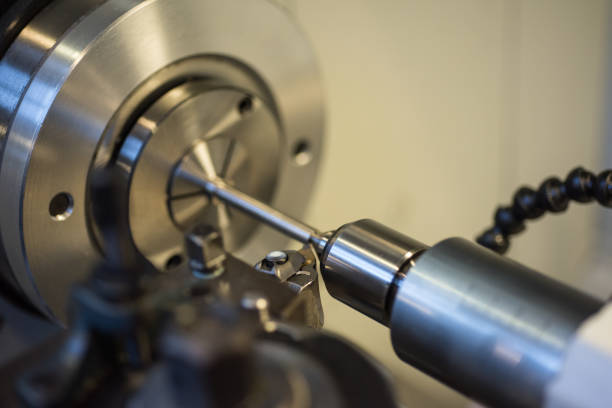
In the realm of high-end CNC machining, there is a fundamental gap between “programmed precision” and “actual precision.” A computer program can easily command a move of 0.001 mm, but translating that command through heavy metal castings, rotating ball screws, and fluctuating temperatures into a physical part requires more than just mechanical strength. It requires a sophisticated “nervous system.”The Fanuc servo system, when integrated with high-resolution absolute encoders and full closed-loop feedback, represents the pinnacle of this industrial evolution. It is a system engineering masterpiece that doesn’t just move a tool; it monitors, compensates, and corrects in real-time. This article delves into the “System Engineering” of Fanuc’s motion control—analyzing how its CNC, servo motors, and absolute encoders work in harmony to ensure that theoretical precision is perfectly etched into every workpiece.
1. The Absolute Vision: Never Losing the “Zero.”
The foundation of precision begins with knowing exactly where you are. In traditional systems using incremental encoders, the machine is “blind” upon startup; it must perform a “homing” routine to find its reference zero. Any power fluctuation can lead to a loss of coordinate integrity.
The Power of Absolute Position Encoders
Fanuc’s absolute encoders utilize a unique multi-turn physical coding system.
-
Zero-Loss Integrity: Even if the machine is powered down or moved manually while off, the absolute encoder retains the exact coordinate. There is no need for limit switches or “homing” cycles.
-
Safety and Speed: This eliminates the risk of “homing crashes” and allows for immediate production restart, ensuring that the machine’s “internal map” always aligns with the physical reality of the worktable.
2. Full Closed-Loop: Correcting the “Mechanical Flaws.”
No matter how high the quality of a ball screw, physics imposes limits. As a machine runs, the friction of the ball screw generates heat, causing the metal to expand—a phenomenon known as thermal elongation. Additionally, the microscopic gap between the screw and the nut creates backlash.
Semi-Closed vs. Full Closed-Loop
-
Semi-Closed Loop: The encoder is mounted on the motor. The system assumes that if the motor turns 360°, the table moved . However, it cannot see if the ball screw has expanded or flexed.
-
Full Closed-Loop: By integrating an external scale (linear scale/optical scale) directly on the machine slide, the system creates a “Dual Feedback” loop.
The Fanuc Real-Time Compensation
The Fanuc servo system constantly compares the motor’s position (Semi-closed) with the actual table position (Full-closed).
-
Eliminating Thermal Drift: If the ball screw expands by due to heat, the linear scale detects this discrepancy instantly. The Fanuc CNC then micro-adjusts the servo motor to compensate, ensuring the tool tip remains at the exact programmed coordinate.
-
Backlash Suppression: The system senses the “lag” during direction changes and applies a precise burst of torque to overcome the mechanical gap, resulting in perfect circularity during milling.
3. Nano-Interpolation: The Art of Smooth Motion
High accuracy is useless if the motion is “stuttery.” When a CNC processes a complex curve, it breaks it down into tiny straight-line segments. If these segments are too large, the surface finish will appear “faceted.”
The 1-Nanometer Command
Fanuc’s Nano-Interpolation technology operates at a resolution of (). Even if the part program is written in microns, the internal CNC engine processes the movement in nanometers.
-
Sub-Micron Surface Finish: This ultra-fine resolution allows the servo system to produce incredibly smooth acceleration and deceleration curves.
-
Ripple Reduction: By smoothing out the “steps” in the command, Fanuc reduces the vibration (ripple) sent to the tool tip. This is the secret behind achieving “mirror-like” surface finishes directly from the machine without secondary polishing.
4. High-Speed HRV Control: The “Reflexes” of the System
Precision at slow speeds is common, but Fanuc excels at maintaining precision at high feed rates. This is achieved through HRV (High Response Vector) Control.
-
Friction Compensation: As the tool enters a heavy cut, the resistance changes. HRV control senses the current change in the motor and adjusts the torque within microseconds—faster than a human eye can blink.
-
Corner Accuracy: When a tool approaches a sharp corner at high speed, inertia wants to carry it past the point. Fanuc’s “Look-Ahead” and “Bell-Shaped Acc/Dec” ensure the machine slows down just enough to hit the corner with micron-accuracy before accelerating away, maximizing both speed and precision.
5. The “System Engineering” Synergy
The true irreplaceable value of a Fanuc-equipped CNC lies in the vertical integration. Because Fanuc manufactures the CNC, the Servo Drive, and the Motor, the communication between these components happens over a high-speed fiber-optic bus (FSSB).
-
Synchronization: All axes are synchronized within nanoseconds. This is critical for 5-axis simultaneous machining, where the coordination of the rotating table and the spindle must be perfect to avoid gouging.
-
Reliability: The hardware is designed to withstand the harsh vibrations and coolant mist of a CNC environment, ensuring that the “Full Closed-Loop” remains stable over years of 24/7 operation.
6. Conclusion: Precision as a Standard, Not an Accident
The synergy between the Fanuc servo system and absolute position encoders transforms a machine tool from a piece of iron into a high-precision instrument. By mastering the “System Engineering” of motion—from the nano-level interpolation of the CNC to the real-time thermal compensation of the full closed-loop—Fanuc ensures that “Theoretical Accuracy” is no longer a goal, but a guaranteed result.
For manufacturers, this means fewer scrapped parts, higher surface quality, and the ability to take on the most challenging aerospace and medical projects. When every micron counts, the Fanuc control chain is the “Ghost Hand” that guides the tool to perfection.