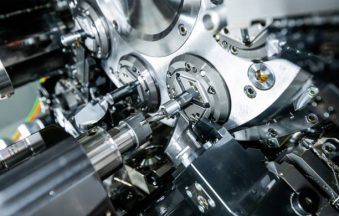
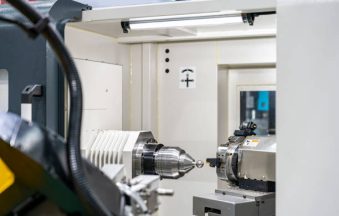
A Turning Point in Modern Machining
Modern manufacturing demands faster production, tighter tolerances, and consistent finish quality. As industries push these expectations higher, multi-axis CNC machining becomes essential. Although two-axis systems once handled most machining needs, rising complexity now requires 4-axis and 5-axis CNC solutions. Because manufacturers want greater flexibility, they now pursue machines that move tools across multiple coordinated directions. Therefore, multi-axis CNC machining has become the foundation of advanced production lines.
Today, sectors such as aerospace, automotive, medical devices, robotics, and energy systems rely on these systems. Since geometric complexity continues to rise, companies need machines that deliver accuracy without slowing output. Therefore, both 4-axis CNC machining and 5-axis CNC machining have become crucial for competitive machining strategies.
This article explores how multi-axis CNC machining enhances speed and precision, while also explaining why advanced CNC machining centers remain essential for modern industrial growth.
1. How Manufacturing Arrived at Multi-Axis CNC Machining
Earlier CNC machines offered only linear movements. However, design innovation increased sharply, and components soon required deeper cavities, angled surfaces, and complex contours. Because two-axis systems could not support these features efficiently, manufacturers had to perform multiple setups. Every setup increased misalignment risks, wasted time, and added labor.
Consequently, machines evolved. The introduction of rotary axes allowed new functions. Therefore, 4-axis CNC machining brought better side-cutting capability, and 5-axis CNC machining enabled seamless tool access from nearly any direction. As industries embraced these shifts, machine builders pushed spindle speeds, motion control systems, and rigid structures forward.
Today, multi-axis CNC machining embraces servo-driven stages, advanced controllers, smart tool paths, and structural stability designed for vibration reduction. Because these machines reduce manual intervention, they allow manufacturers to produce complex parts reliably.
2. Understanding the Mechanics Behind Multi-Axis CNC Systems
A multi-axis CNC machine moves a cutting tool along several axes while coordinating motion in real time. Although every axis contributes to part formation, the axes function differently in 4-axis and 5-axis formats.
2.1 Core Axes in Modern CNC Machining
-
X-axis moves the tool or table horizontally.
-
Y-axis moves the tool or table perpendicular to the X-axis.
-
Z-axis drives vertical motion.
These three axes form the foundation of CNC machining centers. However, industries now require more advanced angular movements.
2.2 Additional Axes in Advanced CNC Systems
4-axis CNC machining adds a rotary A-axis, while 5-axis CNC machining introduces B-axis or C-axis movement. Because rotary motion changes the part orientation relative to the cutting tool, the tool reaches more surfaces without repositioning. Therefore, operators reduce handling errors and shorten machining time.
These extra axes transform a basic machine into a highly flexible platform. Consequently, manufacturers gain access to entire part geometries with fewer fixtures and greater stability.

3. Why Industries Prefer 4-Axis CNC Machining
4-axis CNC machining processes parts using the X, Y, Z, and A axes. Because the rotary axis allows the part to rotate, it supports side milling, drilling on curves, and machining around cylindrical structures.
3.1 More Efficient Machining of Cylindrical Features
Because the part rotates, the tool maintains continuous engagement. As a result, manufacturers achieve smooth surfaces, consistent depths, and accurate internal shapes. Industries such as automotive and energy components rely heavily on this ability.
3.2 Reduced Processing Time for Lightly Complex Parts
Although 5-axis CNC machining handles extremely complex designs, many parts only need moderate geometry. Therefore, a 4-axis system offers the ideal balance. Because it reduces unnecessary complexity, companies save money while keeping high accuracy.
Moreover, multi-axis CNC machining in this format still supports angled tool paths. Therefore, manufacturers can produce deeper channels and optimized contours without costly fixtures.
4. When Manufacturers Turn to 5-Axis CNC Machining
5-axis CNC machining adds a rotary axis, unlocking full spatial flexibility. Although 4-axis offers rotational capability, it cannot resolve complex undercuts, deep pockets, or free-form surfaces. Because modern product designs use organic geometry, companies often turn to 5-axis CNC machining.
4.1 Multi-Sided Machining Without Repositioning
Because the machine rotates the part intelligently, the tool approaches every surface in one setup. Therefore, accuracy increases significantly. Aerospace, medical implants, and automotive prototypes rely heavily on this capability.
4.2 Structural Benefits for Thin or Delicate Components
Because the tool remains aligned with the optimal cutting angle, forces are distributed evenly. Therefore, delicate materials avoid vibration damage. This advantage is critical for titanium, aluminum, carbon fiber, and engineering plastics.
4.3 Improved Surface Finish Through Continuous Tool Orientation
Since the tool tilts while it moves, path smoothness increases. Consequently, the machine eliminates abrupt direction changes that would mark the surface. This technique supports high-end finishing workflows that demand premium aesthetics.
5. How Multi-Axis CNC Machining Improves Speed
Speed comes from reducing steps. Because multi-axis CNC machining minimizes repositioning, the machine eliminates manual transfers, fixture checks, and alignment processes. Therefore, cycle times drop sharply.
5.1 Continuous Tool Engagement
Tools maintain engagement while rotating around complex surfaces. Because of this continuous motion, machining centers remove material more efficiently.
5.2 Advanced Toolpaths Accelerate Roughing and Finishing
Modern controllers generate optimized paths using algorithms that reduce air-cutting time. Therefore, machines maintain better feed rates while protecting tool life.
5.3 Shorter Setup Times Increase Output
Because multi-axis CNC machining handles several sides in one session, operators spend less time adjusting parts. Consequently, production lines keep a higher uptime.
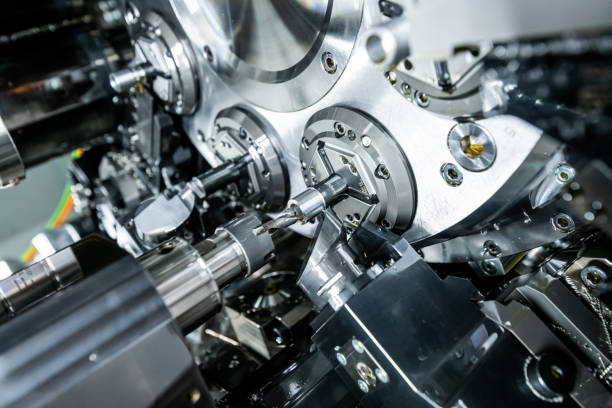
6. Why Multi-Axis CNC Machining Enhances Accuracy
Accuracy extends beyond part tolerance. It includes stability, repeatability, and surface precision. Because multi-axis CNC machining reduces vibration, decreases human error, and improves orientation, the system delivers consistent output.
6.1 Better Angular Positioning Reduces Tilt Errors
Because rotary axes position parts precisely, the machine maintains exact matching between surfaces.
6.2 Fewer Fixtures Reduce Compounded Errors
Every fixture introduces a tolerance risk. Because multi-axis CNC machining reduces fixture changes, cumulative errors drop.
6.3 Tool Orientation Improves Chip Evacuation
Because tools tilt for better access, chips exit freely, reducing heat and improving accuracy.
7. Multi-Axis CNC Machining Across Industries
No modern sector ignores the advantages of multi-axis CNC machining. Because industries seek efficiency, reliability, and precision, these systems support global innovation.
7.1 Aerospace
Aerospace relies on 5-axis CNC machining for turbine blades, structural braces, and complex housings. Because weight and precision matter, advanced machines dominate.
7.2 Automotive
Automotive manufacturers need fast prototyping and high-precision mass production. Therefore, multi-axis CNC machining supports engine components, chassis parts, and transmission systems.
7.3 Medical Devices
Medical manufacturers depend on 5-axis CNC machining for implants, diagnostic parts, and surgical tools. Because the human body demands accuracy, multi-axis systems remain essential.
8. Choosing Between 4-Axis and 5-Axis CNC Systems
Although both systems improve production, manufacturers choose based on complexity, budget, and material needs.
-
Choose 4-axis CNC machining for moderate parts, curved surfaces, and cylindrical geometry.
-
Choose 5-axis CNC machining for organic shapes, multi-sided features, and premium surface demands.
Because both options contribute unique benefits, companies often use a mixed fleet to balance flexibility and investment.
Conclusion: Multi-Axis CNC Machining Defines the Next Manufacturing Era
Multi-axis CNC machining reshapes how industries approach precision. Because 4-axis and 5-axis CNC systems provide speed, accuracy, and geometric freedom, manufacturers now rely on these machines to remain competitive. As part designs grow more complex, multi-axis CNC machining will continue unlocking possibilities that earlier systems could not provide.
This evolution proves one message clearly: advanced CNC machining centers now drive progress across global manufacturing. And as industries move forward, multi-axis CNC machining will remain the standard that defines accuracy, efficiency, and innovation.