In the frontier of modern engineering, materials are the bottleneck of ambition. Whether it is the pursuit of higher thrust-to-weight ratios in aerospace turbines or the demand for bio-compatible longevity in medical implants, designers are increasingly turning to “super-materials.” Titanium alloys, Inconel, and Ceramic Matrix Composites (CMCs) offer extraordinary strength, heat resistance, and durability. However, these materials come with a notorious reputation: they are “difficult-to-machine” (DTM).
When traditional 3-axis machining attempts to “tame” these hard materials, the result is often a war of attrition. Tools break, surfaces chatter, and internal residual stresses compromise the part’s integrity. To truly unlock the potential of these materials, we must change our approach from brute force to precision geometry. This is the realm of 5-axis CNC milling machines. By maintaining an optimal cutting posture, 5-axis technology controls advanced alloy hardness. As a result, it transforms rigid materials into flexible creative media. Consequently, the final component performs near its theoretical limits.
1. The War of Attrition: Why 3-Axis Machining Fails “Super-Materials”
To understand why 5-axis technology is transformative, one must first look at the failures of traditional 3-axis methods when facing titanium or high-performance ceramics.
The Problem of “Sub-Optimal Angle”
In a 3-axis setup, the tool is restricted to a vertical or horizontal orientation. When machining complex, curved surfaces—common in turbine blades or structural aerospace ribs—the tool often contacts the material at its centre point (the “dead center” of the ball-nose cutter).
-
Zero Surface Speed: At the very tip of a rotating tool, the cutting speed is effectively zero. This leads to “rubbing” rather than “cutting,” generating massive heat and causing the material to work-harden.
-
Deflection and Chatter: Because the tool cannot tilt to follow the contour, it experiences uneven lateral forces. For a material as “springy” as titanium, this leads to microscopic vibrations (chatter) that ruin the surface finish and fatigue life.
The “Hardness” Rejection
Materials like Ceramic Matrix Composites are essentially “sandpaper” for tools. If the cutting angle is slightly off, the abrasive nature of the material destroys the cutting edge in minutes. In a 3-axis environment, the tool is often “fighting” the material’s internal structure rather than slicing through it.
2. The 5-Axis Dialogue: Precision over Power
A 5-axis CNC mill machine does not simply “push harder.” Instead, it utilises two additional rotational axes to engage in a sophisticated “dialogue” with the material.
Maintaining the “Sweet Spot” (Constant Surface Speed)
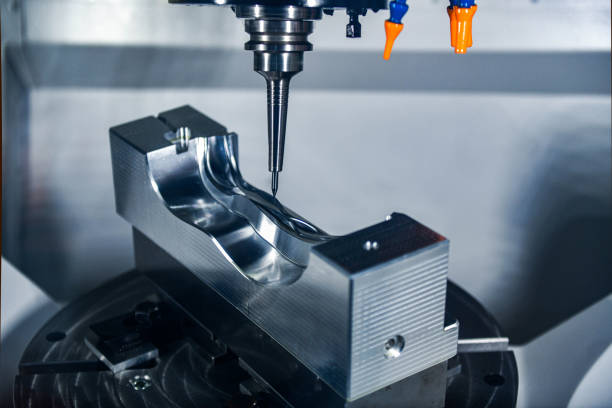
By tilting the tool relative to the workpiece, 5-axis machining ensures that the contact point remains on the “flank” of the cutter rather than the tip.
-
Optimised Slicing: This posture allows for a constant, high-velocity cutting speed. For titanium, this means heat is carried away in the chips rather than being forced back into the part.
-
Extended Tool Life: When a tool cuts at its optimal angle, the wear is distributed evenly across the carbide or PCD (Polycrystalline Diamond) coating. In CMC machining, this can increase tool life by as much as 300% to 500%.
Constant Chip Load (The “Gentle” Extraction)
Advanced 5-axis controllers use high-speed processing to calculate the “Tool Engagement Angle” in real-time.
-
Thermal Management: By keeping the chip thickness consistent, the machine prevents the sudden spikes in temperature that cause titanium to oxidise or ceramics to micro-crack.
-
Residual Stress Reduction: Traditional machining often leaves the surface of a part under “tension,” making it prone to cracking under load. The “gentle” posture of 5-axis milling ensures a more compressive, stable surface layer, unlocking the material’s maximum fatigue strength.
3. Unlocking “Design Freedom”: From Theory to Physical Reality
The true value of 5-axis CNC milling machines is that they remove the “manufacturability” shackles from the designer’s hands.
-
Thin-Walled Integrity: Designers can now specify ultra-thin walls in titanium structures. Because 5-axis machines can approach from angles that minimise “pushing” force, they can machine delicate ribs without bending or breaking the material.
-
Complex Internal Channels: For liquid-cooled components or aerospace manifolds, 5-axis heads can “reach around” obstacles to create internal geometries that were previously considered “un-machinable.”
-
Single-Setup Precision: Moving a part between multiple machines introduces “stacking errors.” A 5-axis machine completes almost all features in one setup, ensuring that the geometric relationship between features—critical for high-RPM rotating parts—is perfect.
4. The “Second Life” of Ceramic Matrix Composites (CMCs)
CMCs are the “holy grail” of high-heat environments, capable of withstanding temperatures that would melt most steels. However, their brittle, abrasive nature makes them a nightmare for standard CNCs.
-
High-Frequency Spindle Stability: 5-axis mills designed for DTM materials often feature high-torque, high-speed spindles with vibration-damping technology. This allows for the “ultrasonic-assisted” or high-speed grinding techniques required for ceramics.
-
Adaptive Feed Control: As the 5-axis head rotates, the software adjusts the feed rate to compensate for the changing geometry, ensuring the brittle ceramic never experiences a “shock” load that could cause a catastrophic fracture.
5. ROI: The Economics of High-End Accuracy
While the initial investment in 5-axis CNC milling machines is higher than 3-axis alternatives, the ROI in the “Hard Material” sector is undeniable:
-
Scrap Reduction: When working with a titanium block that costs thousands of dollars, a single error is unacceptable. 5-axis precision minimises the risk of “gouging” or thermal damage.
-
Surface Finishing: By providing a superior “near-mirror” finish directly from the mill, manufacturers can eliminate hours of manual hand-polishing or secondary grinding processes.
-
Competitive Edge: Manufacturers who master 5-axis “super-material” machining move from being “commodity suppliers” to “strategic partners” for aerospace and medical giants.
6. Conclusion: Mastering the Unyielding
The future of high-performance engineering is written in the language of difficult materials. To build the machines of tomorrow, we must move past the limitations of traditional cutting.
The 5-axis CNC milling machine is the ultimate tool for this transition. It treats hardness not as an obstacle to be overcome by force, but as a potential to be released through geometry. By maintaining the “optimal posture,” we allow titanium to show its true strength and ceramics to show their true resilience. In the hands of a skilled operator, 5-axis technology makes the hardest materials in the world “malleable” to the human will. It is time to stop fighting your materials and start “talking” to them in 5-axis.