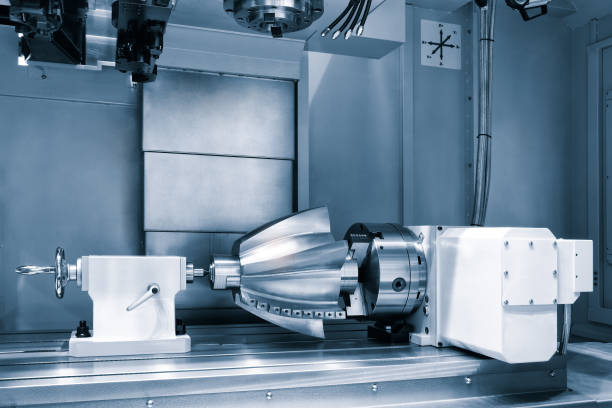
When expanding into large-scale multi-axis production, shop owners face a fundamental architectural choice. In the 5-axis gantry machining centers, two main layouts dominate the market: Moving-Table (where the workpiece moves on a guide rail beneath a stationary bridge) and Fixed-Table (also known as a high-rail or overhead bridge gantry, where the workpiece remains completely static while the entire gantry structure moves over it).
While it is easy to relegate Fixed-Table machines to massive aerospace components (like wing spars) and Moving-Table layouts to smaller mold workshops, a significant decision dilemma exists for medium-to-large components measuring between 1000mm and 2000mm. Sizing this mid-tier envelope correctly requires looking beyond pure part length. This guide establishes a technical decision framework to help you choose the ideal 5-axis gantry architecture for your specific application.
1. Structural Dynamics: How Mass Location Dictates Kinematics
The core difference between the two systems is which major mass moves to achieve the primary longitudinal axis travel (typically the X-axis or Y-axis, depending on the builder’s naming conventions).
   [Moving-Table Layout]                      [Fixed-Table Layout]
    Stationary Bridge Frame                    Moving Gantry Structure
         └── [5-Axis Spindle Head]                 └── [5-Axis Spindle Head]
    [Moving Worktable + Part] ──> Travel       [Fixed Floor Bed + Part] (Static)
The Moving-Table Approach (Stationary Bridge)
In this architecture, the monolithic portal frame (columns and cross-beam) is bolted permanently to the foundation. The 5-axis spindle head moves along the X and Z axes on the beam, while the worktable carries the component along the Y-axis.
-
Constant Kinematics: Because the massive bridge never moves, the structural rigidity and vibration damping of the tool-holding mechanism remain perfectly uniform regardless of where the cut occurs.
-
Weight Dependency: The machine’s acceleration and deceleration dynamics are directly influenced by the mass of the workpiece. As the part gets heavier, the servo motors must exert more force to reverse directions, which can subtly alter surface finishes during high-feed rate 5-axis contouring.
The Fixed-Table Approach (Overhead/High-Rail Gantry)
Here, the part sits on a static floor bed. The entire cross-beam assembly, columns included, travels along overhead rails to execute longitudinal cuts.
-
Weight-Independent Kinematics: The weight of the part has zero effect on the machine’s dynamic performance. Whether you place a 500kg aluminum block or a 5,000kg steel mold on the table, the moving mass of the gantry remains identical.
-
Vibration Management: Because the massive bridge structure itself is in motion, managing inertia requires highly synchronized dual-drive systems (master-slave linear motors or rack-and-pinion setups) to prevent structural deflection or “crabbing” during high-acceleration paths.
2. The Mid-Size Sweet Spot (1000mm – 2000mm): Why Moving-Table Wins for Multi-Sided Machining
For parts sitting in the 1000mm to 2000mm window—such as automotive engine blocks, transmission housings, and medium-scale injection molds—a moving-table gantry often provides a superior return on investment.
Uncompromised Enclosure and Safety Compliance
A major challenge of true 5-axis simultaneous machining is managing fluid containment. High-pressure through-spindle coolant (TSC) drops atomized oil and water throughout the envelope. Because a moving-table machine features a compact, centralized cutting zone directly beneath a fixed bridge, the entire machining area can be easily shrouded in a fully enclosed, compact guard. This contains mist, keeps the shop floor dry, and simplifies integration with environmental mist collectors.
Superior Chip Evacuation and Thermal Management
When multi-axis milling deep cavities or heavy pockets, chip buildup can recut material and damage expensive tool coatings.
-
In a moving-table machine, the physical movement of the table naturally sloshes chips into integrated screw or chain conveyors mounted on either side of the bed line.
-
In contrast, fixed-table setups feature a massive footprint where chips drop across a wider area, requiring complex multi-axis flushing arrays or manual clean-out cycles.
Simplified Operator Access and Ergonomics
For mid-size parts that require frequent inspection, manual probing, or multi-angle flip setups, operator proximity is key. On a moving-table system, the bed moves directly to the front doors of the enclosure, allowing the machinist to easily reach the part without stepping inside a cavernous machine shroud.
3. Architectural Selection Matrix
| Operational Criteria | Moving-Table Gantry (CHANSIN) | Fixed-Table (Overhead Bridge) |
| Workpiece Weight Limit | Dependent on bed size (Typically ≤ 10 Tons) | Virtually unlimited (Supported by the foundation) |
| Physical Floor Footprint | Larger (Requires 2* length for bed travel) | Compact relative to maximum travel |
| Enclosure Capabilities | Easy, full-containment splash guard | Complex open-roof or massive acoustic shrouds |
| Chip Management | Excellent (Direct gravitational fall to conveyors) | Moderate (Requires active bed flushing systems) |
| Best-Fit Part Geometry | High-precision mid-size molds, housings, and aerospace valves | Oversized plates, composite wind-turbine blades, and large structural castings |
4. Making the Final Decision: The Sourcing Checklist
To determine which structure will solve your specific manufacturing bottleneck, evaluate your shop floor parameters against these three operational questions:
-
What is your worst-case part weight variance? If you regularly transition from light composite prototyping to heavy steel forging dies on the same machine, a fixed-table setup prevents your weight swings from altering your acceleration tolerances. If your part weights remain uniform within a 5-ton limit, a moving-table machine will provide faster cycle times due to its lower moving mass.
-
How much physical shop space can you allocate? Remember that a moving-table machine requires a long footprint because the table must stroke fully forward and fully backward. If your shop has tight linear floor space but high ceilings, a fixed-table gantry keeps the entire footprint contained within the absolute boundaries of the machine frame.
-
What are your surface roughness requirements? For elite mold and die finish work where polishing must be minimized, the stationary bridge of a moving-table machine provides unparalleled mechanical stiffness directly at the spindle throat, minimizing micro-chatter during high-torque 5-axis operations.
Conclusion: Form Follows Component Geometry
In high-end 5-axis gantry machining centers, there is no single “best” layout—there is only the correct architecture for your part’s mass and volume.
Stop trying to force mid-size precision parts onto oversized, open-air overhead systems that complicate chip management and fluid containment. Similarly, avoid overloading standard tables with components that compromise axis kinematics. By selecting a dedicated moving-table gantry for your 1000mm – 2000mm high-precision jobs, you secure an enclosed, highly rigid, and easy-to-maintain platform engineered for maximum uptime.
Explore CHANSIN’s line of heavy-duty multi-axis machining centers today to find the structural configuration that turns your complex geometry into predictable throughput.