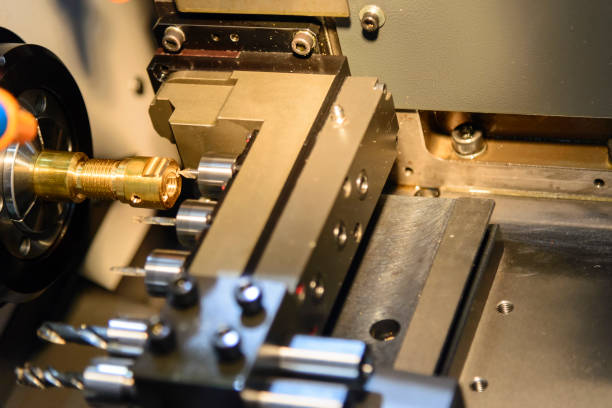
In the precision manufacturing industry, brass—particularly leaded brass like C36000—is often celebrated for its excellent machinability. However, “machinable” does not mean “easy” when the objective is micron-level accuracy. The very characteristics that make brass desirable—its relative softness and ductility—become significant hurdles when attempting to maintain tight geometric tolerances. Without the right approach, brass is prone to deformation under clamping pressure, “spring-back” (deflection), and high-frequency vibration that ruins surface finishes.
To achieve consistent success, CNC brass lathe machining must move beyond general-purpose settings. It requires a sophisticated ecosystem of specialized clamping and damping technologies designed to provide a “firm yet gentle” grip. This article explores how modern CNC lathes “tame” the physical volatility of brass through hydraulic precision, constant-pressure tailstocks, and high-damping machine architecture.
1. The Brass Paradox: Why Softness Demands Rigidity
Brass is a material of contradictions. While it allows for high cutting speeds, it possesses a low modulus of elasticity compared to steel.
The Risk of “Clamping Distortion”
When a standard hard-jaw chuck grips a thin-walled brass component, the localized pressure can easily crush or ovalize the part. Once the pressure is released after machining, the part “springs back” to its deformed state, rendering the micron-level measurements taken during the process useless.
The Burr and “Gumminess” Challenge
Despite being free-cutting, brass can become “gummy” under heat. If the machining system vibrates even slightly, the tool will “rub” rather than “cut,” leading to significant burr formation and a loss of dimensional consistency. Therefore, the “Stable Constraint” is the first law of high-end CNC brass lathe machining.
2. Precision Clamping: The Art of the “Gentle Grip.”
To prevent deformation while maintaining enough rigidity to withstand high-speed cutting forces, professional brass lathes utilize a multi-tiered clamping strategy.
High-Pressure Hydraulic Chucks with Fine Tuning
Unlike manual chucks, specialized CNC lathes for brass use high-precision hydraulic power chucks.
-
Uniform Pressure Distribution: These systems allow for micro-adjustments in clamping force (measured in ). Operators can dial in the exact pressure required to hold the part without exceeding the material’s yield strength.
-
Repeatability: Hydraulic systems ensure that every part in a 10,000-unit run is gripped with the identical amount of force, eliminating the human error found in manual tightening.
Customized “Soft Jaw” Technology
The use of “Soft Jaws” (usually made of aluminum or mild steel) is non-negotiable for precision brass work.
-
True-Circle Contact: Soft jaws are bored or “turned” on the lathe itself to match the exact diameter of the brass workpiece. This creates a contact surface, distributing the clamping force evenly around the circumference rather than at three concentrated points.
-
Reducing “Letting-the-Tool-Pass” (Deflection): By providing a larger contact area, soft jaws provide the structural support necessary to prevent the part from tilting or vibrating during heavy facing or grooving operations.
3. Constant-Pressure Tailstocks: Supporting the Slender
When machining long, slender brass shafts—parts that are often as thin as a needle—the “tailstock” becomes the critical stabilizer.
The Danger of Over-Tightening
If a manual tailstock is pushed too hard against a brass shaft, the material will “bow” or “buckle” in the center. Conversely, if it is too loose, the part will whip.
-
Live Centers with Constant Pressure: Professional CNC brass lathe machining centers employ programmable hydraulic or pneumatic tailstocks. These units maintain a “Constant Force” () throughout the cycle.
-
Thermal Compensation: As the part heats up during machining, it naturally expands in length. A constant-pressure tailstock automatically retracts by microns to accommodate this expansion while maintaining the same support force, preventing the part from bending.
4. High-Damping Machine Design: Eliminating the “Ghost” of Vibration
Even with perfect clamping, the internal resonance of the machine can transfer “chatter” to the soft brass surface.
The Mineral Casting/Heavy Base Advantage
Modern lathes optimized for brass often utilize high-damping base materials.
-
Resonance Absorption: Compared to traditional gray iron, mineral casting or high-damping alloy bases absorb vibrations up to 10 times faster. This ensures that the high-frequency “whine” of a spindle does not translate into “waves” on the part’s surface.
-
High-Rigidity Spindle Bearings: Using our grade high-precision bearings ensures that the “run-out” (concentricity error) is kept below , which is vital when the total tolerance of the part is only.
5. Optimizing the Cutting Chain: Tooling and Fluid
The clamping and damping system provides the stage, but the “performance” is finished by the tool and the coolant.
-
Positive Rake Angles: For brass, tools with a sharp, positive rake angle are used to “slice” the material, reducing the “Pushing Force” that causes deformation.
-
High-Volume Cooling: While brass doesn’t require as much cooling as titanium, a high-pressure coolant stream is essential to evacuate chips instantly. If a brass chip is “recut” by the tool, it creates a momentary vibration spike that can mar the finish.
6. Conclusion: Precision Through Soft Constraints
Taming brass is a lesson in the philosophy of “Soft Rigidity.” By combining the uniform grip of customized soft jaws, the adaptive support of constant-pressure tailstocks, and the silent stability of high-damping machine beds, CNC brass lathe machining achieves the impossible: turning a soft, “sticky” metal into a masterpiece of micron-level engineering.
In the world of CHANSIN-level precision, we don’t just clamp a part; we cradle it in a high-tech environment that understands the material’s “personality.” When the clamping is gentle, the damping is heavy, and the pressure is constant, the brass has no choice but to conform to the perfect dimensions of the digital blueprint.