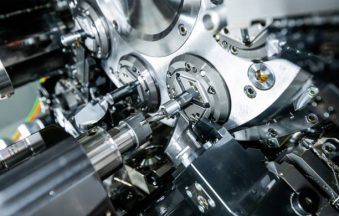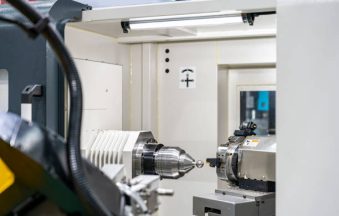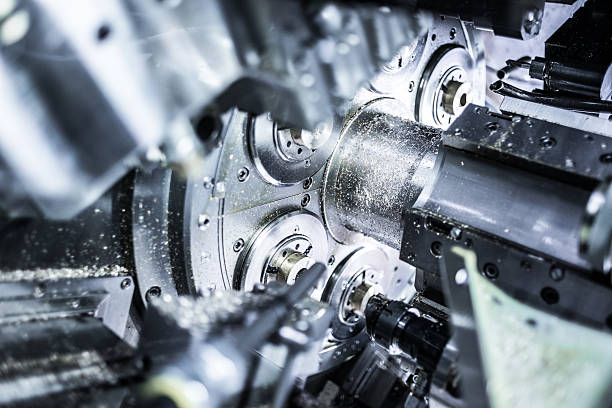
In the world of precision manufacturing, the most persistent enemy is not tool wear or heat—it is vibration, often referred to as “chatter.” When an engineer attempts to machine a slender shaft with a length-to-diameter ratio exceeding 10:1 on a conventional CNC lathe, the physical laws of centrifugal force and material flexibility take over. The part begins to whip, the tool bounces, and the surface finish is ruined. This is the “ghost of vibration” that haunts high-precision workshops.
However, the CNC Swiss-type automatic lathes possess a unique mechanical advantage that acts like an invisible, stabilizing hand. By utilizing “sliding headstock” technology combined with a high-precision guide bushing, these machines provide rigid support mere millimeters from the cutting edge. This fundamental design difference allows for the stable, efficient, and mirror-like turning of parts as thin as a pencil lead. This article explores the physics of the Swiss guide bushing and why it remains the irreplaceable foundation of ultra-slender part production.
1. The Physics of Deflection: Why Conventional Lathes Fail Slender Parts
To understand the genius of the CNC Swiss-type automatic lathes, one must first understand the “Cantilever Problem” in traditional machining.
The Leverage Effect
On a standard CNC lathe, the workpiece is held firmly in a chuck, and the tool moves along the length of the part. As the tool moves further away from the chuck, the “overhang” increases. Basic physics tells us that the further the cutting point is from the support, the more the material will deflect under the pressure of the tool.
-
The Chatter Cycle: When the part deflects, it eventually snaps back, causing a vibration frequency that results in “chatter marks” on the surface.
-
The Accuracy Loss: Deflection also pushes the part away from the tool, leading to tapering and dimensional inaccuracy.
The Swiss Solution: Zero Overhang
The Swiss-type lathe operates on the opposite principle. Instead of the tool moving along the part, the sliding headstock feeds the material through a fixed guide bushing toward a stationary tool. This means the distance between the support (the guide bushing) and the cutting tool remains constant and extremely short—usually within to .
2. The Guide Bushing: The “Ghost Hand” of Stability
The guide bushing is the heart of the CNC Swiss-type automatic lathes. It is a high-precision sleeve, often lined with carbide, that serves as the primary bearing for the raw material as it enters the cutting zone.
Rigidity at the Point of Impact
By providing support at the exact point where the tool meets the material, the guide bushing eliminates the lever effect entirely.
-
Millimeter-Level Proximity: Because the tool is mounted directly adjacent to the bushing face, the material has no room to flex or whip. Even if the part is long and only wide, the “active” machining area is always perfectly rigid.
-
Absorption of Centrifugal Force: At high RPMs (often exceeding ), even the slightest imbalance in raw material can cause a slender part to bend. The guide bushing acts as a stabilizer, dampening these centrifugal forces before they can reach the cutting edge.
The Result: Mirror-Like Surface Finish
When vibration is eliminated, the cutting tool can perform its job with surgical precision. This stability allows for the use of higher cutting speeds and finer feeds, resulting in surface finishes () that often reach mirror-bright levels without the need for secondary grinding or polishing.
3. The “Sliding Headstock” Synergy
The guide bushing cannot function alone; it requires the coordinated movement of the sliding headstock. This synergy is what defines the “Space Grammar” of CNC Swiss-type automatic lathes.
-
Z-Axis Material Feed: In a Swiss-type lathe, the Z-axis movement (longitudinal) is performed by the headstock moving the entire bar of material forward. This ensures that the part is always pushed through the support toward the tool.
-
Telescoping Accuracy: This mechanism allows for “telescoping” machining, where long, complex features can be turned in segments. By machining close to the bushing, then retracting and feeding more material, the machine can produce incredibly long shafts while maintaining sub-micron tolerances across the entire length.
4. Overcoming the Challenges of High-Aspect-Ratio Parts
In industries such as medical (bone screws), aerospace (long connectors), and electronics (micro-pins), the length-to-diameter ratio often exceeds 20:1. These are “impossible” parts for traditional CNCs.
Handling “impossible” Geometry
The CNC Swiss-type automatic lathes turn these impossible geometries into routine production.
-
Uniformity: Because the support point is always the same distance from the tool, the cutting force is consistent. This ensures that the diameter at the beginning of a shaft is identical to the diameter at the end.
-
Complex Features: Swiss-type lathes often feature “Live Tooling,” allowing for milling, drilling, and cross-tapping while the guide bushing still supports the part. This “One-Hit” capability ensures that all features are concentric to the main axis.
5. When to Choose a Swiss-Type Lathe: The Decision Matrix
While the guide bushing is a powerful tool, it is specifically optimised for certain types of work.
-
Diameter Range: Swiss-type lathes are generally designed for bar stock under . Their “sweet spot” is typically between and .
-
Material Quality: To benefit from the guide bushing, the raw material (ground bar stock) must have high-precision diameter tolerances (usually or class). This ensures a perfect fit within the bushing, preventing “play” that could introduce vibration.
-
Production Volume: Because of their high stability and multi-axis capabilities, CNC Swiss-type automatic lathes are the gold standard for high-volume, high-precision runs where consistency is non-negotiable.
6. Conclusion: The Irreplaceable Foundation of Precision
The guide bushing in CNC Swiss lathes transcends mere mechanics. It masters the laws of physics.
This “ghost hand” stabilises material during its exact transformation. Consequently, Swiss lathes produce the “impossible” components fueling modern medicine, flight, and communication.
As devices shrink, tolerances tighten. Therefore, eliminating chatter and achieving mirror finishes on slender parts is essential. Today, the Swiss lathe provides the irreplaceable foundation for the world’s most precise stories.