Investing in a 5-axis machine is a major milestone for any precision workshop. However, the market contains many “3+2” machines labeled as 5-axis. While they have five axes, they cannot perform true simultaneous movement. Understanding this difference is critical for your production success and your budget. A simultaneous CNC machining center offers capabilities that a “3+2” setup simply cannot match. This guide helps you identify “Real 5-Axis” technology and avoid expensive purchasing mistakes. We explore the mechanical and algorithmic secrets that define modern high-precision machining.
1. Understanding 3+2 Positioning: The “3.5-Axis” Reality
Many entry-level machines use “3+2” technology to handle complex angles.
The “Fixed Angle” Limitation
In a 3+2 setup, the machine rotates the part to a specific fixed position. Consequently, the two rotary axes lock tightly before the cutting starts. The tool then moves along only three linear axes to finish the work. Furthermore, you must stop the tool to change the part’s angle for the next side. This method is great for drilling holes on slanted faces or simple blocks. Therefore, it acts more like a “Three-and-a-Half Axis” machine than a true 5-axis system.
2. True Simultaneous 5-Axis: Continuous Fluid Motion
A simultaneous CNC machining center allows all five axes to move together at once.
The Power of Constant Engagement
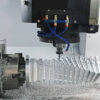
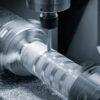
In true 5-axis machining, the tool follows a complex path while the part rotates constantly. Consequently, the cutter maintains the optimal angle against the surface throughout the entire cycle. Furthermore, this eliminates the “steps” or “marks” often left by 3+2 repositioning. This is the only way to manufacture high-efficiency impellers and turbine blades. Therefore, simultaneous movement provides superior surface finishes and much faster cycle times.
3. The “Smoking Gun”: Does it Have RTCP?
The easiest way to identify a fake 5-axis machine is to look for a specific algorithm.
What is RTCP (Rotation Tool Center Point)?
RTCP is the “brain” that manages the tool tip during complex rotations. Consequently, the controller automatically compensates for the changing distance between the tool and the pivot. Without RTCP, you would have to manually calculate every movement in your CAM software. Furthermore, the machine would lose its precision as soon as the rotary axes moved. Therefore, any machine without an active RTCP function is not a simultaneous CNC machining center.
4. Why “Fake 5-Axis” Fails for Complex Parts
Choosing the wrong machine limits the types of contracts your shop can accept.
-
Impellers and Turbines: These require a tool to “snake” through narrow, curved channels.
-
Deep Cavity Molds: Simultaneous motion allows for shorter tools and less vibration.
-
Aerodynamic Surfaces: Only continuous motion can create perfectly smooth, flowing curves.
Consequently, a 3+2 machine will fail to produce these parts regardless of your skill level. Furthermore, attempting these parts on “Fake 5-Axis” leads to broken tools and scrapped material. Therefore, you must verify the RTCP and simultaneous capabilities before signing any contract.
Conclusion: Investing in Real Precision for Growth
The success of your workshop depends on the honesty of your equipment.
Stop settling for “3+2” workarounds that limit your creative and industrial potential. Instead, embrace the full freedom of a professional simultaneous CNC machining center. Consequently, you will be able to tackle the most difficult aerospace and medical projects. Experience the difference that true algorithmic control makes for your production quality. Start your journey toward high-precision simultaneous manufacturing today. Your complex parts deserve a machine that can actually move with them.
Seeking Our Facebook 👉: CHANSIN