When analyzing the supply chain of modern orthopedic surgery, one manufacturing statistic stands out: an estimated 95% of all bone screws, dental implants, and spinal fixation devices are produced on Swiss-type lathes.
From micro-maxillofacial pins to high-torque pedicle screws, these complex components are the mechanical anchors of modern implantology. Because these parts are permanently embedded within living human tissue, the medical device sector enforces a zero-fault manufacturing standard. Tolerances are held within single-digit microns ($\pm0.005\text{ mm}$), and surfaces must be completely free of micro-burrs or tool marks that could impede osseointegration.
To achieve this level of precision on long, slender biocompatible metals, traditional fixed-headstock CNC centers are completely inadequate. This technical playbook explores why Swiss-type CNC machining for medical applications has become the absolute industry standard, mapping out the precise production paths for life-critical orthopedic hardware.
1. The Application Map: Critical Medical Hardware Manufactured via Swiss Lathes
The versatile design of sliding-headstock Swiss machines allows factories to process complex geometries from raw bar stock to finished, deburred parts in a single automated cycle. The primary medical components produced via this methodology include:
-
Orthopedic Bone Screws: Cortical, cancellous, and cannulated screws used to anchor bone plates or stabilize fractures.
-
Dental Implants & Abutments: Micro-threaded titanium roots featuring highly detailed internal geometry to securely anchor prosthetic teeth.
-
Spinal Fixation Devices: Polyaxial pedicle screws and rods engineered to stabilize the vertebral column during spinal fusion surgeries.
-
Surgical Instrumentation: High-precision guide wires, drill bits, taps, and handles used by surgeons during delicate operating room procedures.
                  [Sliding Headstock Bar Feed]
                               │
       ┌───────────────────────┼───────────────────────┐
       ▼                       ▼                       ▼
 [Bone Screws]          [Dental Implants]       [Spinal Pedicles]
2. The Mechanical Imperative: Why the Sliding Headstock is Non-Negotiable
The primary challenge of machining orthopedic components is their length-to-diameter (L/D) ratio. A typical bone screw or fixation pin is long and exceptionally slender.
When a cutting tool applies lateral force ($F$) to a raw bar on a traditional CNC lathe, the material deflects away from the tool insert. According to beam deflection theory, this displacement ($\delta$) multiplies exponentially with the unsupported length ($L$):
-
The Traditional Limitation: On standard lathes, this deflection causes micro-chatter, taper errors, and early tool chipping, rendering micron-level tolerances impossible.
-
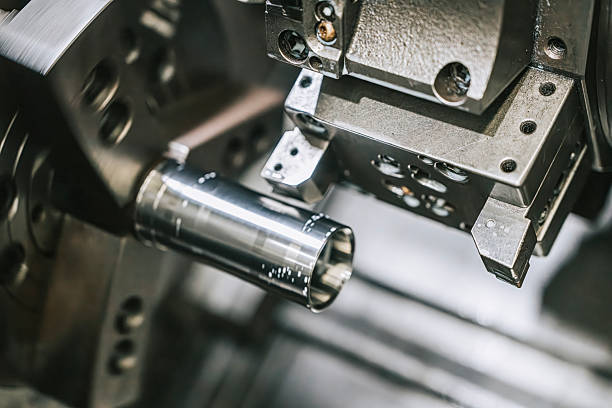
The Swiss Advantage: A Swiss-type lathe solves this problem by passing the raw material through a rigid guide bushing right up to the cutting zone. The tool cuts the metal mere millimeters away from the bushing support face. Because the unsupported distance ($L$) effectively approaches zero, material deflection is mathematically eliminated. This unparalleled stability allows shops to machine exotic medical metals with absolute geometric consistency.
3. Process Playbook: Machining Key Structural Features
Producing a medical-grade bone screw requires a sequence of highly specialized operations, all executed within the enclosed envelope of a multi-axis Swiss turn-mill center:
[Raw Titanium Bar] ──> [Thread Whirling] ──> [Slot/Torx Milling] ──> [Self-Tapping Fluting] ──> [Finished Implant]
Feature A: Bone Threads via High-Velocity “Thread Whirling”
Traditional single-point threading tools take too many passes and subject slender titanium bars to excessive stress. Swiss lathes solve this by using an integrated thread whirling head.
In this setup, the raw bar passes through the center of a high-speed, eccentrically rotating ring loaded with multiple carbide inserts tilted at the precise helix angle of the screw. The whirling head cuts the deep, specialized profiles of cancellous or cortical threads in a single, high-efficiency pass. This approach maximizes thread profile accuracy while achieving a mirror-like surface finish (≤ 0.4μm).
Feature B: Drive Slots & Internal Torx Profiles
The head of a bone screw features a specialized drive interface—typically a hexavalent, cross-slot, or high-torque Torx profile (Star Drive)—designed to prevent cam-out during surgical insertion. Swiss machines utilize high-rpm live tooling arrays equipped with sub-spindle synchronization to mill these internal geometries directly into the face of the part, eliminating the need for a secondary broaching process.
Feature C: Self-Tapping Flutes & Cutting Grooves
Many modern implants are self-tapping; they feature sharp cutting flutes at the tip to slice through dense bone tissue without requiring a pre-tapped hole. Multi-axis Swiss machines engage specialized live milling attachments along the Y-axis to cut these aggressive, multi-angled flutes into the tip while the main spindle indexes the part with precise C-axis control.
Feature D: Spherical Tips & Ball Heads
Spinal pedicle screws feature a spherical ball head that snaps into an articulated top-housing, allowing the surgeon to orient stabilizing rods at variable angles. To generate a perfectly round, distortion-free sphere, the Swiss lathe uses simultaneous 3-axis interpolation, checking tool wear paths continuously to maintain a true spherical sphericity tolerance within 0.003 mm.
Medical Machining Material Evaluation
| Operational Parameter | Titanium Alloy (Ti-6Al-4V ELI) | Medical-Grade Stainless Steel (316LVM) | Cobalt-Chromium Alloys (CoCrMo) |
| Primary Clinical Use | Permanent Implants, Bone Screws | Surgical Instruments, Bone Plates | Artificial Joint Replacement Joints |
| Machinability Rating | Moderate (High heat generation) | Good (Prone to work hardening) | Difficult (High tool wear rate) |
| Coolant Integration | High-Pressure Oil Mandate | High-Pressure Oil / Water Emulsion | High-Pressure Chilled Oil Array |
| Swiss Lathe Advantage | Eliminates bar deflection during heavy whirling cycles | Maintains micron tolerances on ultra-thin instrument shafts | Rigid structural dampening stabilizes high-torque cuts |
Conclusion: Precision Engineering Saves Lives
In the medical device industry, machining tolerances directly impact patient recovery outcomes and long-term implant success.
Stop risking your production quotas on standard, unoptimized turning centers that struggle with material deflection, tool chatter, and burr formation. By standardizing your production floor on high-rigidity, multi-axis Swiss-type CNC machining for medical platforms, you gain the ability to turn raw titanium and cobalt-chrome bars into pristine, surgical-ready components in a single automated setup.
Explore CHANSIN’s comprehensive lineup of high-precision Swiss-type lathes today to discover equipment engineered to meet the world’s most demanding medical manufacturing standards.