In the high-stakes sector of tool, die, and mold manufacturing, profitability is dictated by two highly demanding metrics: machining throughput and surface finish quality. Whether you are producing large-scale automotive injection molds, structural packaging cavities, or high-precision electronic connectors, your shop regularly confronts the core friction of modern tooling. Heavy workpiece blocks often exceed standard machine travel limits, and complex, deep-draw geometries frequently require multiple manual setups.
Every time an operator flips, adjusts, or repositions a half-finished steel mold core on a standard 3-axis mill, human error is introduced. This minor deviation can misalign the toolpath, resulting in a scrapped part.
To overcome these roadblocks, advanced machine shops are moving away from legacy small-bed configurations and adopting high-capacity 4-axis vertical machining center models paired with oversized working envelopes. This technical guide explores how combining a massive workspace with an integrated rotary axis transforms mold manufacturing from a high-risk bottleneck into a streamlined, high-margin competitive advantage.
1. The Large-Work Envelope: One Setup, Total Dimensional Control
Standard vertical mills often force operators to machine large mold blocks in multiple sections. As a result, they must frequently reposition or re-clamp the workpiece to reach peripheral features.
However, this traditional workflow creates significant risks for precision mold manufacturing. Each re-clamping step can introduce alignment deviations and dimensional inaccuracies. Consequently, manufacturers face higher chances of machining errors and reduced mold precision.
Eliminating the Alignment Penalty
By sourcing a high-capacity 4-axis vertical machining center with extended X/Y/Z travel, manufacturers can efficiently machine large mold cores and cavity plates within a single setup. In addition, integrating a heavy-duty gantry milling machine into the production line allows operators to handle oversized components with greater precision and stability. As a result, the entire workpiece fits comfortably within the machine’s travel range, which improves machining efficiency, reduces repositioning errors, and supports high-precision mold manufacturing.
The raw tool block is clamped onto the bed once, squared, and probed. From that single reference datum, the spindle can reach every pocket, runner line, and alignment pin hole. This eliminates the stack-up errors that occur when shifting components between multiple setups.
Heavy-Duty Structural Rigidity Against Hardened Steels
Large-envelope machines engineered for toolmaking are constructed with massive, stress-relieved cast-iron bases and wide box-way or heavy roller linear guideways. This robust structural build provides excellent mechanical stiffness. When machining pre-hardened mold steels (such as P20, H13, or NAK80 registering at HRC 30–52), the machine dampens the intense high-frequency vibrations caused by aggressive pocketing routines.
2. The 4-Axis Advantage: Streamlining Incline Holes and Multi-Sided Electrodes
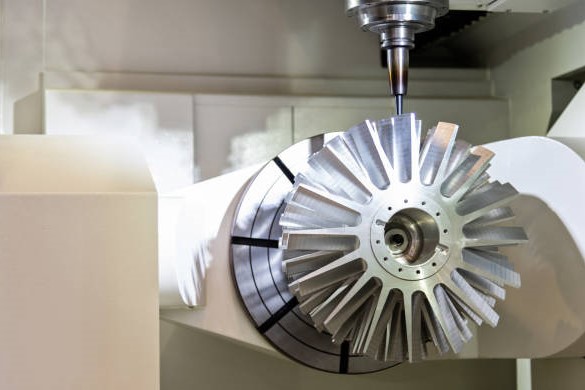
Adding a high-precision, direct-drive rotary indexer (typically designated as the A-axis or B-axis) to a large-envelope vertical platform changes how complex mold features are planned and executed.
 [Traditional 3-Axis Setup]              [CHANSIN 4-Axis Rotary Setup]
     Vertical Spindle Only                    Vertical Spindle + A-Axis Rotation
            │                                             │
      (Requires angled                             (Rotates part dynamically
    fixtures for slides)                         to any angle in seconds)
Milling Sliders, Lifters, and Angular Core Pins
Modern injection molds rely heavily on moving parts like mechanical sliders and lifters to release complex internal part undercuts. These components require channels, lifter slots, and ejector pin guide holes angled anywhere from 3° to 25° relative to the primary parting line.
-
The 3-Axis Vulnerability: Machining these features on a standard 3-axis mill requires building custom angled sine plates, tilting fixtures, or using complex manual compound vises. This setup stage adds hours of non-productive prep work.
-
The 4-Axis Solution: With an integrated rotary indexer, the workpiece rotates dynamically to the exact angular coordinate programmed in your CAM software. The machine can drill deep waterlines, mill slide tracks, and ream lock angles in a single continuous automated routine.
High-Efficiency, Single-Pass EDM Electrode Production
For deep, narrow rib sections that cannot be milled directly, shops rely on Electrical Discharge Machining (EDM) using custom graphite or copper electrodes.
3. Surface Quality Realities: Reducing the Polishing Bottleneck
Manual bench work creates one of the highest hidden costs in modern mold manufacturing. When machine tools produce micro-chatter marks, visible step-down lines, or uneven scalloped surfaces, toolmakers must spend hours correcting the steel cavity by hand.
To achieve the required mirror finish, experienced technicians manually polish the mold surface with diamond compounds and precision tools. As a result, excessive polishing increases labor costs, extends production time, and reduces overall manufacturing efficiency.
High-Rigidity 4-Axis Platform ──> Suppressed Harmonic Chatter ──> True Constant Chipload ──> Zero Manual Polishing
By leveraging the structural mass of a large-format platform combined with optimized multi-axis toolpaths, you maintain a completely stable, predictable chip load.
-
True Contouring Continuous Engagement: Rather than executing a choppy series of jagged 3-axis point-to-point moves, 4-axis simultaneous indexing allows the cutter to maintain a continuous spiral engagement path across curved surfaces.
-
This stable cutting dynamic suppresses harmonic chatter, resulting in an exceptionally smooth surface finish (Ra ≤ 0.4μm ). Consequently, bench-polishing times are slashed by up to 60%, allowing you to assemble your mold bases and deliver finished tools to your clients days ahead of schedule.
Conclusion: Future-Proofing Your Machining Workflow
In today’s competitive tool and die industry, traditional 3-axis machining shops face increasing pricing pressure. To secure high-value aerospace, automotive, and medical projects, manufacturers must upgrade production capabilities. Modern customers demand larger, more complex, and higher-precision components. Therefore, machining facilities need greater flexibility and fewer manual operations.
Multiple setups and custom fixtures reduce production efficiency. In addition, manual polishing increases labor costs and delivery risks. These challenges often slow cycle times and affect machining accuracy.
By upgrading to a high-rigidity 4-axis vertical machining center, manufacturers improve precision and productivity. The large working envelope supports complex mold and tooling applications. Moreover, 4-axis machining reduces setup time and improves part consistency. As a result, manufacturers achieve tighter tolerances and faster delivery schedules. Furthermore, advanced machining capabilities help shops win high-value contracts and improve long-term profitability.
>>Explore CHANSIN’s comprehensive lineup of high-performance vertical and gantry machining centers today to invest in hardware engineered for absolute dimensional consistency.