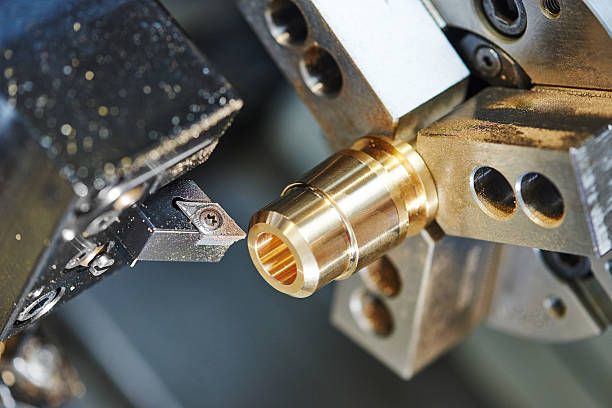
When manufacturers need to produce extremely thin and long components, traditional CNC turning often faces challenges caused by vibration, deflection, and unstable cutting conditions. This is why Swiss-type lathe guide bushing technology plays a critical role in precision manufacturing.
Swiss-type CNC lathes can machine long slender parts with high accuracy because the workpiece passes through a guide bushing located directly next to the cutting tools. This design creates continuous support near the cutting point and significantly reduces bending deformation.
For industries such as medical devices, electronics, aerospace, and precision components, this structure enables stable machining of parts with high length-to-diameter ratios.
Why Does a Guide Bushing Matter in Swiss Machining?
How Does the Guide Bushing Prevent Workpiece Deflection?
The primary function of a guide bushing is to provide a continuous support point close to the cutting area.
In conventional turning, the workpiece is usually held by a chuck. When the exposed length becomes longer, the unsupported section increases, making the part more likely to bend under cutting forces.
This can result in:
- Dimensional errors
- Surface vibration marks
- Tool deflection
- Reduced machining stability
A Swiss-type lathe guide bushing changes this machining principle.
The bar material passes through the guide bushing, while the cutting tool works immediately after the support point. The distance between the support area and cutting zone is typically only a few millimeters.
This minimizes the unsupported length during machining.
Why Is Guide Bushing Support Important for Long Slender Parts?
Long shaft components often have a high length-to-diameter ratio (L/D).
When the ratio exceeds approximately 20:1, traditional machining methods may struggle to maintain stability because the workpiece behaves like a flexible beam.
The guide bushing provides:
- Radial support
- Reduced vibration
- Improved cutting rigidity
- More consistent dimensional control
This is the physical foundation behind swiss machining deflection elimination.
How Does Swiss Machining Eliminate Workpiece Deflection?
The Difference Between Sliding Headstock Technology and Traditional Turning
The biggest difference between Swiss-type machining and conventional CNC turning is how the workpiece moves.
A traditional CNC lathe:
- Holds the material in a chuck
- Rotates the entire workpiece
- Uses a fixed cutting position
- Creates longer unsupported sections as the part extends
A Swiss-type lathe:
- Uses sliding headstock technology
- Moves the bar material through the guide bushing
- Keeps the cutting point close to the support area
- Maintains stable rigidity during machining
| Machining Method | Workpiece Support Method | Main Challenge |
|---|---|---|
| Traditional CNC Lathe | Chuck holding with extended material | Increased deflection with length |
| Swiss-Type Lathe | Guide bushing near cutting area | Reduced vibration and bending |
The total part length does not significantly affect machining stability because the active cutting section remains continuously supported.
How Does Guide Bushing Technology Improve Machining Accuracy?
Maintaining Micron-Level Precision During Cutting
Because the guide bushing reduces movement and vibration, cutting forces are transferred more effectively through the supported structure.
This helps achieve:
- Stable dimensions
- Improved surface finish
- Reduced tool vibration
- Higher repeatability
High-precision Swiss machining applications can achieve tolerances around ±0.005 mm (5 microns) depending on:
- Machine accuracy
- Material characteristics
- Tool selection
- Process optimization
For precision components, maintaining consistent geometry throughout production is often more important than achieving maximum cutting speed.
Why Are Swiss-Type Lathes Suitable for Medical and Precision Parts?
Many industries require small-diameter components with strict dimensional requirements.
Typical applications include:
- Medical screws and implants
- Electronic connectors
- Watch components
- Aerospace pins
- Micro shafts
These components often require:
- Small diameters
- Long aspect ratios
- Tight tolerances
- Excellent surface quality
The guide bushing system provides the machining stability needed for these applications.
What Is the Relationship Between Guide Bushing Design and Machining Performance?
Factors That Influence Swiss Machining Stability
Although the guide bushing provides critical support, overall performance depends on multiple factors.
Important considerations include:
| Factor | Influence on Machining |
|---|---|
| Guide Bushing Accuracy | Determines support consistency |
| Clearance Control | Affects vibration and material movement |
| Cutting Tool Condition | Influences surface quality |
| Material Properties | Affects cutting force and deformation |
| Machine Rigidity | Supports long-term accuracy |
A properly adjusted guide bushing system helps maintain stable production quality.
When Should Manufacturers Choose a Swiss-Type CNC Lathe?
Applications Requiring High Precision Slender Part Machining
A Swiss-type CNC lathe is suitable when products require:
- Small diameter machining
- Long slender geometries
- High production consistency
- Tight dimensional tolerance
Typical examples include:
- Precision medical components
- Micro mechanical parts
- Automotive sensor components
- Optical equipment parts
For standard short turning parts, conventional CNC lathes may provide a more economical solution. The advantage of Swiss machining becomes significant when part geometry creates deflection challenges.
What Should Buyers Consider When Selecting a Swiss-Type Lathe?
Procurement Checklist for Precision CNC Equipment
Before purchasing a Swiss machining system, manufacturers should evaluate:
| Evaluation Factor | Key Consideration |
|---|---|
| Guide Bushing System | Support accuracy and adjustment capability |
| Machine Structure | Rigidity and vibration control |
| Spindle Performance | Required speed and material compatibility |
| CNC Control System | Programming efficiency and stability |
| Application Experience | Previous machining examples |
A professional CNC swiss lathe manufacturer should provide technical support based on part dimensions, materials, and production requirements.
Guide Bushing Is the Core Reason Swiss Lathes Handle Slender Parts
The advantage of swiss type lathe guide bushing technology comes from one simple mechanical principle: keeping the cutting point close to a rigid support location.
Unlike traditional turning methods, where long workpieces create increasing deflection risk, Swiss-type machining continuously supports the material during cutting through sliding headstock technology.
This structure reduces vibration, improves dimensional stability, and enables precision machining of slender components that are difficult to produce with conventional CNC lathes.
For manufacturers evaluating high-precision turning solutions, understanding the role of guide bushing technology is essential for selecting the right CNC machining equipment.
CHANSIN provides CNC machining equipment solutions with advanced Swiss-type turning technology, supporting precision manufacturers in medical, electronics, automotive, and industrial applications.