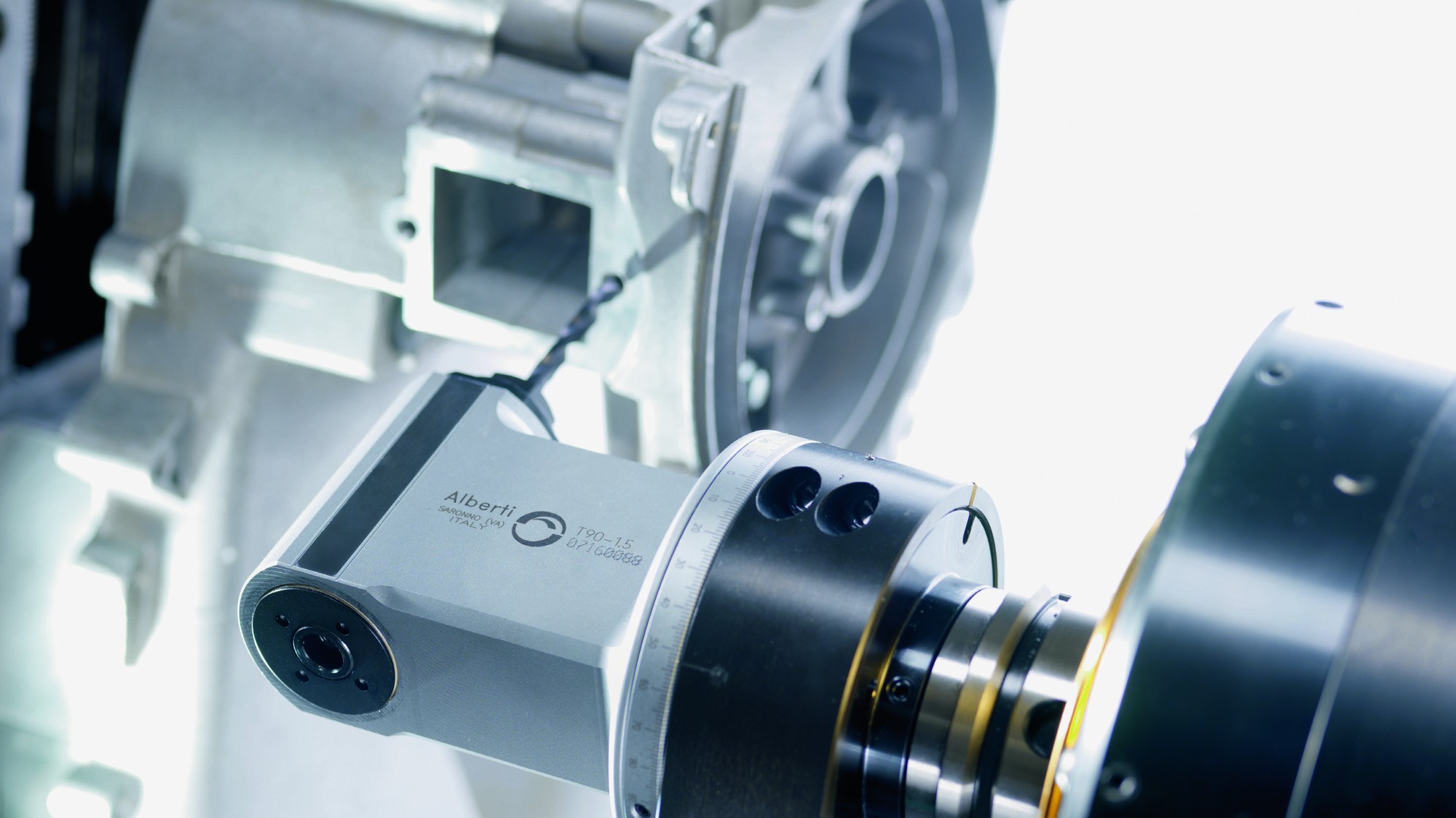
A frame casting sits on the gantry table, clamped and indicated from its top face. The top features are done, and the drawing still shows six holes on one side wall. Someone orders an angle head because the drill reaches the hole on the CAD model. On the machine, the head body hits the clamp before the drill gets there. That's a common way angle head machining goes wrong: the tool fits, the housing doesn't.
Use an angle head when the side holes must hold position to the top-face datum, the part is heavy or awkward to flip, and the head body, tool and reaction support all fit in the space you have. Re-clamp when the side features have their own tolerances, the part flips easily, or the cut needs more load than the head can carry. The rest of this article explains how to check each of those conditions.
| Decision factor | Angle head | Re-clamping |
|---|---|---|
| Side holes tied to the top datum | Datum stays put; only the tool turns | A second setup has to re-find the datum |
| Heavy or large part | No lifting or re-indicating | Crane, indicating and often a second fixture |
| Cutting load | Limited by the head's rating | No angle-head limit; the fixture still has to hold |
Angle head machining: which kind of head do you mean?
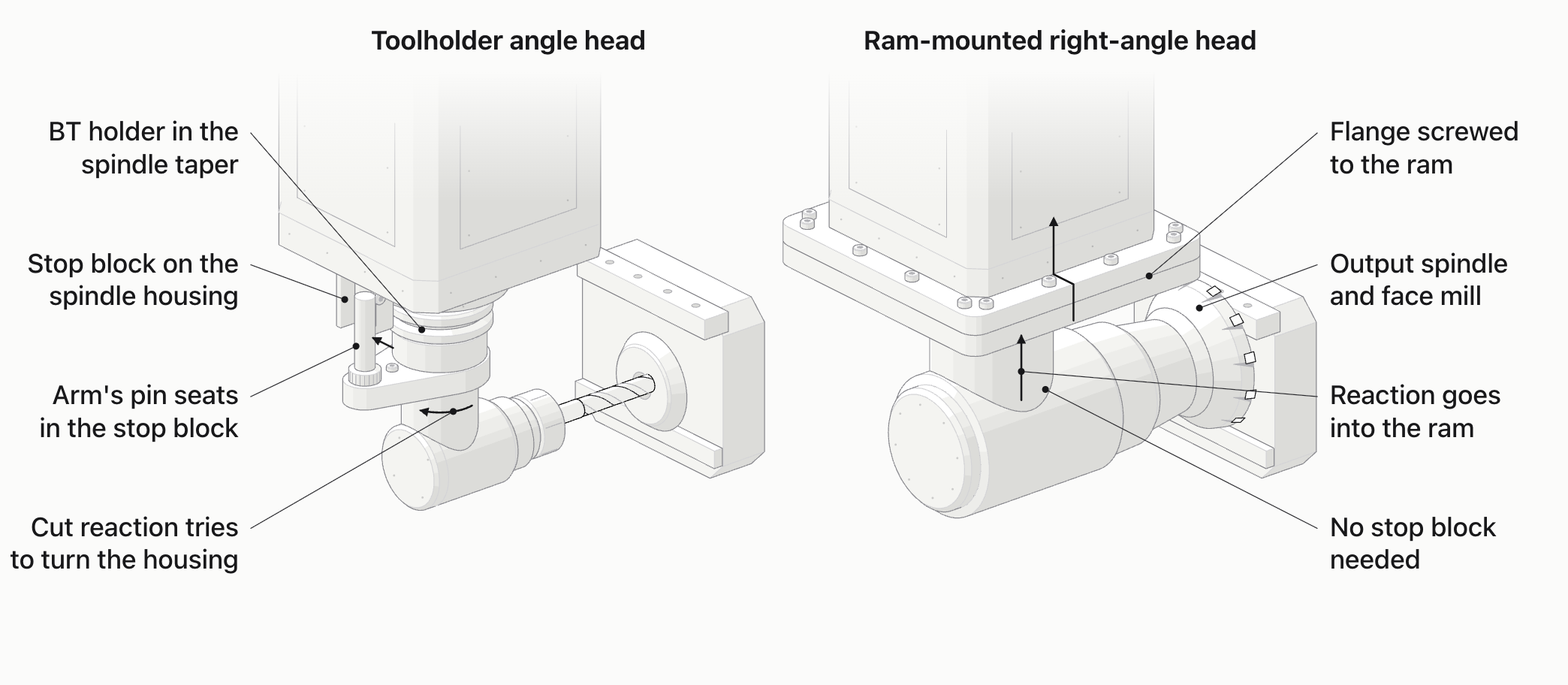
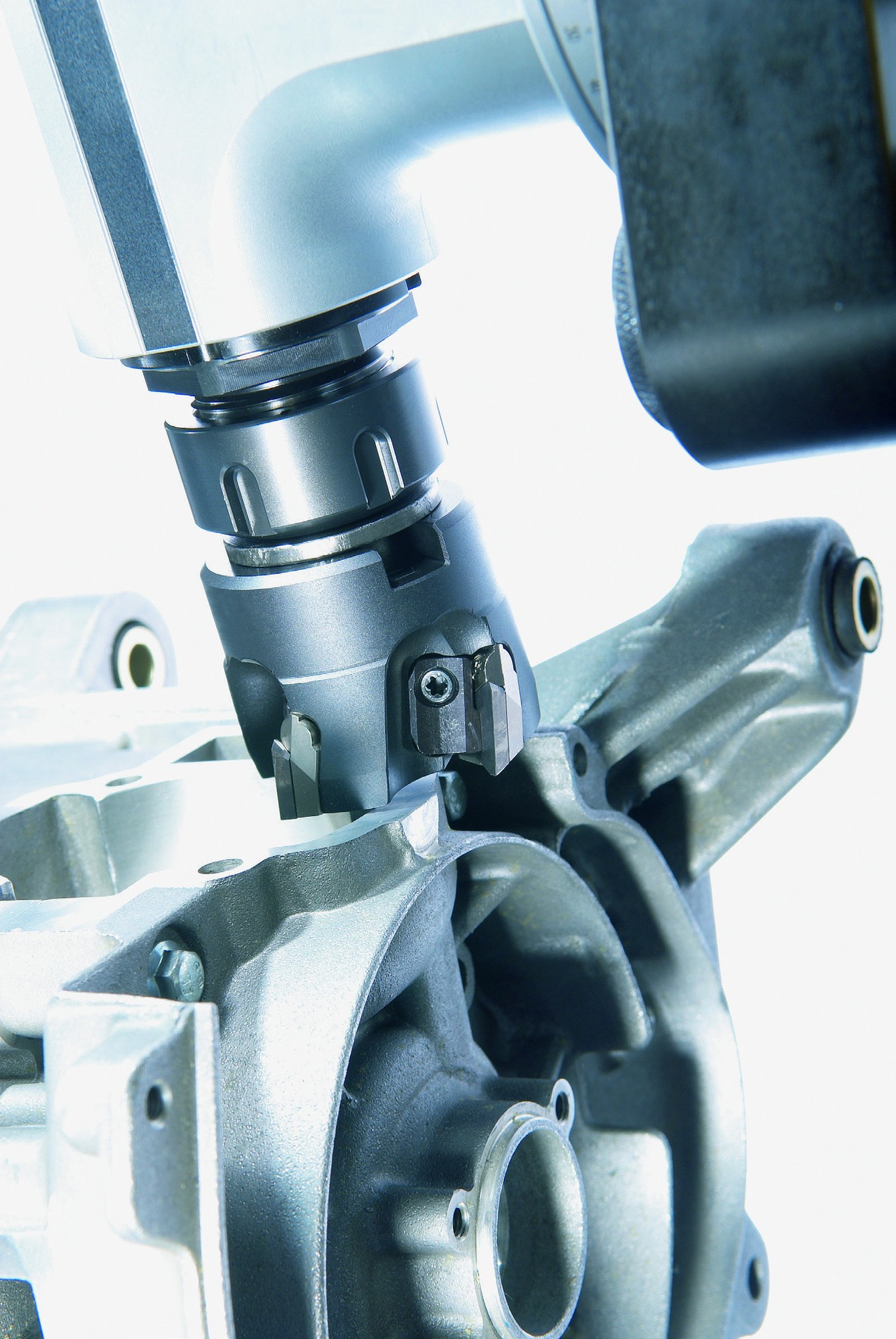
On a gantry, "angle head" can mean two quite different things. A toolholder angle head goes into the spindle taper like any other holder. The spindle drives it, and a locating pin on the head housing seats in a stop block fixed to the spindle housing, so the housing can't spin. Many of these can go into the tool magazine and change automatically.
A ram-mounted right-angle head bolts to the face of the gantry ram. It's a heavier attachment built for larger cuts, and how it's changed, by hand or by an automatic attachment changer, depends on the machine. The two take cutting reaction through different paths and carry very different loads, so the experience from one doesn't transfer to the other.
Does the side feature have to hold position to the top face?
This is the first question, and it decides how much one setup is worth. If the side holes are positioned from the same datum as the top features, keeping the part clamped keeps that datum. Only the tool direction changes. Flip the part, and the second setup has to find the datum again by indicating or probing. Whatever error that step adds goes straight into the hole positions.
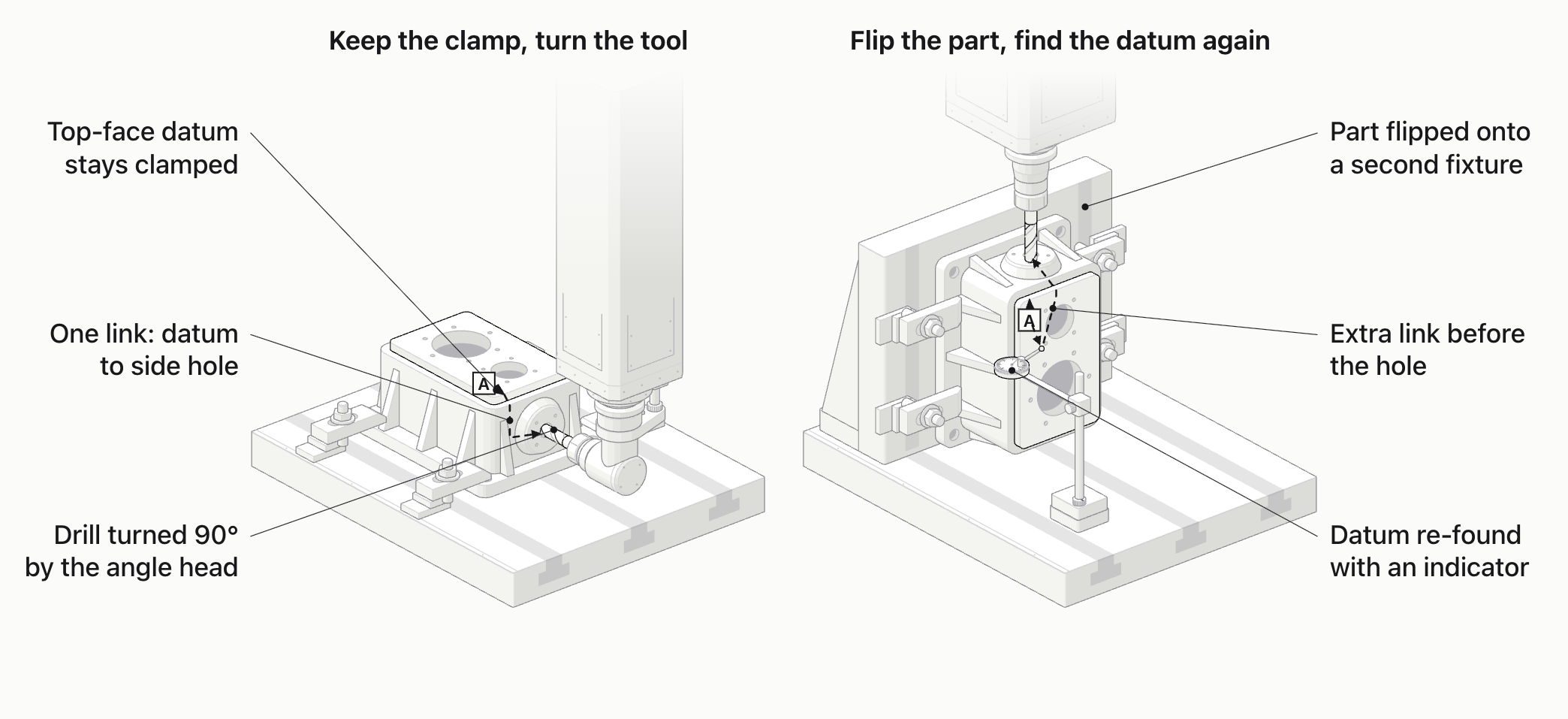
If the side holes only need their own size and a loose position, that advantage shrinks. Re-clamping is then often simpler, and the cut is no longer limited by the head's rating, as long as the second fixture holds the part rigidly.
What stops the head housing from turning?
A toolholder angle head is driven through the taper, and the cut puts a reaction torque on the head housing. The stop block carries that reaction into the spindle housing. BIG DAISHOWA's angle head manual sets out how the stop block has to be fitted before the head is used, and BENZ describes the matching support the machine side has to provide.
The taper only drives the input shaft; the housing sits on bearings around it. If the machine has no stop block or bracket for the head's pin, nothing holds the housing against that torque. Sort out the machine-side support the head's manual calls for before you plan the cut.

A ram-mounted head doesn't need a stop block, because its flange is bolted to the ram. What you check there is the head's own power, speed and load rating, and whether the machine's control can index it.
Will the head and tool fit under the beam?
In angle head machining, the deeper a side hole sits below the top face, the further the head has to reach down. Its body is longer than a normal holder, and it sticks out sideways. Check three dimensions on the drawing with the head modelled in place: spindle nose to table, the space under the beam, and the clearance between the head housing and your clamps.
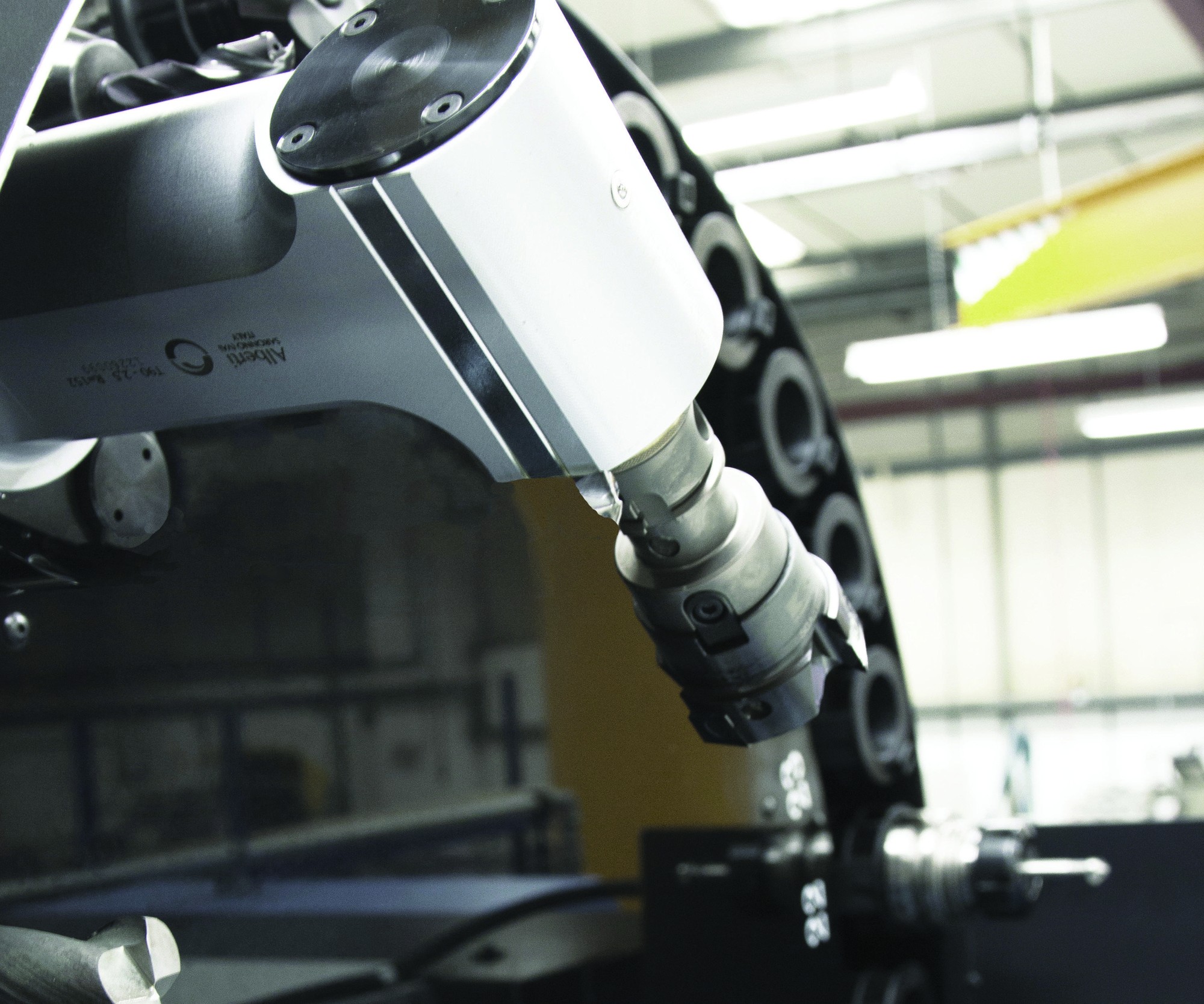
On our gantries, for example, the CS-LP2014 takes workpieces up to 1,060 mm high with a spindle-nose-to-table range of 160–960 mm, and the CS-LP2518 takes 1,160 mm with 250–1,050 mm. Those numbers are the space the head and the part share.
What does one flip really cost?
On a small part, flipping takes a few minutes. On a large casting it means a crane, re-indicating on the machine and often a second fixture designed for the new orientation. For a single prototype, that may still be cheaper than buying and proving a head. For a batch with side features on every part, the flip repeats on every part, and the angle head's preparation cost spreads across the whole run.
There's also a third route for multi-face parts that fit a horizontal machining center with a rotary table. We covered how that layout handles complex multi-face parts separately.
Choose an angle head or a second setup
Choose angle head machining if:
- the side features must hold position to the top-face datum;
- the part is large or heavy, and flipping means a crane and a second fixture;
- the batch repeats the same side features;
- the head body, the tool and the reaction support all fit with your fixture in place.
Choose re-clamping if:
- the side features carry their own tolerances;
- the part flips easily and indicates quickly;
- the cut needs more power or rigidity than the head is rated for;
- it's a one-off and the head would have to be bought and proven for a single job.
If you're still deciding between a gantry and a vertical machining center for this kind of part, start with our gantry vs VMC comparison.
Setting up a Chansin gantry for side work
Our gantry machining centers can be fitted with an angle head for side machining. We start from your part and fixture drawings: we model the head body together with the clamps, check the reach against the machine's spindle-nose range and workpiece height, and match the head to the side features you need to cut. The CS-LP series runs BT50 spindles, with tables from 2,000 × 1,200 mm on the CS-LP2014 to 2,700 × 1,600 mm on the CS-LP2518.
Upload your part drawing through our product inquiry page, with the material, batch size and the side features marked. We'll go through the reach and setup options with you, recommend a configuration, estimate the cycle time and quote.
FAQ
Can an angle head change automatically from the tool magazine?
Many toolholder angle heads can, as long as the head's locating pin lines up with the stop block on the spindle housing at each tool change. Nikken, for example, offers automatic-change and modular versions in its angle head range. Ram-mounted heads are changed as attachments, by hand or by an attachment changer on the machine.
Is the stop block just there to stop the housing spinning?
It does more than that. It carries the cutting reaction into the spindle housing and fixes the head's angular position, so the output tool points where the program expects. BIG DAISHOWA's manual treats fitting the stop block as part of installing the head.
Sources and Method
- BIG DAISHOWA — Angle head instruction manual: stop block fitting and handling.
- BENZ — Angle heads for metal: machine-side support and interfaces.
- BIG DAISHOWA — Right-angle solutions for hard-to-reach features.
- Nikken — Angle head range: automatic-change and modular types.
The frame-casting example is illustrative. Machine dimensions are Chansin CNC product data.
Photos: Alberti angle head catalogue.