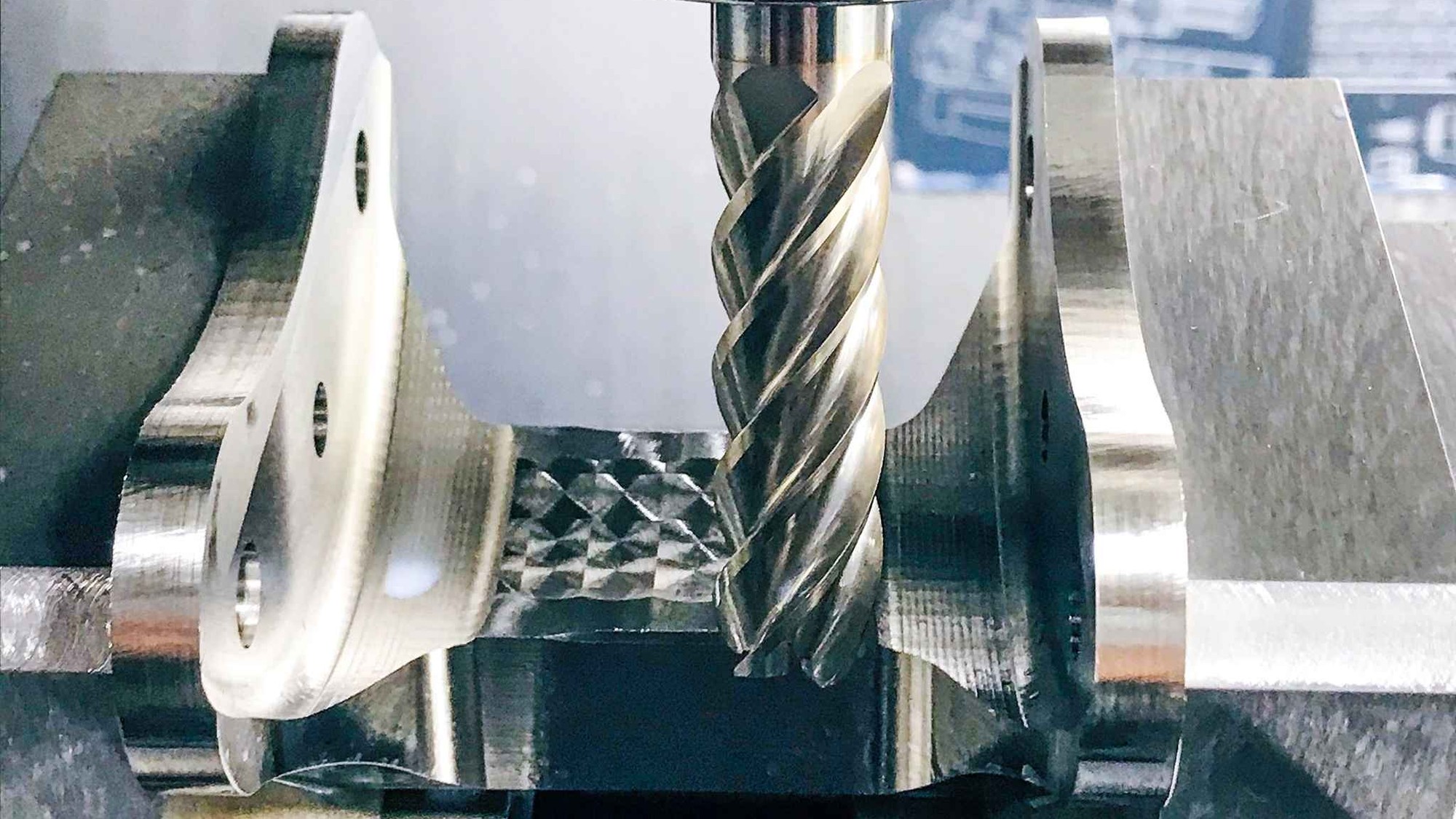
Titanium milling with a 50 mm face mill at 40 m/min turns the spindle at about 250 rpm. On a machine sold as 12,000 rpm and 11 kW, that's about 2% of top speed, and if the 11 kW only arrives at 1,500 rpm, less than 2 kW is left.
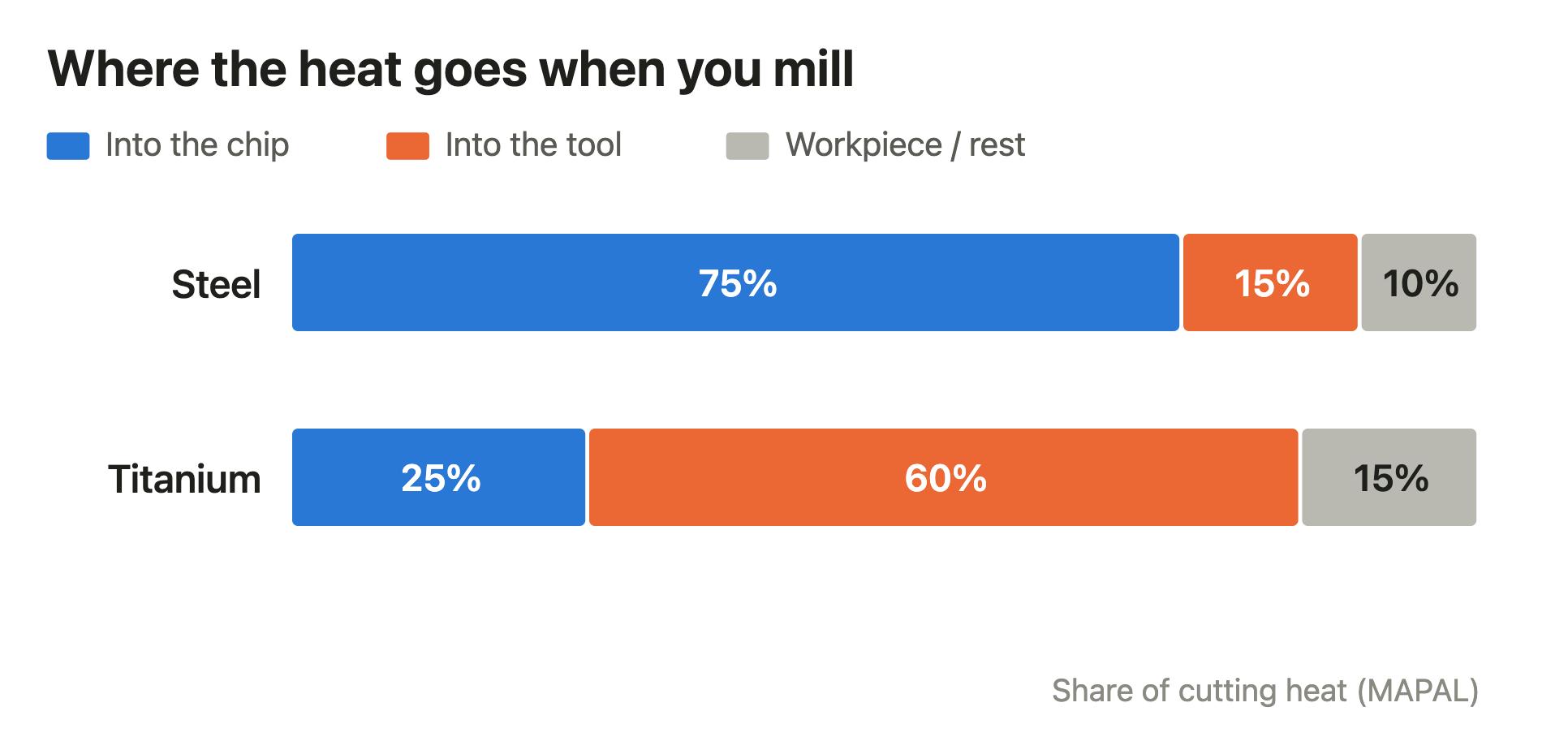
The speed stays that low because of heat. In steel, about 15% of the cutting heat goes into the tool. In titanium it's about 60%, so the edge wears out quickly if you run faster.
So a machine for this work is judged on low-speed torque, stiffness and coolant at the edge. This article covers roughing and semi-finishing Ti-6Al-4V on a machining center. Finishing with small tools runs much faster, and we come back to it near the end.
Why titanium milling has to run slowly
Titanium conducts heat poorly: TIMET's data sheet lists annealed Ti-6Al-4V at 6.6 W/m·K at 20 °C. MAPAL's figures show the result in milling. In steel, the chips carry away about 75% of the heat. In titanium they carry about 25%, and around 60% goes into the tool, which shortens tool life considerably.
MAPAL also calculated what higher speed costs. For a four-edge indexable cutter milling Ti-6Al-4V at 4 mm depth and 24 mm width of cut, raising cutting speed from 32 to 50 m/min raised the total cost per part by 259%. With tool life that short, MAPAL says, the cost of the cutting material becomes the main concern. The best result in that calculation came from high feed at low cutting speed. In their steel example, doubling cutting speed from 200 to 400 m/min lowered the cost per part by 24%. Those figures hold only for those cutters and cuts, but titanium and steel clearly move in opposite directions.
What low cutting speed does to spindle speed
Spindle speed follows from cutting speed and tool diameter: n = 1000 × Vc ÷ (π × D). A 50 mm face mill at 32–50 m/min turns at only about 200–320 rpm. A 20 mm end mill at 50 m/min turns at about 800 rpm.
Most spindle motors deliver constant torque only up to a base speed. Below it, as Scott Smith explains in Cutting Tool Engineering, torque stays flat and power falls in step with speed, so there's little power available at low rpm. Modern Machine Shop's article on roughing titanium makes the same point from the user's side: with speed capped, torque is the only way to get the power you need, and a gearbox is often used to turn motor power into low-end torque.
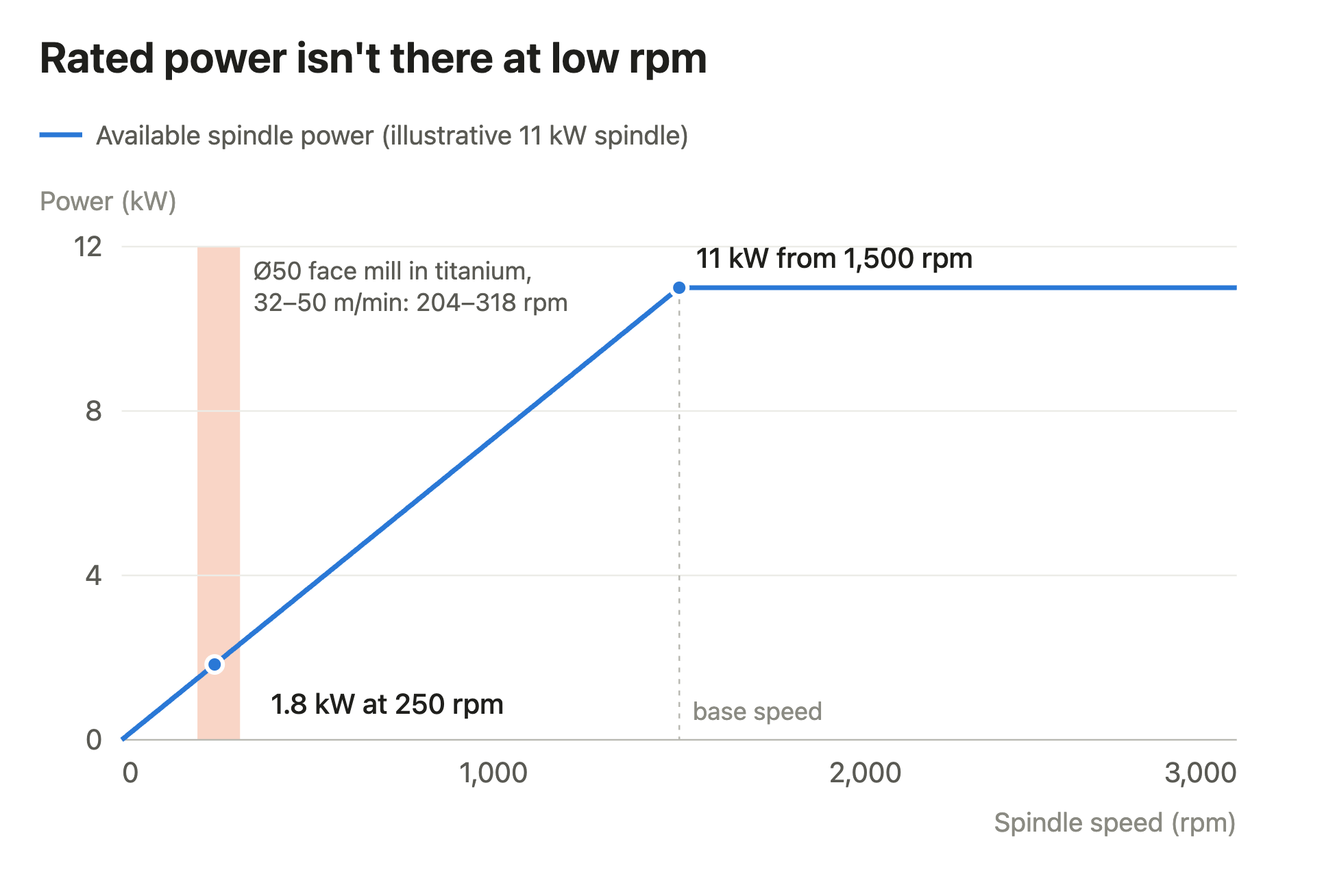
So when you compare machines for titanium milling, ask for the spindle's power and torque curve and read it at your own cutting speed and tool diameter. Take the spindle from the opening: 11 kW at 1,500 rpm, with constant torque below that. At 250 rpm it has under 2 kW (11 × 250 ÷ 1,500).
Whether that's enough depends on the cut. The cut's average power has to stay below the spindle's continuous output at that speed, after any belt or gearbox losses, so work it out from your own data: net power in kW = ap × ae × vf × kc ÷ (60 × 10⁶), with depth and width of cut in mm, feed in mm/min and specific cutting force kc in N/mm² from your tool maker. A light cut can fit inside 2 kW. A large cutter taking a wide, deep cut may not.
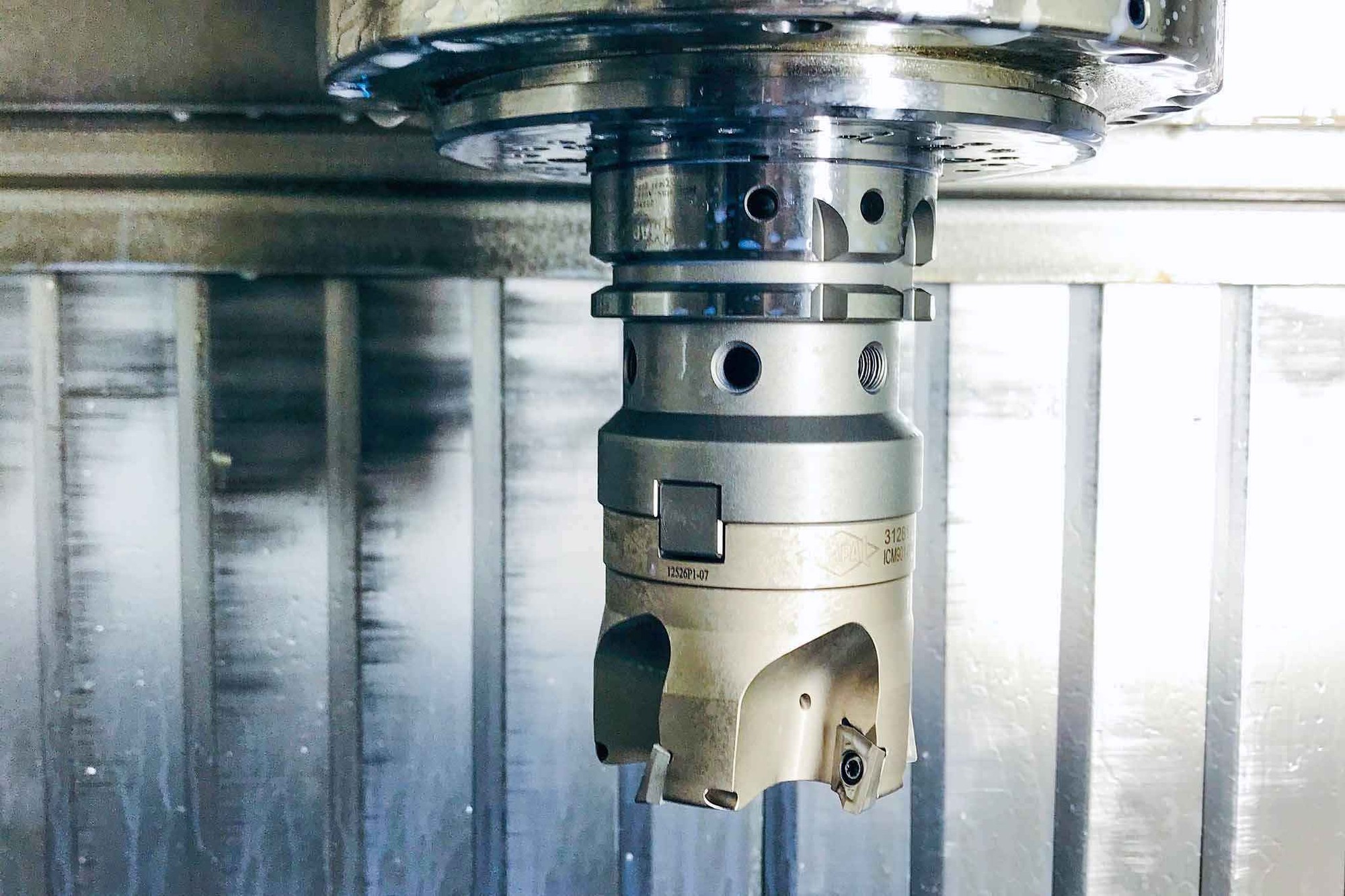
Stiffness and workholding
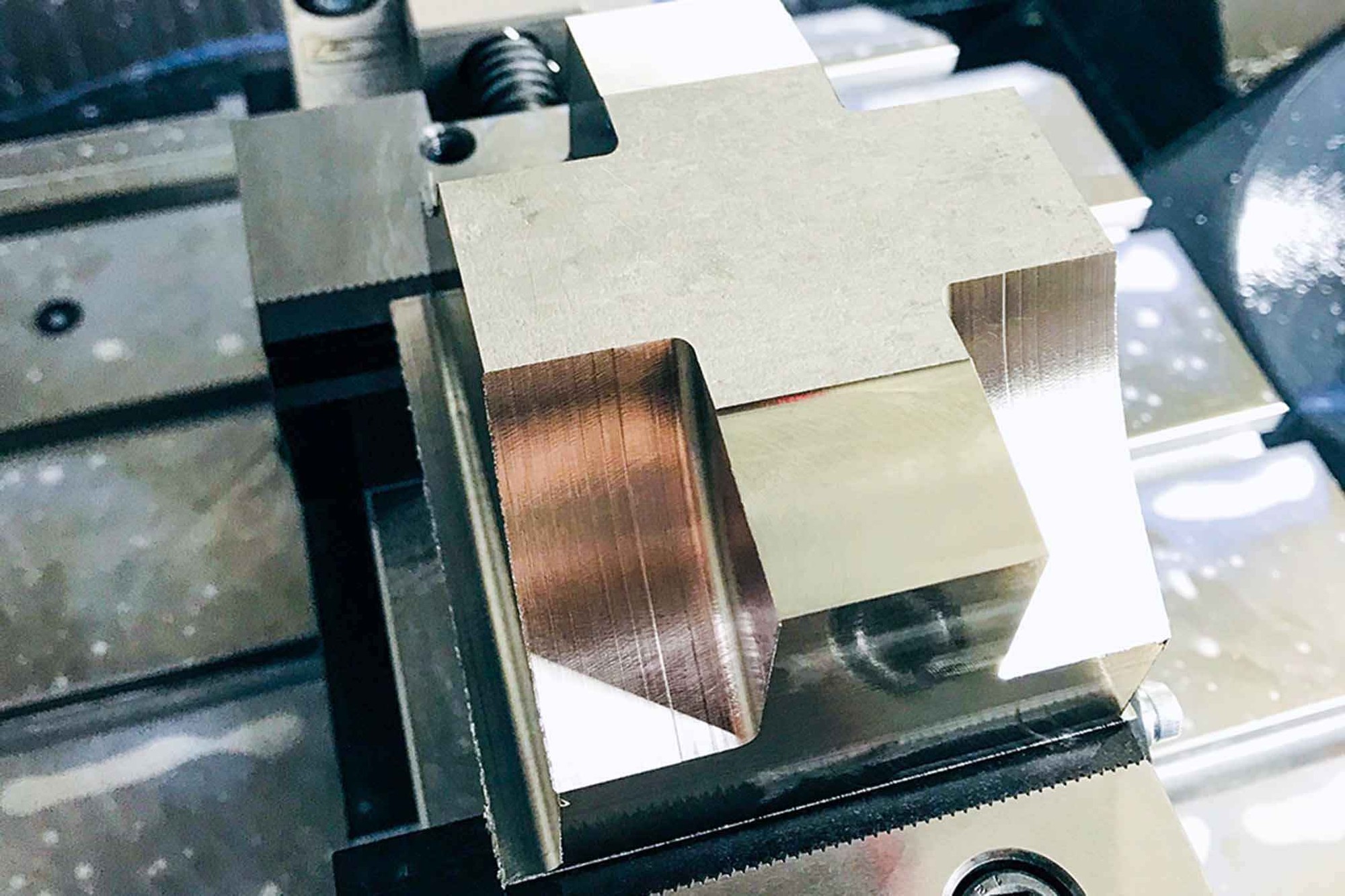
Titanium is springier than steel. TIMET gives Ti-6Al-4V a modulus of 107–122 GPa, depending on texture and heat treatment, while SSAB puts steel at around 200 GPa. For the same part geometry, support and cutting force, a titanium wall therefore deflects roughly 1.6 to 1.9 times as much as a steel one. That makes chatter more likely, though whether it starts depends on the dynamics of the machine, tool and fixture and on the cut. Chatter chips an edge that's already running hot.
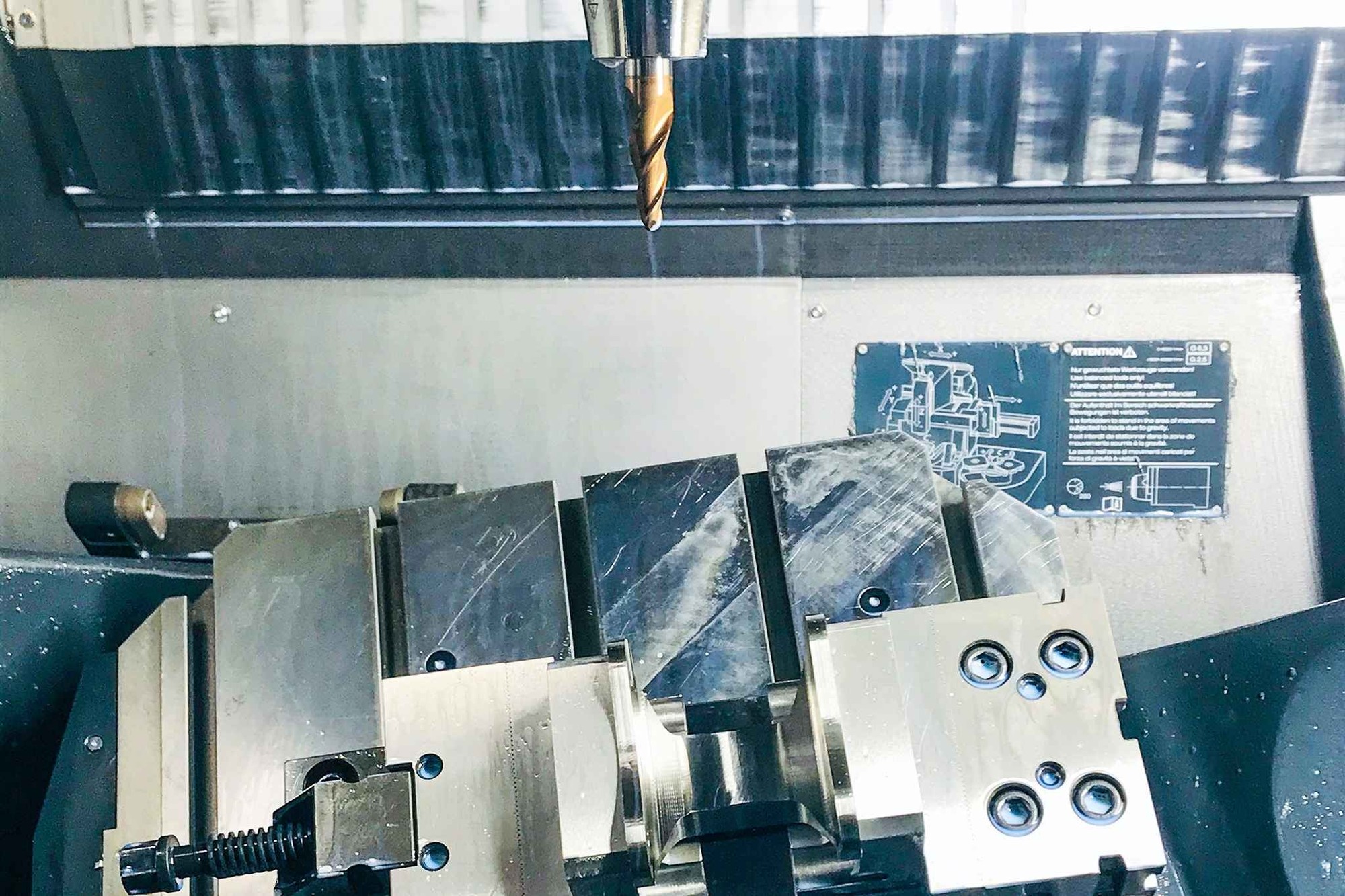
The machine needs a rigid structure and a solid spindle-to-holder connection, and the fixture needs to support the part close to the cut. Keep tool stick-out short, whatever the spindle size.
Getting coolant to the edge
Because the heat stays in the tool, coolant has to reach the cutting edge, and flooding the part won't do that. Through-tool coolant does. In MAPAL's SME Aerospace job, the chucks were chosen to get coolant to the cutting edges, and external coolant was added on top of the internal supply. If the cutters you choose have them and the process calls for it, the machine has to supply through-spindle coolant at a pressure that suits the tool and the cut. We compared through-spindle and flood coolant in more detail in another article.
When you don't need a bigger machine
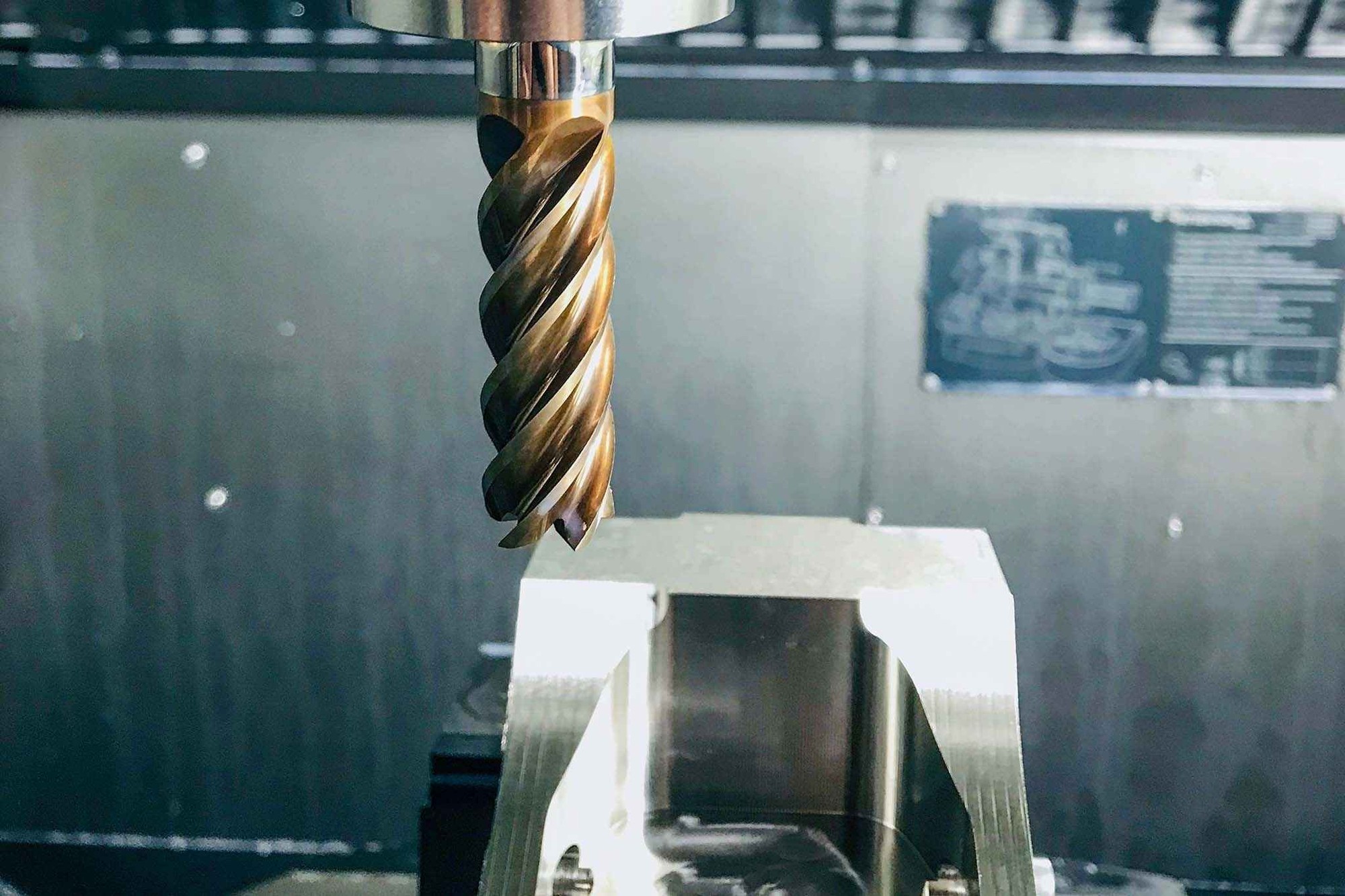
If your titanium milling is mostly finishing with small end mills, light radial depths and short tools, spindle speeds climb back into the thousands and torque stops being the limit. A BT40 vertical machining center with good rigidity and through-spindle coolant can handle that. Low volume may mean an upgrade doesn't pay, but a machine still can't take a cut it isn't strong enough for. A heavier spindle is worth buying when you rough a lot of material with large cutters.
How we set up a Chansin machine for titanium
For a titanium job, we start from your cutters and cutting data and work out the torque and power the cut needs at its spindle speed, then match the machine to it. For roughing with large cutters, we'd look first at the BT50 versions of our CS-L series, from the CS-L1270 up: belt-driven spindles at 8,000 rpm, with 6,000 rpm also available from the CS-L1380, and 15–18.5 kW motors, on a heavier structure built for heavy cutting. We'd fit through-spindle coolant at a pressure matched to your cutters; we offer several levels from 20 bar up to 120 bar.
For finishing with smaller tools at spindle speeds in the thousands, our CS-V series with BT40 direct-drive spindles at 12,000 rpm can be the better fit. See the CS-L series for travels and table sizes. If you send the part drawing, material grade and the cutters you plan to use through our product inquiry page, we'll check the spindle and coolant setup against the cut and recommend a configuration.
Sources and Method
- MAPAL — Titanium machining: heat distribution and the cost of higher cutting speeds.
- MAPAL — SME Aerospace Malaysia relies on MAPAL (titanium aerospace parts).
- Cutting Tool Engineering — Spindle power and torque limitations (Scott Smith, May 2012).
- Modern Machine Shop — On Power, Torque, Speed and Hogging Titanium (Matt Danford, 2016).
- TIMET — TIMETAL 6-4 data sheet: thermal conductivity and modulus.
- SSAB — 20 questions on steel: elastic modulus.
Spindle speeds and net power use the standard milling formulas. The 11 kW at 1,500 rpm spindle and the 40 m/min opening example are illustrative.