The global transition toward Electric Vehicles (EVs) has fundamentally altered the requirements for automotive component manufacturing. Unlike traditional internal combustion engines, EV components such as integrated motor housings and structural battery trays often rely on large-scale, thin-walled aluminum castings. Consequently, these parts present significant challenges regarding geometric complexity and dimensional stability. To meet the rigorous standards of the new energy sector, 5-axis machining centers have become the indispensable solution for finishing these integrated die-cast parts. This guide explores how 5-axis technology masters the intricate features required for high-performance electrification.
1. Tackling Integrated Die-Castings: The Challenge of Scale
Modern EV architecture favors “Giga-casting” or integrated die-casting to reduce vehicle weight and assembly parts. However, these large-scale components—specifically motor housings and battery trays—are prone to deformation and internal stress.
-
Complex Hole Systems: Motor housings require numerous bearing seats and sensor ports aligned across multiple planes.
-
High Flatness Requirements: Battery trays must maintain extreme flatness across a large surface area to ensure proper thermal contact with cooling plates and secure sealing.
-
Thin-Walled Rigidity: Machining these parts requires high-speed spindles and precise tool paths to prevent chatter on thin aluminum walls.
Consequently, traditional 3-axis or 4-axis setups often fail due to the need for multiple re-clamping steps, which introduces cumulative errors. Therefore, 5-axis centers provide the “one-hit” solution needed to maintain the integrity of the part’s geometry.
2. 5-Axis Precision: Mastering Seals and Multidimensional Features
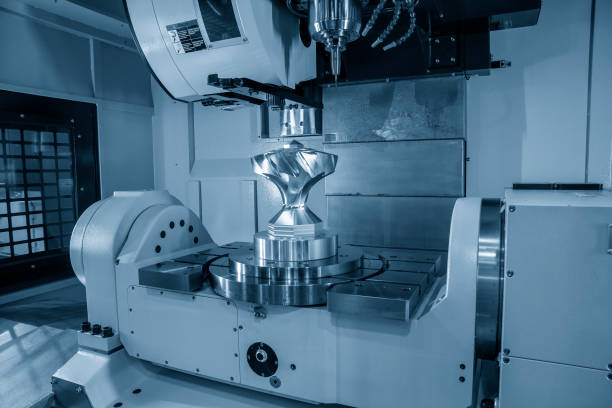
The primary advantage of a 5-axis machining center in EV production is its ability to reach every angle of a complex housing in a single setup.
-
Seamless Sealing Grooves: EV motor housings require high-precision O-ring grooves to prevent coolant leaks. 5-axis motion allows for continuous contouring of these grooves across non-linear surfaces.
-
Deep Hole Alignment: Achieving perfect concentricity for long-axis bearing bores is simplified when the machine can orient the tool exactly to the part’s datum in one operation.
-
Surface Integrity: By maintaining an optimal tool-to-part angle, 5-axis machining achieves superior surface finishes, which are critical for the airtight seals required in battery enclosures.
Consequently, you eliminate the alignment variations caused by moving the part between different fixtures. Furthermore, the reduced handling lowers the risk of damaging expensive, large-format castings.
3. Efficiency Metrics: 5-Axis vs. Traditional Machining
| Feature Requirement | Traditional 3/4-Axis Setup | CHANSIN 5-Axis Machining Center |
| Setup Frequency | Multiple (3–5 times) | Single Setup (One-and-Done) |
| Hole Concentricity | Difficult to maintain across planes | High Precision via TCPM Technology |
| Flatness (Battery Tray) | Susceptible to fixture error | Uniform Surface via Continuous Motion |
| Cycle Time | High (Due to manual re-fixturing) | Low (Optimized Tool Paths) |
Consequently, 5-axis machining centers provide the throughput necessary for high-volume automotive production lines. Furthermore, the ability to perform complex undercuts and angled drilling without specialized custom tooling reduces overall production costs.
Conclusion: Driving the Future of Precision
As modern automotive engineering moves toward greater integration and lightweight design, manufacturing precision becomes more critical than ever. In today’s EV industry, even the smallest machining deviation can affect structural stability, thermal management, and overall vehicle performance. Therefore, manufacturers can no longer rely on the limitations of traditional machining methods for high-performance applications.
By adopting a professional 5-axis machining center built for next-generation electrification, you gain the ability to machine complex components with exceptional multidimensional accuracy. As a result, motor housings achieve greater efficiency, battery trays deliver stronger structural security, and production workflows operate with higher consistency and profitability. Moreover, advanced 5-axis technology improves surface quality, reduces setup time, and supports the intricate geometries required in modern electric vehicle platforms.
As the automotive sector continues to evolve, precision manufacturing will define the leaders of the industry. Ultimately, your innovations deserve machining solutions that match the sophistication of your engineering vision. With advanced 5-axis technology, you build stronger, safer, and more reliable automotive components while setting a higher standard for structural integrity and production excellence.