In traditional manufacturing, complex parts often require multiple setups across different machines—moving from a lathe to a milling center and back again. Consequently, each transfer introduces the risk of alignment errors and increases labor costs. However, the emergence of dual-spindle CNC lathe centers equipped with live tooling has revolutionized this workflow. By combining “Mill-Turn” capabilities on a single platform, manufacturers can achieve “One-Hit” machining. This guide explores how the synergy of twin chucks and active turrets allows you to complete complex components in a single clamping cycle.
1. The Power of Live Tooling: Beyond Simple Turning
Standard lathes are limited to stationary tools that can only remove material from a rotating workpiece. In contrast, a “Live Tooling” turret features independent motors that drive rotating tools like end mills and drills.
-
Integrated Milling: Perform slotting, hex-milling, and pocketing on the face or diameter of a cylindrical part.
-
Off-Center Drilling: Precisely place bolt patterns or lubrication holes without moving the part to a separate drill press.
-
Precision Tapping: Execute high-speed threading and tapping operations directly on the lathe.
Consequently, the turret acts as a mini-machining center. Furthermore, because the workpiece remains in the high-precision chuck, the concentricity between turned and milled features is virtually perfect. Therefore, you eliminate the “tolerance stack-up” that occurs when moving parts between different machines.
2. Twin Chucks: The “Done-in-One” Handover
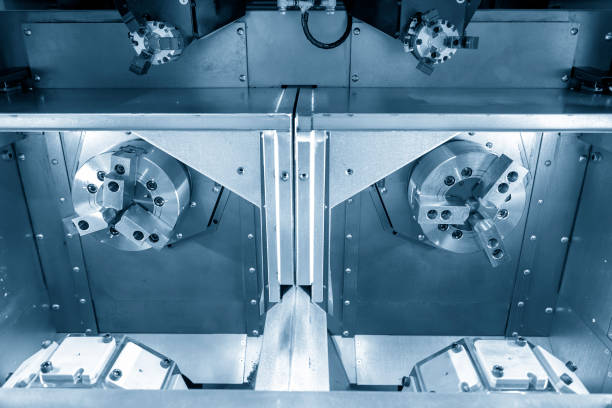
The dual-spindle (Twin Chuck) configuration is the second half of the efficiency equation. Instead of a standard tailstock, these machines feature a sub-spindle that can move forward to “grab” the part from the main spindle.
-
Seamless Handover: The sub-spindle synchronized with the main spindle allows for a part transfer while both are rotating.
-
Back-End Machining: Once the part is transferred to the second chuck, the machine can process the “back side” of the component.
-
Concurrent Processing: Advanced controllers allow the main spindle to start the next part while the sub-spindle finishes the current one.
Consequently, a raw bar goes in one end, and a 100% finished part comes out the other. Furthermore, this automation removes the need for manual intervention mid-cycle. This is the cornerstone of “lights-out” manufacturing for complex geometries.
3. Performance Advantage: Multi-Setup vs. Dual-Spindle Mill-Turn
| Feature | Multiple Machine Setup | Dual-Spindle + Live Tooling |
| Clamping Cycles | 2 or 3 Setups | Single Clamping (“One-Hit”) |
| Accuracy / Concentricity | Risk of Transfer Error | Micron-Level Precision |
| Labor Requirement | High (Loading/Unloading) | Low (Automated Handover) |
| Production Time | Long (Buffer & Transit Time) | Ultra-Short (Single Process) |
4. Ideal Applications for Mill-Turn Technology
This dual-spindle CNC lathe center is particularly effective for high-precision industries where geometric complexity is the norm:
-
Medical Implants: Small, intricate bone screws and valves requiring secondary milling and cross-drilling.
-
Aerospace Fasteners: Complex fittings that need hexagonal flats and internal threads in one go.
-
Automotive Sensors: Housings that require precision bores on both the front and rear faces.
Conclusion: Transforming Complexity into Throughput
Stop wasting time and risking accuracy by shuffling parts between lathes and mills. Instead, embrace the integrated power of professional dual-spindle platforms equipped with live tooling. Consequently, your production line will move faster, your tolerances will be tighter, and your labor costs will drop significantly. Experience the precision of “One-Hit” machining today. Your complex parts deserve a machine that can do it all.