You cut two minutes off the cycle, and the shift report looks great: more parts through the machine, the spindle busier than ever. Then quality closes out the batch, and the scrap bin has eaten the saving and then some.
Your customer only pays for parts that pass inspection, so that’s the number to divide by. Here’s how to compare a faster cycle with a slower one on cost per good part, and how to find the scrap rate at which the faster cycle stops paying.
Divide by good parts, not parts started
JITbase describes something most shops will recognize. The quote says a job will make a 22% margin, and after delivery the ERP agrees, because it calculates from the same routing times the quote was built on. The real cost depends on what happened at the machine: a longer cycle than planned, a second setup, a few scrapped parts. Their fix starts with the denominator. Take everything the batch actually cost and divide it by the parts you shipped.
For a quick comparison between two cycles you can simplify. If every part you start costs the same and nothing gets reworked, cost per good part = cost per started part ÷ yield, where yield is good parts divided by parts started.
Be clear about what your hourly rate includes before you plug it in. If tooling is already inside the rate, don’t add it again per part. If you haven’t built the rate yet, our article on CNC machine hourly-rate calculation walks through it.
Two cycles, one part
Take these illustrative inputs: a $20 blank, $60 an hour for machine and operator together, and $2 of tooling per part, kept outside the hourly rate. Cycle A takes 10 minutes and passes 98% of parts. Cycle B pushes the feeds, takes 8 minutes, and passes 90%.
Illustrative inputs
| Input | Cycle A | Cycle B |
|---|---|---|
| Blank | USD 20 | USD 20 |
| Machine + operator | USD 60/h | USD 60/h |
| Cycle time | 10 min | 8 min |
| Tooling per part | USD 2 | USD 2 |
| Yield | 98% | 90% |
Cycle A uses $10 of machine time, so each part you start costs $20 + $10 + $2 = $32. Cycle B uses $8 and costs $30. On paper, B saves you $2 a part.
Now divide by yield. A comes to $32 ÷ 0.98 = $32.65 per good part. B comes to $30 ÷ 0.90 = $33.33. The faster cycle costs you 68 cents more for every part you can actually ship.
What the good parts cost
| Result | Cycle A | Cycle B |
|---|---|---|
| Cost per part started | USD 32 | USD 30 |
| Cost per good part | USD 32.65 | USD 33.33 |
This assumes every scrapped part ran the full cycle, both cycles wear tools at the same rate, and nothing gets reworked. It also covers only the per-part running costs listed above. Setup and other batch costs come on top, and once they’re spread over different numbers of good parts, they shift the break-even slightly. If your losses happen earlier in the process, or the two cycles use tools differently, swap in your own numbers.
Find the scrap rate where B stops paying
Set B’s cost per good part equal to A’s: $30 ÷ y = $32 ÷ 0.98. That gives y = 91.875%, a scrap rate of 8.125%. Keep B’s scrap under that and it really is cheaper. Let it creep above and you’re paying for the speed in material.
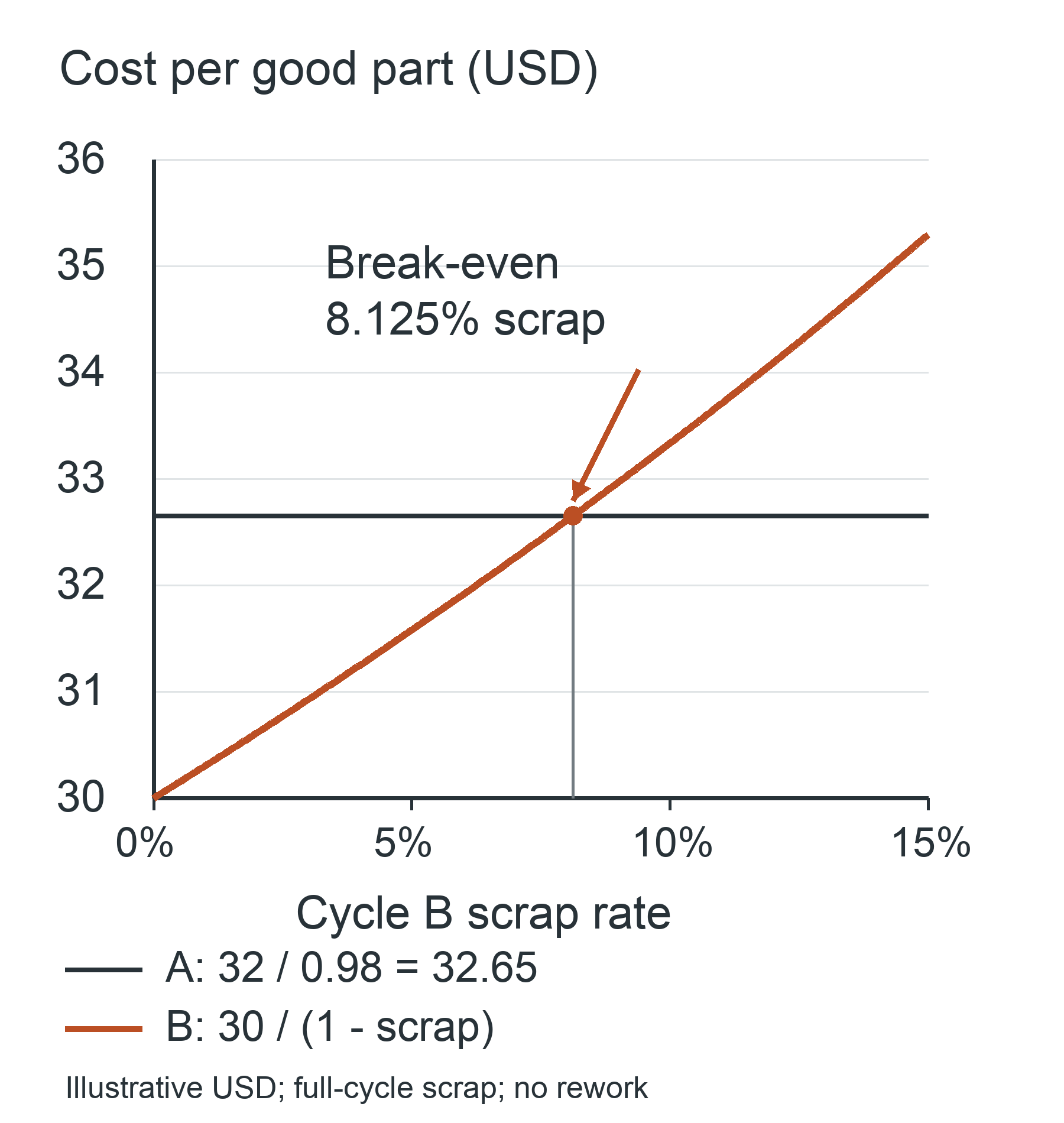
The general version works with any numbers: required yield for B = B’s cost per started part ÷ A’s cost per good part. If that comes out above 100%, no amount of quality work will rescue B. Its cost per part started has to come down as well.
Don’t judge it on one good run. A short batch with zero scrap can hide a loss that only shows up once the tool wears, the shop warms up or the next lot of blanks arrives slightly different. Run the comparison over several batches, and write those conditions next to each yield.
Count each cost once
Where a part gets scrapped matters. A blank rejected after the first operation has used a fraction of the cycle; one rejected at final inspection has used all of it. When your scrap is a mix of both, use the batch’s real cost and real good-part count instead of charging every reject a full cycle.
The opposite mistake is counting twice. If your logged machine hours already include the time spent on parts that were later scrapped, JITbase’s warning applies: don’t add that time again as a separate scrap charge. The same goes for tooling that’s already inside the hourly rate.
Keep freed-up time apart from money earned, too. Two minutes saved per part brings in extra revenue only if you have more work to put on the machine. If the spindle just sits idle for those minutes, count only the costs that really go away, such as power, consumables or overtime. Depreciation and wages don’t shrink with the cycle.
When the break-even tells you to change something
If B stays under the scrap limit across several batches, check that its tool life and inspection load hold up too, then make it the standard. If it’s over the limit, find out where the parts are going before you push the feeds any further.
Rejects that drift steadily in size through the batch are a reason to check tool wear and the machine’s thermal state first. Rejects scattered at random are a reason to look at the fixture, the blanks, the measurement and the cutting edge together.
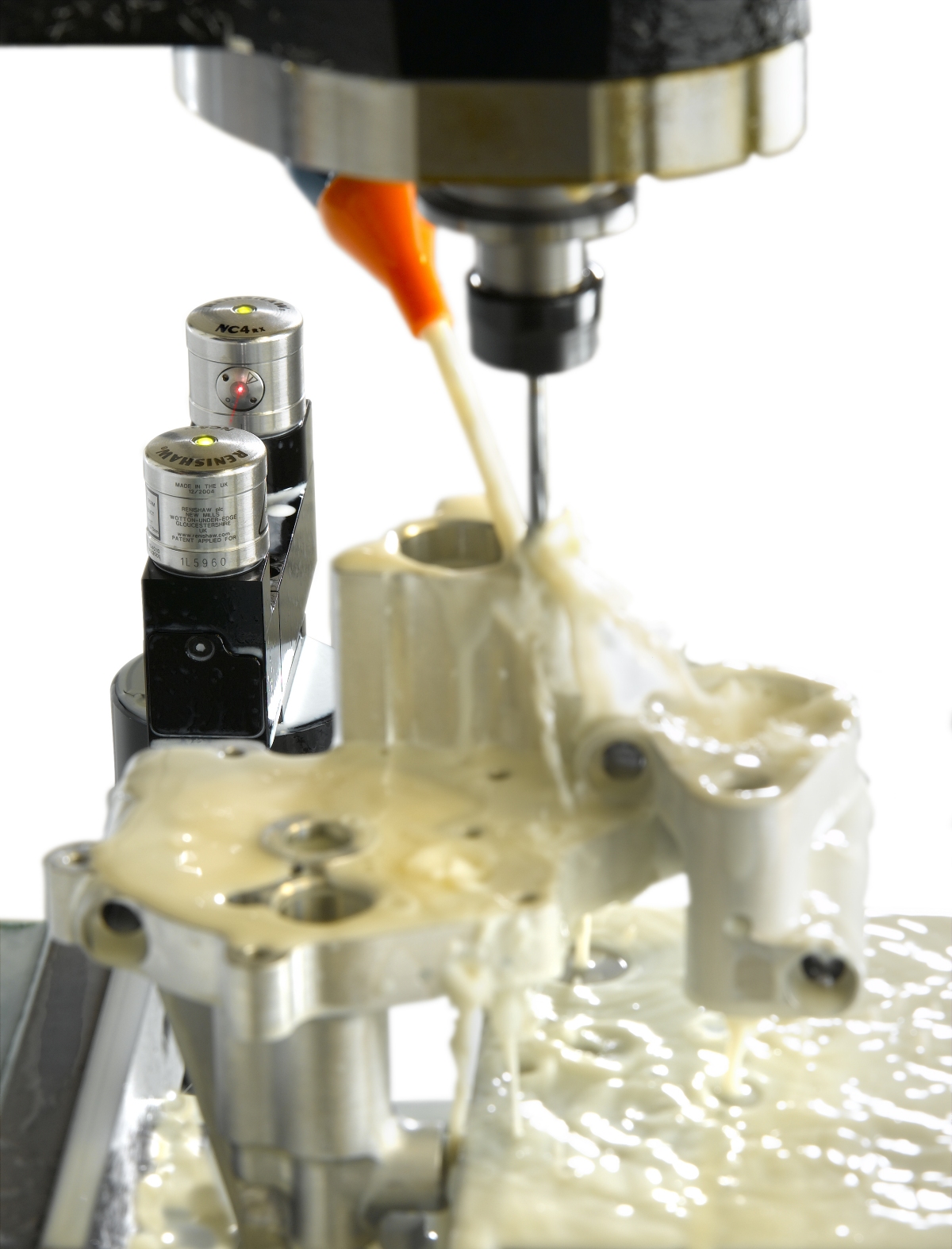
Measurement is worth adding when it catches the defect you’re actually losing parts to. Depending on the system and the cycle you program, a tool check measures length or diameter changes and can catch a broken tool before the next part is cut. It also takes time, so put its cycle into the comparison like everything else.
Set the machine up for the loss you’re fighting
For repeated aluminum parts like these, our V855 gives you 800 × 550 × 550 mm of travel and a 1000 × 550 mm table. Where your scrap records point to setup errors or tool wear, we’d set it up with workpiece probing and tool measurement, and build their cycle time into the estimate from the start.
The same arithmetic tells you whether a measuring step earns its cycle time: if the scrap it prevents costs more per part than the time it adds, it’s worth a full cost comparison that also counts the equipment and its upkeep.
For a machine comparison and quote, send Chansin CNC your drawing, material, annual quantity, started and good-part counts, and how the costs break down on both routes. We’ll work through the configuration and the cycle estimate against the same acceptance requirements you used in your calculation.
Sources and Method
- JITbase: Actual Job Cost in CNC Machining, quoted versus actual cost, dividing by good parts and avoiding double-counted scrap
- CNCCookbook: CNC Machine Hourly Rate Calculator, what goes into an hourly rate
- Renishaw: Tool setting technology, what tool measurement covers
- Featured image: Renishaw
The USD figures and the scrap curve are our own illustrative calculation, not production data or a machine quotation. Costs are divided before rounding to two decimal places.