AI hardware has moved to liquid cooling. NVIDIA’s GB200 NVL72, for example, is a rack-scale, liquid-cooled design. Every one of those chips sits under a cold plate, and a lot of shops that have never made one are now being asked to quote them.
If you’re one of them, the part looks simple: a slab of aluminum or copper with grooves in it. The machining isn’t. A cold plate is mostly small tools, thin walls, lots of holes and a face that has to stay flat. Each of those asks something specific of your machine.
What goes into a machined cold plate
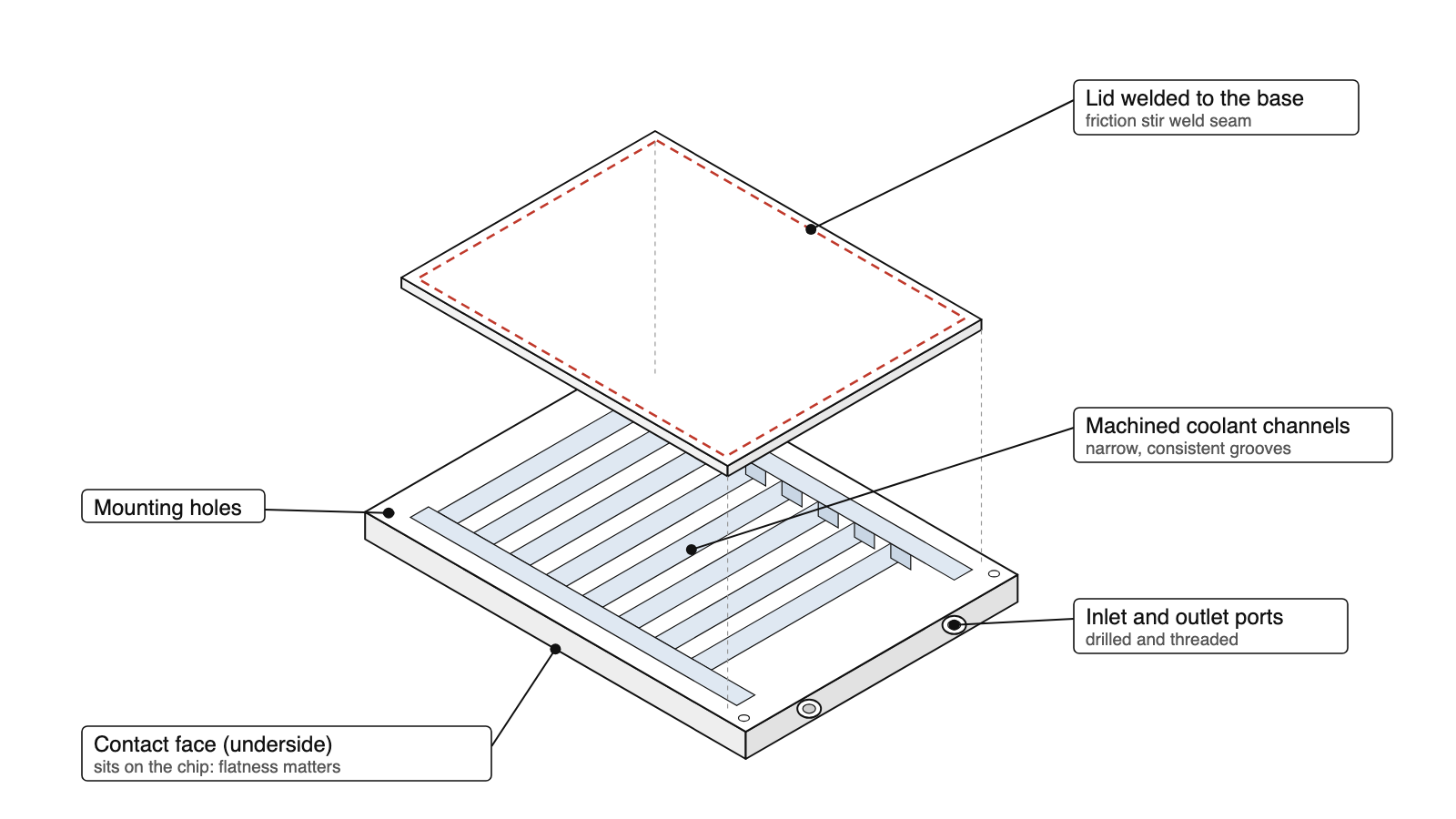
DATRON, a German builder of high-speed machines, describes cold plates as layered aluminum or copper plates with internal liquid channels, where the grooves have to be narrow and consistent for good heat transfer. A common build is a machined base with the channels, ports and mounting holes, and a cover plate joined on top.
That cover is often attached by friction stir welding. As a technical article in EEPower explains, it joins the parts without filler, heats the metal only locally, and runs under CNC control. For you, that means the base has to arrive at welding flat and to size. The weld won’t fix a warped plate.
For the joining and leak-test side, our guide to cold plate joining distortion and leak testing picks up where this article stops.
1. Spindle speed for small tools
Narrow channels mean small end mills. Small end mills in aluminum need rpm to reach a sensible surface speed.
DATRON goes as far as saying spindles under 20,000 rpm are inefficient for cold plates. They build very high-speed machines, so take that with a pinch of salt. But the direction is right: the narrower your channels, the more spindle speed you need.
2. Holding a thin plate flat
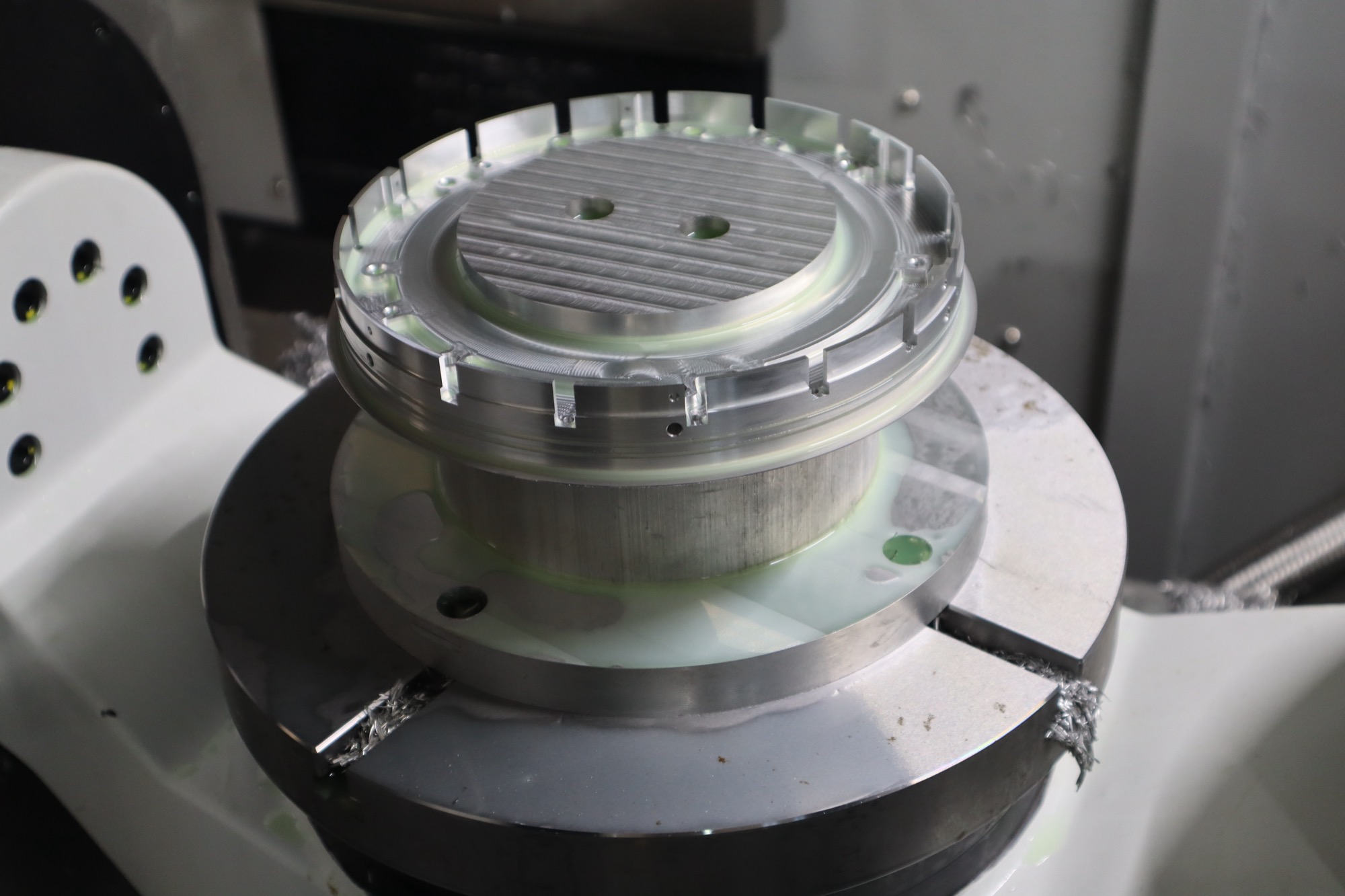
Clamp a thin plate hard at the edges and it bows. Machine it bowed, release it, and your channels and contact face come out uneven.
A vacuum table holds the whole underside evenly instead. That’s why it’s the usual answer for thin, flat parts. On large sheets, a probe can also map the surface so the machine holds channel depth consistent across the plate, a method DATRON uses.
3. Chips out of the channels
Aluminum chips pack into narrow grooves, get recut, and leave burrs right where coolant will later flow. Through-spindle coolant or a strong air blast keeps the groove clear while the tool is still in it.
Don’t count on catching burrs later. Once the lid is welded on, a burr inside a closed channel is very hard to find.
4. Fast tool changes for all the holes
Ports, mounting holes and threads add up to a lot of drilling and tapping on every plate. That’s work for a fast tool changer and a quick spindle, which is exactly what a drill-tap center is built around. Our comparison of drill-tap centers and VMCs covers where each fits.
When machining isn’t the answer
At very high volumes, some cold plates aren’t machined much at all. The same EEPower article describes a design that pairs a cold-forged base with a die-cast top, which virtually eliminates secondary machining. Machining wins on prototypes, short runs and designs that change often, which is where most AI hardware still is.
Three questions before you quote one
- How narrow is your narrowest channel? That sets your smallest tool, and the spindle speed you’ll need.
- How thin is the plate after machining, and how flat must the contact face be? That decides whether you need vacuum holding.
- How many ports and threaded holes are on each plate? That decides how much a fast tool changer will save you.
What we’d set up for cold plates
- Small plates with many holes: a drill-tap center with a 20,000 rpm BT30 spindle and tables from 700 × 420 mm up
- Fine channels in thin plates: a high-speed engraving and milling machine with a 24,000 rpm spindle
- Larger plates and manifolds: a V-series machining center, with 15,000 or 20,000 rpm spindles available on request
- On any of them: a vacuum table, through-spindle coolant and a workpiece probe, all available as options
See our high-speed engraving machines for the fine-channel end of the range.
If you’re quoting cold plates now, send us the drawing and your expected volumes, and we’ll suggest which setup fits.
FAQ
Aluminum or copper for cold plates? Copper moves heat better; aluminum is lighter, cheaper and easier to machine. Many cold plates are aluminum. Copper shows up where the heat load is extreme and weight and cost matter less.
What is friction stir welding? A joining process where a spinning tool softens and stirs the metal along the joint without melting it through or adding filler. It’s CNC-controlled, which suits sealing a cold plate lid evenly.
Can a standard 10,000 rpm VMC machine cold plates? For larger plates with wider channels, yes. As channels get narrower and tools smaller, a higher-speed spindle starts to pay for itself.
Sources
- NVIDIA, GB200 NVL72
- Andreas Engelhardt, New Advances in Friction Stir Welding for Cold Plate Manufacture, EEPower, 2018
- DATRON, CNC Machining Thermal Management Devices