Answer first: Southeast Asia’s medical-technology growth becomes a precision-machining opportunity only after five links are evidenced: a growing regional activity, a specific device or manufacturer, a component that is actually outsourced, defined critical-to-quality requirements, and a qualification path whose cost and production economics fit the supplier. Official output and investment statistics establish the first link. They do not establish the other four, and they cannot be converted directly into demand for a machine tool, a material or a particular machined part.
This article asks a deliberately narrow market question: what evidence should a precision-machining supplier require before treating Southeast Asian MedTech growth as an actionable opportunity? It is not a market-size forecast and does not provide regulatory or legal advice.
What the official numbers actually say
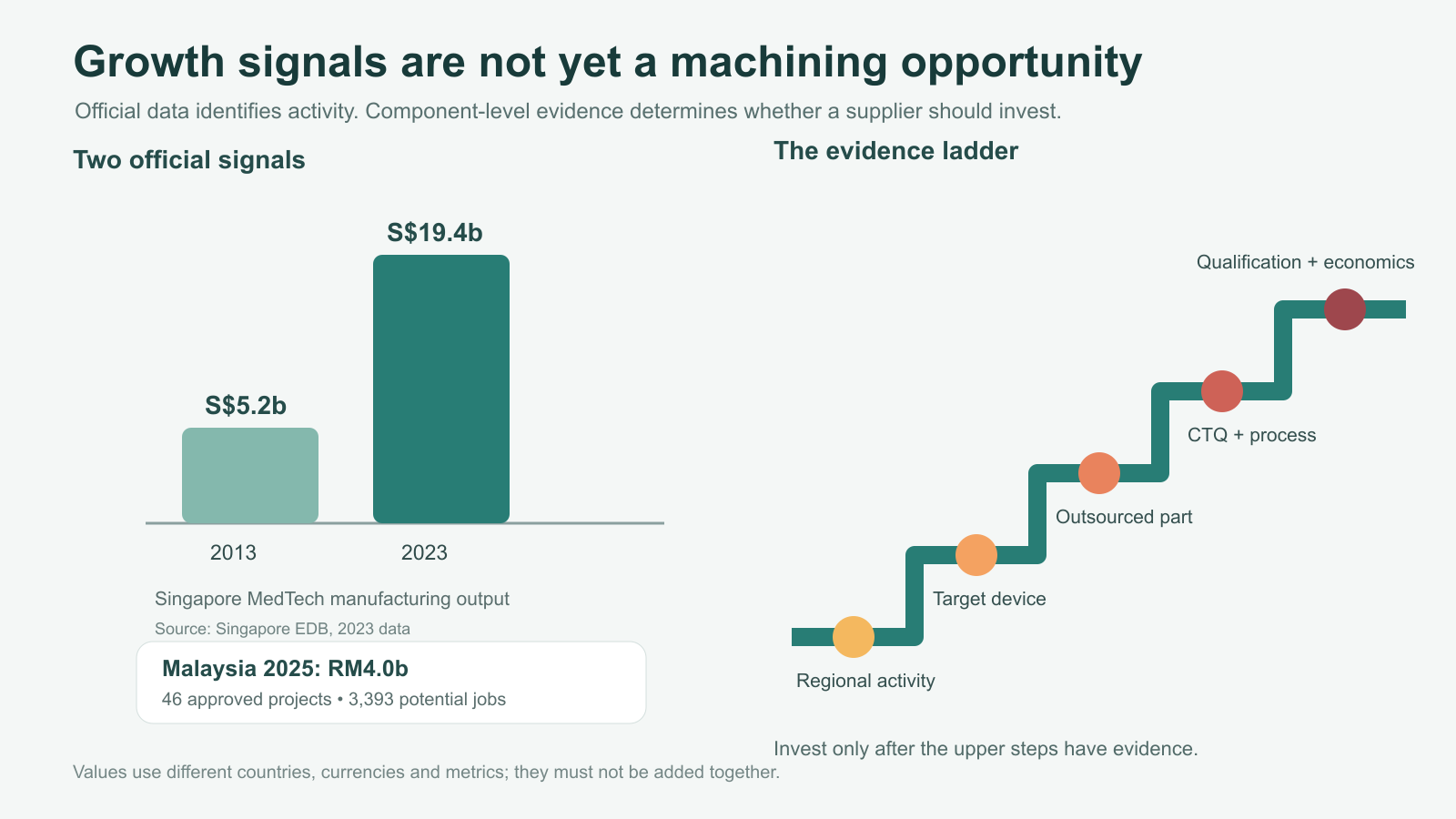
Singapore’s Economic Development Board reports that the country’s MedTech manufacturing output increased from S$5.2 billion in 2013 to S$19.4 billion in 2023. The same official page reports about 17,000 people employed in the sector, more than 400 global and local MedTech enterprises, and an ecosystem of more than 2,700 precision-engineering and electronics-manufacturing-service providers.
The output ratio is 19.4 / 5.2 ≈ 3.73. If the endpoints are treated as a ten-year series, the implied compound annual growth rate is:
(19.4 / 5.2)1/10 − 1 ≈ 14.1% per year
That is a derived nominal growth rate, not an inflation-adjusted market forecast. “Manufacturing output” is also not the same as outsourced precision-machining spend. It can include devices and processes with little CNC content, vertically integrated production, imported components and value added elsewhere in the chain.
Malaysia’s Investment Development Authority reports RM4.0 billion of approved medical-device investment in 2025 across 46 projects, with 3,393 potential employment opportunities. It also separates foreign and domestic investment and new projects from expansion/diversification. These are approved-investment indicators. They do not prove that every project was fully realized, that the capital was spent on machining, or that a local supplier can enter the approved vendor list.
The denominator problem: MedTech is not one machining market
“Medical technology” covers instruments, diagnostic equipment, life-science tools, patient-monitoring systems, contact lenses, software and implantable devices. Even within a mechanical device, the bill of materials can include molded polymers, sheet metal, electronics, optics, purchased fasteners and only a small number of machined parts. A regional sector total provides no denominator for the fraction that is machinable, externally sourced, geographically available or suited to a supplier’s process.
The first meaningful narrowing step is therefore not “Which CNC machine is needed?” It is “Which named device family and which manufacturer are being investigated?” The next step is a component map: which parts are made, which are bought, which suppliers are already qualified, and which functions create measurable quality requirements.
A five-level opportunity evidence ladder
Level 1 — Regional activity
Evidence includes official manufacturing output, approved projects, facilities, employment and ecosystem activity. It answers whether the region deserves attention. It does not identify an order. The Singapore and Malaysia data above pass this level for their respective national ecosystems.
Level 2 — Target device and manufacturer
Identify companies, device families, manufacturing locations, new-product activity and likely supply-chain role. Public product information, facility announcements and technical hiring can support a hypothesis, but they should not be treated as proof of a sourcing event. A device assembled in Singapore may use components produced elsewhere under a global supply agreement.
Level 3 — Outsourced component
Evidence becomes actionable when there is a real mechanical component: drawing family, sample, supplier request, known make-versus-buy decision or credible component architecture. The relevant questions now include material, annual quantity, feature set, special processes, current source and switching barrier. Without this level, an article can discuss industry direction but should not estimate spindle hours or equipment demand.
Level 4 — CTQ and process control
A machined component is not defined only by its geometry. Depending on device and function, requirements may include material traceability, cleanliness, surface condition, passivation or coating, measurement-system capability, process validation, lot records, packaging, change control and control of external special processes. These requirements are not universal. They must come from the product owner, drawing, quality agreement and applicable market.
ISO 13485 specifies a quality-management-system framework for organizations involved in medical-device design, production, installation and servicing. ISO itself notes that certification is not a requirement of the standard. More importantly for a machining supplier, a certificate is not sufficient evidence that a particular operation, measurement or subcontracted special process is controlled for a particular component.
Level 5 — Qualification and economics
At the top of the ladder, the supplier understands sample phases, documentation, process validation, audit expectations, change restrictions, recurring volume, yield risk, liability allocation and time to revenue. A technically machinable part can still be a poor opportunity if qualification cost is high, volume is uncertain, pricing excludes the control burden or a critical special process is unavailable.

Two opposite cases test whether the ladder rejects weak opportunities
Case A — The attractive statistic that stops at Level 1
A supplier sees the S$19.4 billion Singapore output figure and targets “medical parts.” No manufacturer, device or outsourced component is identified. The factory buys a new high-speed machining center in anticipation of demand. After outreach, the discovered opportunities are mostly molded consumables, electronics assemblies and parts locked into existing global contracts.
The ladder would stop the investment at Level 1. The data was accurate; the conclusion was unsupported. The failure was not a weak MedTech market but a missing component-level denominator.
Case B — A smaller signal that reaches Level 5
A manufacturer is transferring assembly of an instrument platform to the region. A supplier receives a family of stainless instrument-housing drawings, expected annual volumes, CTQs, surface-process requirements and a qualification schedule. The supplier can measure the critical bores, has a qualified external finishing route, can segregate lots, and estimates the validation and documentation cost separately from recurring machining.
This case may be smaller than the headline market, but it is an actionable opportunity because the evidence reaches the part, process and economics. Whether it should be accepted still depends on capacity, yield and commercial terms.
How to build evidence without pretending to have private sourcing data
A disciplined public-research stage can narrow the field before direct customer evidence is available:
- Start with official facility, output and project data; keep country, year and metric separate.
- List 10–20 target manufacturers and their actual device families, not a generic “medical” label.
- Identify which device families contain mechanical structures plausibly made by precision machining.
- Separate direct evidence—supplier pages, technical roles, tenders, disclosed partners—from engineering inference.
- Record what evidence would disprove the opportunity, such as vertical integration or a non-machined architecture.
- Delay capacity investment until component, qualification and economics reach the upper levels.
This method is compatible with AI-assisted research because each answer has a defined evidence type. An AI system can summarize official statistics and public device information, but it should not fill missing make-versus-buy, volume or CTQ fields with typical industry assumptions. Unknown fields are decision-relevant results, not gaps to hide.
Quality-system claims require precise wording
The ASEAN Medical Device Directive provides a regional framework intended to harmonize medical-device regulation and common documentation. National implementation and device registration still matter. A component supplier’s obligations depend on its role, the finished device, the markets where it will be placed, and contracts with the legal manufacturer.
For that reason, statements such as “ISO 13485 is required for every medical machining job” or “ASEAN harmonization creates one approval for all countries” are too broad. A better opportunity study asks the target customer which quality-system status, process validation, traceability, inspection records and change controls apply to the exact component and supplier tier.
What the data can and cannot support
| Evidence | Supported conclusion | Unsupported leap |
|---|---|---|
| Singapore output and ecosystem data | A substantial MedTech manufacturing ecosystem exists and expanded over the reported period | A fixed share will become outsourced CNC work |
| Malaysia approved-investment data | Approved medical-device projects and capital activity were recorded in 2025 | All capital was realized or spent on machining |
| ISO 13485 | A medical-device-specific quality-management-system framework exists | A certificate alone qualifies every component and process |
| A component drawing and quality agreement | Concrete CTQs and supplier responsibilities can be assessed | The order is profitable before yield and qualification cost are modeled |
Engineering conclusion
Singapore and Malaysia provide credible evidence that MedTech manufacturing and investment activity are significant. That is a reason to investigate, not a reason to buy capacity or claim expertise in every medical component. An opportunity becomes real only when regional data is connected to a target device, an outsourced part, its CTQs, a qualification route and sustainable economics.
The evidence ladder is designed to reject attractive but unsupported conclusions early. It also prevents a different error: dismissing a technically demanding but well-defined component because its opportunity is smaller than a headline market. For precision suppliers, the most valuable market intelligence is often not a larger forecast. It is a narrower, verified chain from device function to process responsibility.
Sources and Method
- Singapore Economic Development Board, Medical Technology — 2013 and 2023 manufacturing output, employment, enterprise and supplier-ecosystem indicators.
- Malaysian Investment Development Authority, Malaysia Investment Performance Report 2025 — approved medical-device investment, project and potential-employment figures.
- ISO, ISO 13485 — Medical Devices — quality-management-system scope and certification context.
- ASEAN Secretariat, ASEAN Medical Device Directive — regional harmonization objective and regulatory framework.
The 3.73 ratio and 14.1% implied annual rate are calculated from Singapore EDB’s two reported nominal output endpoints. The five-level opportunity ladder and the two cases are original analyses; the cases are hypothetical and contain no customer claim.