Answer first: Semiconductor investment in Southeast Asia is a demand signal, not a precision-machining order forecast. A CNC supplier must pass four filters before treating an announcement as an addressable opportunity: project stage, local value-chain function, part risk, and supplier-qualification evidence. The same investment figure can imply very different work in Singapore, Malaysia and Thailand.
This article asks one research question: when does Southeast Asian semiconductor expansion become a realistic opportunity for a precision-machining supplier? It does not estimate machine-tool sales or claim that a named investment will source components locally.
First remove a common statistical error
Government releases use different measures: fixed-asset investment commitments, approved applications, announced project values and planned full-capacity output. These are not interchangeable with capital already spent, factories already producing or purchase orders available to a machine shop.
Three current signals illustrate the problem:
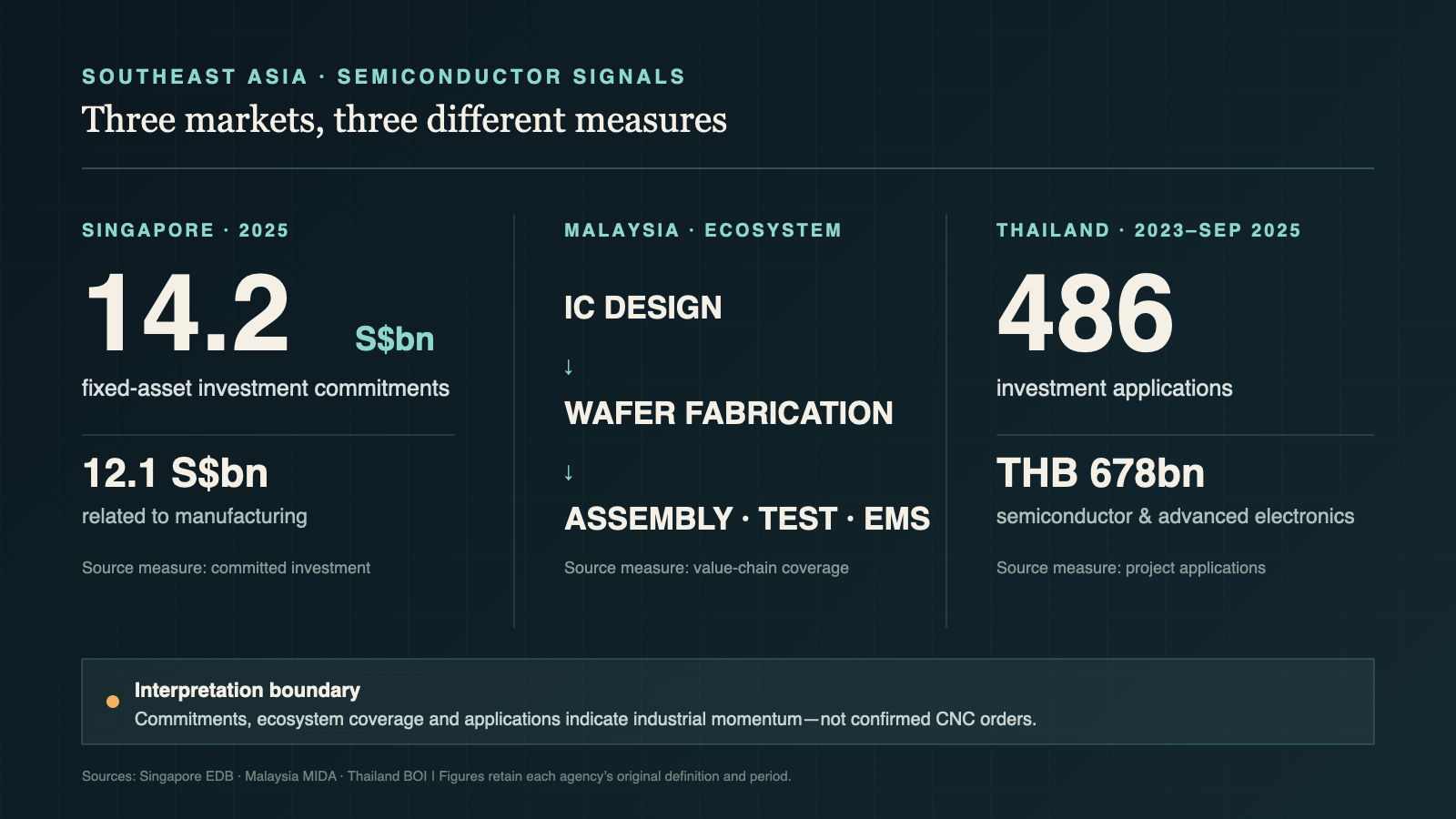
- Singapore’s Economic Development Board reported S$14.2 billion of fixed-asset investment commitments in 2025, of which about S$12.1 billion was manufacturing-related. “Commitments” is the essential word.
- Thailand’s Board of Investment reported 486 semiconductor and advanced-electronics applications totaling THB 678 billion from 2023 through September 2025. These are applications over a defined period, not 486 operating fabs.
- UMC’s Singapore fab expansion was announced with planned phase-one production in 2026, full-capacity output of 30,000 wafers per month and investment of up to US$5 billion. The announcement identifies a real project, but it still does not identify which machined parts will be locally sourced.
A useful article must preserve those statistical labels. Converting “commitment” or “application” into “demand” without the intermediate steps creates a false precision that can misdirect sales and capital spending.
Map the region by function, not by a single growth ranking
The regional ecosystem is distributed. Singapore combines wafer fabrication, equipment, materials and precision-engineering capabilities. Malaysia’s investment reporting describes an ecosystem spanning IC design, wafer manufacturing, assembly and test, and electronics manufacturing services. Thailand’s recent applications include semiconductor and advanced-electronics projects within a broader manufacturing base.
These functions create different machining entry points:
| Value-chain function | Possible machined-part families | Evidence still required |
|---|---|---|
| Wafer fabrication and process equipment | Tool frames, motion components, thermal parts, gas/fluid distribution and chamber-related hardware | Approved drawings, cleanliness/vacuum boundary, material traceability and OEM qualification route |
| Assembly, packaging and test | Handlers, nests, tooling plates, alignment components and automation structures | Process contact, wear, ESD, thermal and measurement requirements |
| Equipment build and refurbishment | Replacement mechanical parts, brackets, covers, manifolds and motion-system components | Configuration control, reverse-engineering permission, service-life and contamination limits |
| Facility and utilities | Skids, supports, heat-transfer and utility-distribution hardware | Applicable pressure, welding, material and facility standards |
The table deliberately says “possible.” The investment source does not prove the local-content share, buyer list, component drawings, volume or supplier geography.
Use part risk to estimate the qualification burden
“Semiconductor part” is too broad to be an engineering category. A machine base outside the process environment and a process-wetted vacuum component can both be machined metal, yet their failure consequences and evidence requirements are very different.
| Screening tier | Typical function | Failure concern | Likely evidence burden |
|---|---|---|---|
| Tier 1: external structural | Frames, guards and non-process supports | Fit, stiffness, safety and assembly access | Drawing control, material evidence, dimensional report and finish requirements |
| Tier 2: precision functional | Motion, alignment, thermal or metrology interfaces | Drift, runout, flatness, wear or thermal error | Capability data, calibrated inspection, controlled finishing and change management |
| Tier 3: process critical | Vacuum-facing, gas/fluid-wetted or contamination-sensitive parts | Leakage, particles, outgassing, chemistry or process excursion | Drawing-specific cleanliness, leak/vacuum, surface, traceability, packaging and validated special processes |
A supplier should not claim Tier 3 capability simply because it can machine the geometry. Machining is only one operation in a chain that may include material certification, special cleaning, controlled handling, leak testing, surface treatment, packaging and configuration control.
Convert an investment signal into a four-gate opportunity record
A practical research record should pass four gates:
- Project gate: distinguish announcement, application, construction, equipment installation, ramp and operating phase.
- Function gate: identify whether the project is design, fabrication, packaging/test, equipment, facilities or another function.
- Part gate: name a component family and assign a provisional risk tier.
- Qualification gate: identify the buyer, drawing owner, required evidence, approved special processes and realistic qualification time.
If the record cannot name a part family or qualification route, it remains market intelligence rather than a sales-qualified manufacturing opportunity.
A worked comparison: two parts under the same fab announcement
Imagine one new fab project creates interest in two hypothetical parts: an external equipment frame and a vacuum-facing manifold. Both may require CNC machining, but the opportunity is not equivalent.
The frame can often be screened from size, material, stiffness, interface and dimensional-report requirements. The manifold requires additional questions about wetted material, internal passages, sealing surfaces, joining, cleaning, allowable residues, leak method, packaging and any customer-approved suppliers. A shop may be ready for the first part and unqualified for the second even if both fit within its machine travels.
This comparison prevents two opposite errors: rejecting the whole semiconductor sector because the most critical parts appear inaccessible, or accepting process-critical work based only on geometric capacity.
What the public data can and cannot support
| Public evidence | Supported conclusion | Unsupported leap |
|---|---|---|
| Investment commitments/applications | Capital interest and project pipeline exist | A fixed amount of local CNC orders will follow |
| Named fab capacity and start date | A project has a defined operating target | The supplier list and part volumes are known |
| Regional value-chain description | Different supplier categories may be relevant | Every country offers the same part mix |
| A machine shop’s geometric capability | Certain parts may fit its physical process envelope | It is qualified for vacuum or contamination-critical work |
Engineering conclusion and limits
The strongest Southeast Asia semiconductor opportunity analysis is not a list of investment totals. It is a traceable chain from project stage to regional function, from function to a defined part family, and from part risk to a realistic qualification path. This method shows where to investigate without pretending that public investment data reveal future purchase orders.
The remaining unknowns—local sourcing policy, buyer identity, part volume, drawing requirements, qualification duration and commercial competition—must be resolved before capacity or revenue decisions are made.
Sources and method
The investment figures and labels come from the Singapore EDB 2025 review, the Singapore EDB/UMC expansion announcement, the Malaysia Investment Performance Report 2025 and Thailand BOI investment material. The four-gate opportunity record and three part-risk tiers are original screening frameworks. They are not official country rankings, semiconductor standards or demand forecasts.