In the high-precision manufacturing sector, particularly when dealing with titanium alloys, Inconel, or medical-grade stainless steel, the cost of raw materials often accounts for a significant portion of the total production budget. For years, engineers have accepted “remnant loss”—the unusable tail end of a bar remains in the spindle—as an unavoidable cost of doing business.
However, as global competition intensifies and material prices fluctuate, “good enough” utilization is no longer sufficient. The emergence of the dual-spindle Swiss-type CNC machine has fundamentally redefined the economics of bar machining. By employing a “head-to-head” relay processing technique, these machines allow for the near-total consumption of bar stock. This article dives into the mechanics of dual-spindle synchronization and how it transforms what once was “expensive scrap” into “direct profit,” pushing material utilization to a staggering 99% limit.
1. The “Tail-End” Problem: Why Traditional Spindles Waste Money
To appreciate the dual-spindle advantage, we must first look at the mechanics of a traditional single-spindle Swiss-type lathe.
The Physics of the Remnant
In a standard configuration, the bar stock is fed through the main spindle and held by a collet. To maintain the rigid clamping necessary for high-precision turning, a certain length of the bar—the “tail”—must remain inside the collet. Once the bar feeder pushes the material to its physical limit, the last 50mm to 120mm of material cannot be reached by the cutting tools without risking a collision or losing clamping force.
The Hidden Cost of High-Value Alloys
For a shop processing 1,000 parts from $500-per-bar titanium, a 100mm remnant on every 3-meter bar represents a permanent $15 to $20 “tax” on every cycle. Over a year of 24/7 production, this “scrap tax” can amount to tens of thousands of dollars in lost revenue. In an industry where margins are measured in cents, this waste is the primary barrier to achieving a truly optimized bottom line.
2. The “Relay” Logic: How Dual-Spindle Synchronization Works
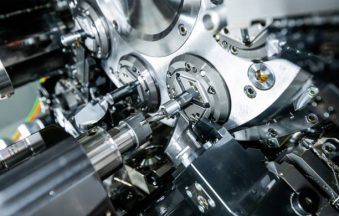
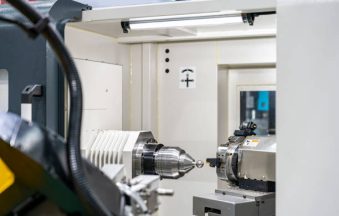
The dual-spindle Swiss-type CNC machine solves this by introducing a secondary, or “sub-spindle,” that acts as a synchronized partner to the main spindle. This enables a “Head-to-Head” (or Hand-off) workflow.
Phase 1: Front-End Mastery
The main spindle (Spindle 1) grips the bar stock and performs the primary turning, threading, and milling operations on the front portion of the part. Because it is a Swiss-type machine, the sliding headstock ensures the cutting happens right next to the guide bushing, providing maximum rigidity.
Phase 2: The Synchronized “Handshake”
As the first part of the piece is completed, the sub-spindle (Spindle 2) moves forward along the Z2 axis. It synchronizes its rotation speed perfectly with Spindle 1. Once synchronized, Spindle 2 clamps onto the finished front end of the part.
Phase 3: The Rear-End Finish and Parting
With the part held firmly by both spindles, the cutoff tool (parting tool) separates the part from the main bar. However, the story doesn’t end there. Spindle 2 then retracts with the semi-finished part to perform back-end operations (such as drilling, boring, or back-milling), while Spindle 1 immediately begins the next part.
3. Pushing the 99% Limit: The Final Inch
The true magic of the dual-spindle system occurs when the bar feeder reaches the end of a bar.
-
Continuous Clamping: In a “head-to-head” mode, when the bar is too short for the main spindle to hold safely for the final operation, the sub-spindle takes over the primary clamping duty.
-
Minimal Remnants: Because the sub-spindle can “pull” the remaining nub of the bar through the guide bushing, the machine can process the very last piece of the bar.
-
Results: The “dead zone” of the bar is reduced from over 100mm to essentially the width of the parting tool (usually ) plus a tiny sliver for the final collet grip. This is how utilization moves from the traditional 85% – 90% to an incredible 99%.
4. Economic Impact: Converting Scrap into Direct Profit
Let’s look at the mathematical reality of upgrading to a dual-spindle Swiss-type CNC machine for high-volume production of long-shaft parts.
The Mathematical Example
Imagine a production run for a medical bone screw made from Grade 5 Titanium.
-
Bar Length:
-
Part Length: (including parting allowance)
-
Traditional Remnant: (4 potential parts lost)
-
Dual-Spindle Remnant: (0.1 parts lost)
By recovering those 4 parts per bar, the manufacturer essentially gains “free” inventory. Over 500 bars, that is 2,000 extra parts produced without buying a single extra gram of titanium. The dual-spindle machine doesn’t just save material; it increases the total output capacity of the raw material investment.
5. Beyond Savings: Complexity and Precision
While material utilization is the “headline” benefit, the dual-spindle architecture provides secondary advantages that are equally vital for elite CNC shops.
-
Elimination of Secondary Operations: By completing the “back-work” on Spindle 2, the part drops off the machine finished. This eliminates the need for manual secondary labor or a second machine setup, which further reduces the risk of human error and part damage.
-
Increased Concentricity: Because the “handshake” between spindles occurs while the part is rotating in perfect sync, the concentricity between the front and back features is maintained within microns. This is a critical requirement for aerospace connectors and high-speed rotary components.
-
Complex Geometry Support: Dual-spindle machines often feature independent tool posts for the sub-spindle. This allows for simultaneous machining—Spindle 1 turns the next part while Spindle 2 mills the previous one—drastically reducing total cycle time.
6. Conclusion: The New Benchmark for CNC Efficiency
In the modern manufacturing landscape, the “Zero Waste” goal is no longer a sustainable ideal; it is a competitive necessity. The dual-spindle Swiss-type CNC machine represents the peak of this philosophy. By mastering the “Head-to-Head” relay, these machines allow manufacturers to extract every possible cent of value from every millimeter of bar stock.
Maximizing material utilization to 99% does more than reduce waste. It shields your supply chain from material price fluctuations. At the same time, it boosts factory output and maintains geometric precision. In high-value CNC machining, the dual-spindle relay drives profitability.
It’s not just a feature—it’s the key to optimizing production efficiency.