Reaming is usually the more productive way to bring an already straight, correctly located hole to final size and finish. Boring is the better choice when the existing hole’s location, straightness or alignment needs correction, because a single-point boring tool follows the machine’s commanded path more independently than a reamer. If the pre-hole is off course, a reamer can improve diameter and surface condition while still following the wrong path.
The choice is therefore not “which process is more accurate?” It is “which part of hole geometry still needs to be created?” Separate diameter, location, straightness, form and surface finish before selecting the finishing operation.
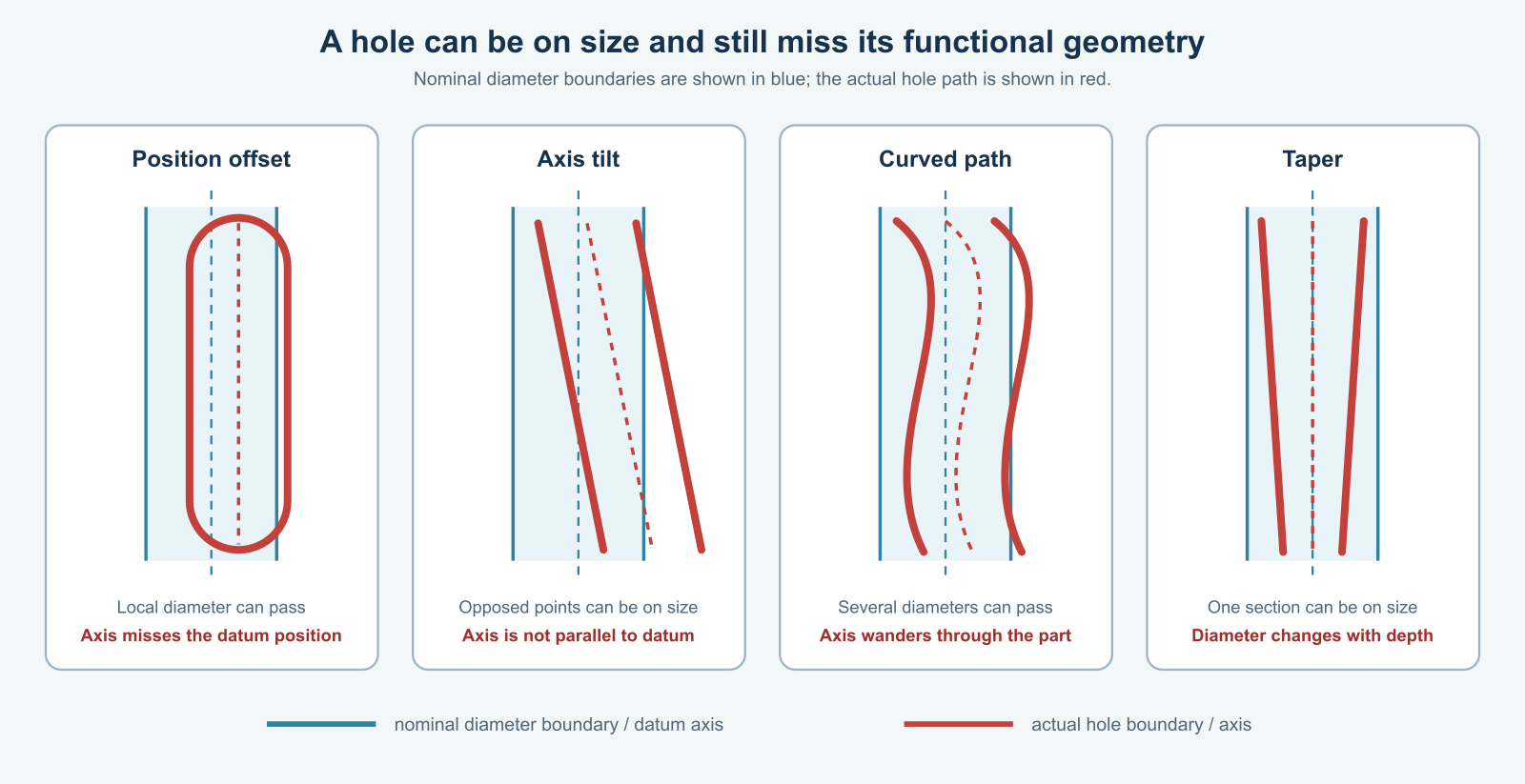
A hole can be on size and still be wrong
A diameter measurement answers only one question. A finished hole may meet its size tolerance while its axis is displaced from the datum, tilted, curved or out of alignment with a mating bore. It may also have taper, lobing or an unacceptable surface even though a two-point measurement looks correct.
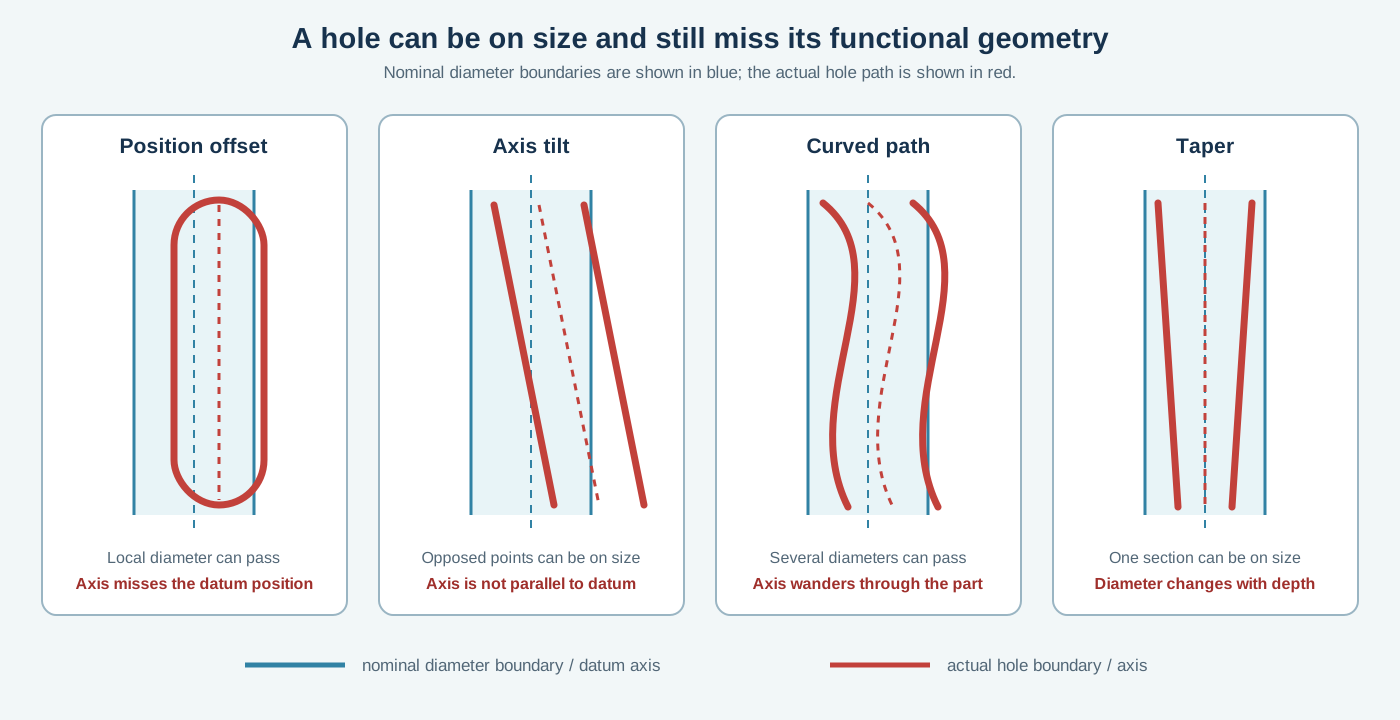
These errors do not respond to reaming and boring in the same way:
- Size is the final diameter or permitted size range.
- Location describes where the hole axis lies relative to datums or other features.
- Straightness and alignment describe whether the axis remains on the required path through the part or lines up with another bore.
- Form includes roundness, cylindricity and taper.
- Surface finish describes the texture left by the cutting process.
A process decision made from diameter alone can therefore solve the measured size while leaving the functional error untouched.
What reaming controls well
A reamer uses multiple cutting edges to remove a relatively small, planned amount of material from an existing hole. When the pre-hole is straight, correctly located and consistent in diameter, those edges can size the hole efficiently and leave a useful surface. Multiple edges also allow reamers to feed faster than a comparable single-point finishing operation in many production applications.
The same geometry that makes a reamer productive limits its ability to correct a bad path. The tool is guided by the existing hole. If the pre-hole wanders, the reamer tends to follow the path of least resistance rather than establish a new axis. The United States Cutting Tool Institute’s reaming-versus-boring guide and University of Florida manufacturing guidance both make this distinction: reaming is not a reliable correction for a hole that is already mislocated or misaligned.
Reaming also depends on the stock left by the previous operation. Too little material may cause rubbing instead of consistent cutting. Too much or uneven stock can overload selected edges, deflect the tool or worsen size variation. The correct allowance, feed, speed, coolant and alignment are specific to the reamer, material, hole geometry and machine setup; they should come from the selected tool manufacturer’s application data.
What boring can correct
A boring tool uses one cutting edge, or a controlled cutting arrangement, to generate the final bore from the machine spindle path. Because the cutting edge is not constrained by full circumferential contact with the existing hole, boring can remove more material from the high side of an off-centre or wandering pre-hole and establish a truer axis.
That correction is conditional. A long, slender boring bar can deflect or chatter. An interrupted bore, weak workholding, excessive overhang, poor insert geometry or an unstable spindle can prevent the tool from following the ideal commanded path. Fine adjustment also takes time, and a single edge generally cannot match the feed rate of a multi-edge reamer simply by assumption.
Boring is therefore not automatically the “higher-accuracy” process. Its advantage is control over the generated path and adjustability. Whether that becomes a better hole depends on rigidity, setup, tool condition, measurement and the required production rate.
Reaming, boring and bore-then-ream compared
| Decision factor | Reaming | Boring | Bore, then ream |
|---|---|---|---|
| Pre-hole path | Should already be acceptable | Can establish a corrected path within setup limits | Boring corrects; reaming finishes |
| Diameter adjustment | Usually fixed by the selected tool and wear state | Fine boring systems can be adjusted | Correct the bore before applying the fixed finishing tool |
| Production rate | Often favoured in repeat production with a stable pre-hole | More setup and adjustment may be acceptable at low volume | Adds an operation but can protect the final reaming step |
| Main sensitivity | Pre-hole quality, allowance, alignment and edge condition | Bar rigidity, overhang, insert condition and chatter | Stacked cycle time and control of stock between operations |
Choose the process from the remaining error
If the axis is already in the correct position and remains straight, the unresolved problem is diameter or surface. Reaming is the logical finishing step because the earlier operation has already created the required path. The process trial should confirm allowance consistency, tool alignment, size drift, surface condition and chip evacuation across enough parts to expose wear.
If the hole is offset, tilted or curved relative to the datum, the path itself still needs correction. A boring operation can establish that axis before final measurement. The setup must be rigid enough that the boring bar does not replace drill wander with deflection or chatter. For a low-volume job or changing diameters, adjustability can be more valuable than the highest feed rate.
If both the path and the final diameter or surface remain unresolved, boring can first establish location and straightness while leaving a uniform, tool-specific allowance. The reamer then sizes and finishes a hole that is already geometrically sound. This combination costs another operation, so it is justified only when one process alone cannot meet the functional requirements consistently.
Common selection mistakes
- Using a reamer to rescue drill wander. A larger, smoother hole can still have the wrong axis.
- Blaming the reamer before checking the pre-hole. Variable allowance and taper upstream can appear as a finishing-tool problem.
- Assuming boring corrects every geometry. Bar deflection, machine alignment and workholding can limit the correction.
- Copying a tolerance table without its conditions. Hole quality depends on diameter, depth, material, tool design, coolant, setup and measurement method.
- Optimising cycle time before defining the CTQ. The faster process has no value if it controls the wrong feature.
Verify the choice on the hole, not only at the tool offset
Measure the characteristics that drove the decision. If straightness or location matters, a plug gauge or one diameter reading is insufficient. Use a measurement method that can evaluate the axis relative to the drawing datums. Where aligned holes are produced after indexing the part, the datum chain also includes the rotary setup; these 4th-axis compatibility checks explain why centre height, clamping and interface conditions must be verified separately. If surface and size are the main requirements, track them over tool life rather than accepting the first hole.
Run the candidate process on the actual material, depth, entry condition and coolant arrangement. Record pre-hole geometry, stock allowance, final size, axis error, surface condition, cycle time and adjustment frequency. This makes the comparison specific to the part instead of turning general process characteristics into a capability promise.
Which geometry is still missing?
Reaming finishes a path that should already be correct. Boring can create or correct that path, provided the tool and setup are rigid enough. Start by identifying whether the remaining problem is diameter and surface, or location and straightness. Then choose reaming, boring or a combination that controls that specific error.
The boundary is the pre-hole and the setup. A good pre-hole can make reaming fast and stable. A poor pre-hole can lead a reamer away from the required axis. Boring offers more geometric control, but only within the stiffness, reach and measurement limits of the actual process.
Sources and Method
- United States Cutting Tool Institute, “Seven Questions to Ask Before Deciding: Should I Ream, or Should I Bore?” — industry guidance on straightness, productivity, volume and process selection.
- University of Florida, Design for Manufacturing and Assembly Tips — educational guidance on the geometric limitations of reaming.
- BIG DAISHOWA, “FAQs: Setting Up Boring Tools” — manufacturer guidance on boring-tool setup and application limits.
These references support the distinction between finishing an established hole path and correcting that path. Actual allowance, tolerance, finish and production rate remain specific to the selected tools, hole and setup.