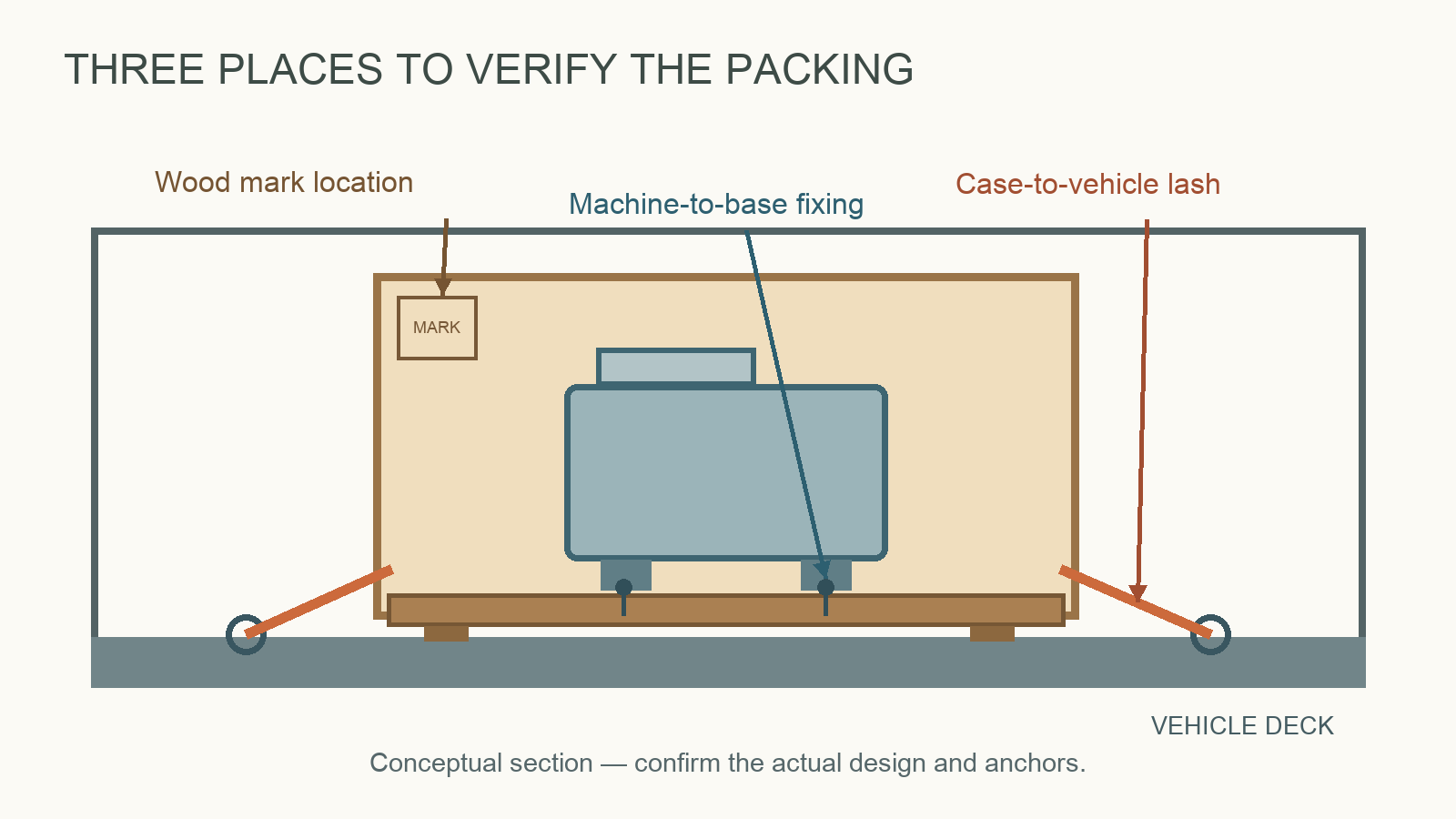
A CNC machine export crate needs three separate checks before it is closed: the wood packaging must suit the destination, the machine must be restrained inside the crate, and the loaded crate must be secured in the transport unit. A treatment mark on a wooden case addresses a plant-health question; it says nothing about whether a heavy machine can shift at sea. Ask for evidence of each layer while the fixing points are still visible. The actual design and restraint calculations belong to the packing and transport specialists working with the machine’s confirmed weight, centre of gravity, route and handling method.
Start with the route, not the crate photograph
Before anyone builds a packing list, confirm where the machine will travel, how it will be handled and who is responsible for the crate and container loading. A short road move, an ocean container and a later warehouse lift expose the package to different handling. The machine maker should provide verified mass, lifting and tie-down information for the exact configuration. The crate designer and freight team can then state how those inputs are used. If the machine’s centre of gravity or shipping mass has not been confirmed, a reassuring photograph cannot close that gap.
Keep the machine, its loose accessories and the crate itself distinct in the review. A tool changer component, guard or transformer may need its own identification and restraint. A box that looks intact from outside does not prove these items are secured inside.
Layer one: what wood is actually in the package?
ISPM 15 covers wood packaging made from raw wood used in international trade, including crates, pallets and dunnage. Packaging made wholly from processed wood such as plywood or particle board is among its listed exemptions. A crate may combine processed panels with raw-wood skids or blocks, so the material check must cover every component rather than the panels alone. Ask the packer to identify the materials, show the relevant marks on regulated components, and confirm the destination’s current import requirements with the responsible logistics party.
The standard’s mark combines the IPPC symbol, a country code, a producer or treatment-provider code, and a treatment code. It identifies approved phytosanitary treatment and marking; it does not rate the crate’s structure or moisture protection. If repaired or remanufactured wood packaging is used, the treatment and marking status needs another look.
Layer two: how is the machine restrained inside?
Request a drawing or annotated packing plan that identifies the machine support points, restraints and load path into the crate base. The plan should say which components are immobilised, which parts are removed for shipment, and how movement in different directions is resisted. It should also identify any protection used at contact points so the restraint does not damage a precision surface.
Photograph the machine after it is fixed but before side panels hide the connections. Images should show the base, restraint attachments, protected surfaces and separately packed accessories. Ask the packing team to identify each image against the packing plan. A list of photographs without a drawing can still leave the buyer unsure what the straps are attached to.
Layer three: how is the loaded crate held in the container?
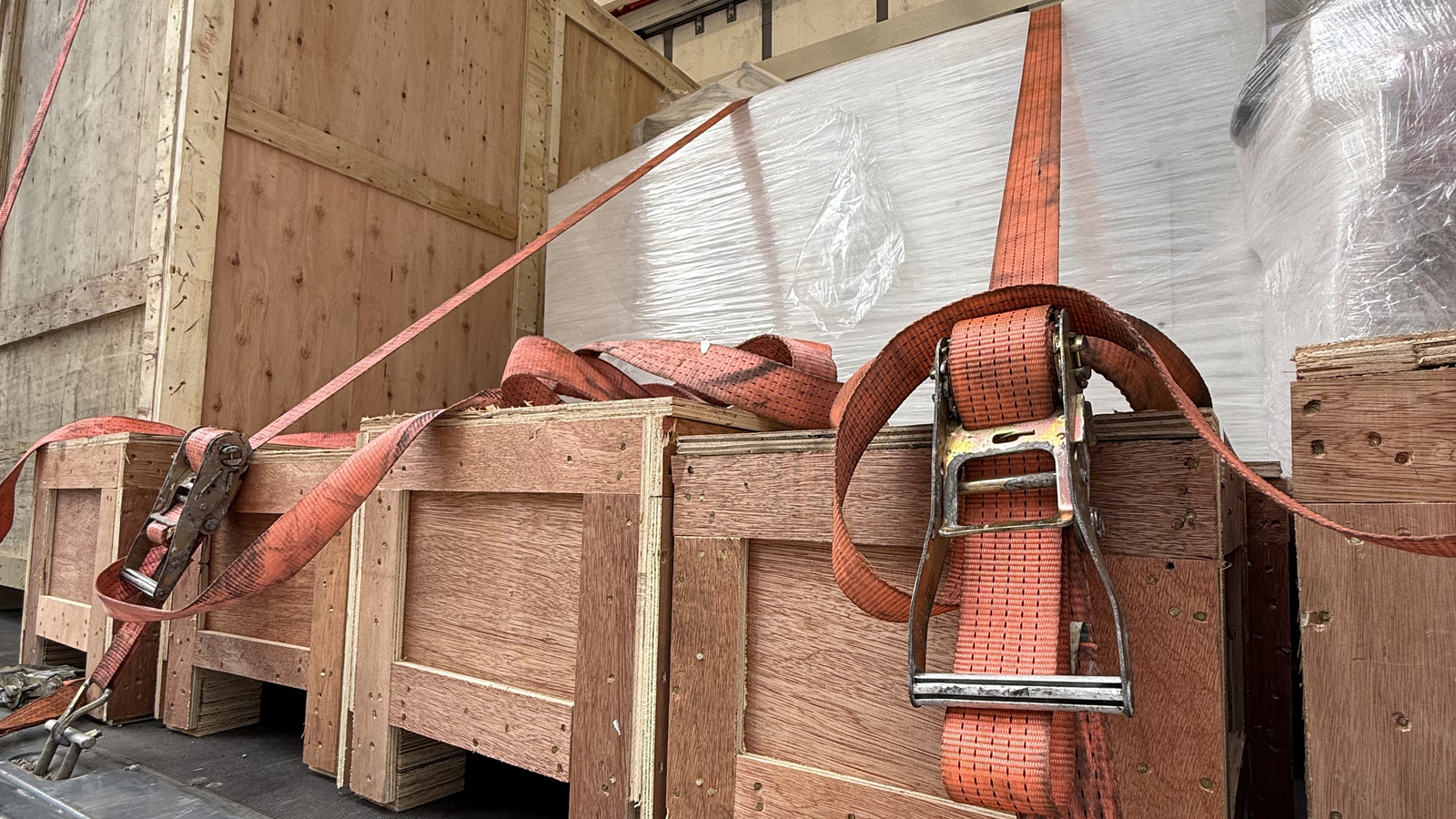
The IMO/ILO/UNECE CTU Code offers guidance for packing and securing cargo transport units. Its guidance is non-mandatory in itself; contracts, carriers and local rules may add requirements. The practical question is whether the loaded case can move, tip or impose an unexpected load on the container during the planned journey. Its mass alone is not a securing method.
Ask the container packer for the loading position, the restraint method, any dunnage arrangement and the final loaded-unit photographs. The plan should account for lifting and unloading access at the destination, not only the outbound forklift move. A machine can be well fixed to its crate while the crate is poorly secured in the container. Conversely, a container plan cannot repair loose accessories inside the case.
A small evidence pack before the lid closes
| Question | Evidence to request | Who should confirm it |
|---|---|---|
| Are the packaging materials suitable for the route? | Material list, applicable ISPM 15 marks and destination check | Packer and destination logistics specialist |
| Can the machine move within the case? | Configuration-specific restraint plan and open-crate photographs | Machine maker and crate designer |
| Can the case move within the transport unit? | Container loading and securing plan with final photographs | Container packer or freight specialist |
| Can it be identified and unloaded safely? | Verified mass, dimensions, lifting information and accessory inventory | Machine maker, packer and receiving team |
If one party owns more than one step, keep the evidence separate anyway. This prevents a single “packed” sign-off from concealing an unreviewed interface. A buyer can use the table to request whichever record is missing.
What should make you pause shipment?
Pause the packing sign-off when the quoted mass differs from the shipping configuration, when raw-wood components cannot be identified, or when the fixing points disappear behind panels before anyone documents them. Also pause if nobody can say who secures the crate inside the container. These are information gaps that should be resolved before closure, because inspection becomes harder afterwards.
For unusual machines, mixed cargo or changing routes, the simple three-layer review still applies but the solution may be different. Ask the responsible specialists to revise the design and evidence for the actual shipment. The goal is a traceable handover: what was packed, how each layer was restrained, and who verified it at the point when it could still be seen.
Sources and method
The wood-packaging questions draw on IPPC ISPM 15; the cargo-securing questions draw on the IMO/ILO/UNECE CTU Code.