

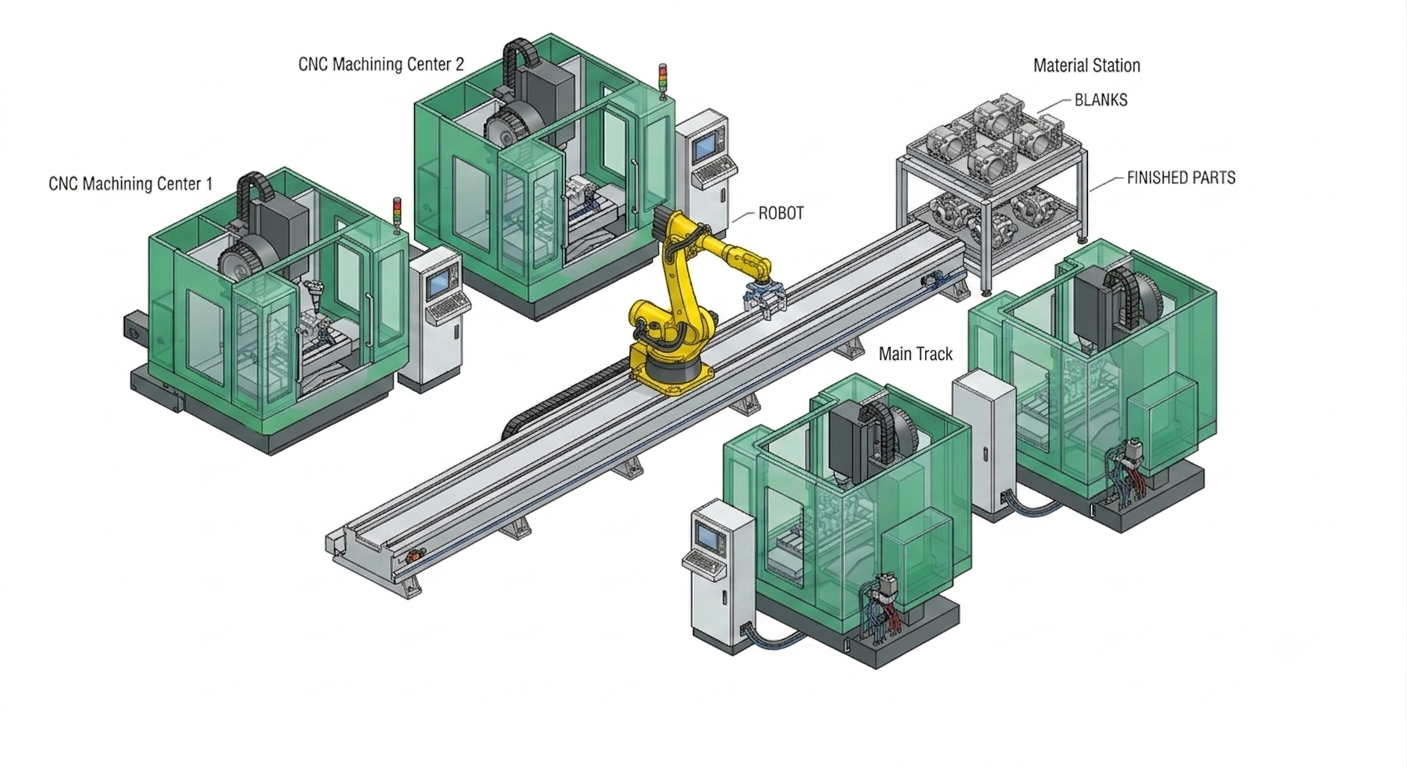
Machine tending automation can reduce repetitive handling around CNC equipment, improve process consistency, and help a shop make better use of available production hours. But automation is not a bolt-on answer to every staffing or capacity problem.
The most successful projects begin with a stable machining process. Before selecting a robot, gantry system, or multi-machine cell, manufacturers should understand the part flow, cycle time, clamping method, quality checks, and failure points in the existing operation.
Start With the Production Problem
Automation should solve a defined operational problem. Common triggers include repeated manual loading, inconsistent part handling, long unattended periods between cycles, high operator movement between machines, or difficulty maintaining output across shifts.
Write the problem in measurable terms. For example: “One operator must manually load two repeat part families with similar cycle times” is more useful than “We need a robot.” It gives the team a starting point for evaluating layout, part presentation, gripper design, and operator responsibilities.
Is the Part Suitable for Automated Tending?
Not every part should be automated first. Good candidates are usually stable, repeatable, and easy to present in a consistent orientation. Review the following:
- Part size, weight, and center of gravity;
- surface condition and sensitivity to handling marks;
- orientation requirements;
- raw-part variation;
- clamping repeatability;
- chip accumulation and coolant carryover;
- cycle time and loading time;
- inspection points and rejection handling.
A highly variable part may still be automated, but it generally requires more sensing, fixturing, or operator intervention than a stable repeat job.
Robot Loading or Gantry Loading?
Both approaches can be effective. The best choice depends on layout, part flow, payload, machine access, flexibility requirements, and the number of machines involved.
Robot Loading
A robot can be useful when the cell may need to change over to different parts or when the layout requires flexible reach. It may handle loading, unloading, simple part transfer, and in some cases secondary tasks such as marking, air cleaning, or presentation to an inspection station.
The real question is not simply whether a robot can reach the door. Review its motion path, gripper clearance, part presentation, safety guarding, recovery process, and maintenance access.
Gantry Loading
A gantry system can be considered when parts move through a more linear, repeatable flow or when several machines are arranged in a predictable cell layout. It may be a practical option for specific workpiece sizes and high-repeat processes.
Its suitability depends on the available overhead space, machine arrangement, load requirements, and how the material enters and exits the cell.
Eight Conditions to Confirm Before You Automate
1. Process Stability
The machining cycle should be consistent enough to support unattended operation. Frequent manual adjustments, unpredictable tool wear, or recurring chip problems should be addressed before automation is added.
2. Workholding
Fixtures must locate and clamp reliably. If an operator currently “feels” whether a part is seated correctly, the process needs more definition before a robot can take over.
3. Part Presentation
Raw parts must arrive in a repeatable position. Trays, pallets, conveyors, racks, vision systems, or simple locating devices may be needed depending on part geometry.
4. Tool and Material Management
An automated cell can stop because of a missing tool, worn insert, blocked coolant path, or empty material queue. Plan how these conditions will be detected and handled.
5. Quality Control
Decide where inspection occurs. Some processes need in-cycle probing, post-process gauging, sampling, or operator checks. The inspection plan should be part of the automation concept, not an afterthought.
6. Safety and Access
Safety guarding, interlocks, access zones, emergency stops, and recovery procedures must be designed for the whole cell. Local regulations and applicable safety requirements should be reviewed with qualified personnel.
7. Changeover
If the cell will run several part families, estimate the time and steps needed to change grippers, fixtures, programs, and material presentation. Flexibility has a real cost, so define where it is genuinely needed.
8. Data and Support
Plan how the team will monitor cycle completion, faults, material status, and maintenance needs. Establish who responds to alarms and how the cell is restarted after an interruption.
Build in Stages
Many shops begin with one machine and one stable part family. Once the process is proven, the same principles can be extended to additional machines, more part types, or connected material handling. A staged approach limits risk and creates a clearer baseline for improvement.
What to Send an Automation Supplier
Provide machine layout drawings, part drawings, weights, cycle times, required output, fixture information, current loading steps, available floor space, and any safety or site constraints. Photos and short videos of the existing operation are also valuable.
CHANSIN can review CNC machine tending requirements together with the machining process, part flow, and planned automation scope to help define a practical starting configuration.
Frequently Asked Questions
Which parts are good candidates for CNC machine tending?
Stable repeat parts with consistent orientation, repeatable workholding, manageable variation, and a defined loading process are often practical starting candidates.
Should I choose robot loading or gantry loading?
The answer depends on layout, part flow, payload, access, flexibility needs, number of machines, and available overhead space.
What should be prepared before an automation review?
Prepare part drawings, weights, cycle times, current loading steps, fixture information, floor layout, quality checks, and safety constraints.
See automation considerations for machining centers or discuss an automation scope with CHANSIN.

Leave a reply