Manufacturing engineers, machine shop owners, and CNC procurement managers constantly evaluate advanced multi-tasking machinery to optimize production efficiency and reduce part handling times. As CNC machine designs evolve, the boundaries between high-end lathes and multi-axis milling centers have blurred significantly. Consequently, prospective equipment buyers frequently ask machinery specialists a fundamental equipment selection question: “Are a dual-spindle turning center and a mill-turn machining center the exact same machine, or do technical structural differences separate these multi-tasking CNC platforms?”
Choosing the wrong multi-tasking CNC architecture leads to underutilized machine capabilities or unexpected production bottlenecks. While both machine configurations aim to achieve single-setup, “done-in-one” machining, their underlying structural design dictates whether they excel at high-volume turning operations or complex, multi-axis milling. Evaluating a dual-spindle turning center vs mill-turn center comparison helps production planners align machine tool kinematics with part geometry requirements. This guide breaks down structural overlaps, functional differences, comparison metrics, and procurement guidelines for multi-tasking CNC machinery.
1. Why Compare These Technologies? Overlapping Multi-Tasking Capabilities
Modern CNC machine configurations frequently integrate features across traditional machine categories, creating functional overlap between high-performance turning centers and multi-tasking mill-turn platforms.
Functional Overlap Through Live Tooling and Y-Axis Integration
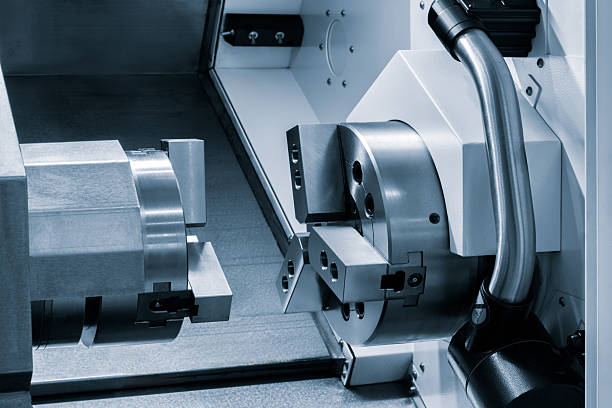
A modern dual-spindle turning center rarely functions as a simple two-axis lathe. Equipping a dual-spindle turning machine with powered live-tool turrets, C-axis spindle indexing, and an off-center Y-axis transforms its operational capabilities. With these integrations, the turning center performs off-center drilling, keyway milling, tapping, and surface profiling directly on rotational workpieces, executing full mill-turn operations within a single machine enclosure.
Automated Part Hand-off Capabilities
Both equipment platforms utilize primary and secondary (sub) spindles to achieve complete “done-in-one” component processing. The main spindle holds the raw bar stock or forging for front-side turning and milling operations. Subsequently, the sub-spindle synchronizes rotational speed, clamps the workpiece, receives the part during cut-off, and processes the rear face, completely eliminating secondary manual setups and reducing part-handling errors.
2. How Do They Differ? Kinematic Architecture and Milling Focus
Despite their shared multi-tasking capabilities, distinct structural differences separate dedicated dual-spindle turning centers from full-fledged mill-turn centers.
| Machine Platform | Structural Layout and Spindle Configuration | Key Characteristics |
|---|---|---|
| Dual-Spindle Turning Center | Features two opposing turning spindles, live-tool turrets, and Y-axis slide capability. | Optimized for high-efficiency turning operations, secondary machining, and improved part transfer automation. |
| Mill-Turn Center | Integrates main and sub spindles, a B-axis milling head, and an automatic tool changer (ATC) magazine. | Provides multi-axis milling and turning capabilities for complex precision components. |
Key Structural Differences
A dual-spindle turning center focuses on high-speed turning efficiency by using two synchronized spindles and live tooling systems. This configuration improves productivity for parts requiring secondary operations and automatic workpiece transfer.
In comparison, a mill-turn center combines turning and multi-axis milling functions in a single machine platform. The B-axis tilting milling head and ATC system allow manufacturers to complete complex machining processes with fewer setups.
This structural difference determines the ideal application range. Dual-spindle turning machines suit high-volume production, while mill-turn centers provide greater flexibility for complex CNC machining projects.
Turning-Centric Architecture (Dual-Spindle Turning Centers)
Dual-spindle turning centers prioritize high-efficiency, high-rigidity metal removal on rotational parts. They typically employ single or twin servo-driven tool turrets (e.g., 12 or 16 stations) fitted with live-tool holders. While highly effective for turning, facing, threading, and cross-milling, their milling envelope remains constrained by turret tool geometry, motor power limits, and fixed indexing angles.
Milling-Centric Architecture (Mill-Turn Machining Centers)
Full mill-turn centers prioritize complex 5-axis milling capabilities on cylindrical workpieces. Instead of relying solely on tool turrets, these machines feature a dedicated milling spindle mounted on a tilting B-axis head. Driven by high-RPM motor spindles and backed by large Automatic Tool Changers (ATC) holding 40 to 120+ tools, mill-turn centers perform continuous 5-axis simultaneous contouring, complex impeller machining, and deep cavity milling at extreme angular positions.
3. Dual-Spindle Turning Center vs. Mill-Turn Center: Comparison
The table below contrasts the mechanical and operational features of dual-spindle turning centers with dedicated mill-turn centers:
| Technical & Operational Metric | Dual-Spindle Turning Center | Full Mill-Turn Machining Center |
| Primary Kinematic Focus | High-volume turning & secondary milling | Complex multi-axis milling & precision turning |
| Tooling Interface System | Live-tool turret (VDI, BMT, or quick-change) | B-axis milling spindle + Automatic Tool Changer (HSK/CAPTO) |
| Tool Storage Capacity | 12 to 32 tools across turrets | 40 to 120+ tools in ATC tool magazine |
| Angled Milling Capability | Limited to fixed angular live-tool blocks | Continuous 5-axis simultaneous contouring via B-axis |
| Part Transfer Efficiency | High; fast sub-spindle synchronization & cut-off | High; automated main-to-sub spindle part transfer |
| Target Workpiece Geometry | Rotational shafts, bushings, valves with cross-holes | Complex aerospace housings, impellers, medical implants |
4. How to Select the Right CNC Machine Platform for Your Shop
Choosing between a dual-spindle turning center and a mill-turn center requires matching machine kinematics with your facility’s dominant part profiles.
Choose a Dual-Spindle Turning Center When:
-
Rotational Features Dominate: The workpiece consists primarily of turned diameters, shoulders, threads, and simple flat milling features (e.g., hex flats, keyways, cross-drilled oil holes).
-
High-Volume Production Runs: Dual-turret, dual-spindle layouts allow simultaneous machining on both spindles, delivering faster cycle times for high-volume automotive or hydraulic fittings.
-
Capital Budget Optimization: Dual-spindle turning centers deliver lower initial acquisition and maintenance costs compared to complex B-axis mill-turn centers.
Choose a Mill-Turn Machining Center When:
-
Complex 3D Geometry is Required: Workpieces require continuous 5-axis surface profiling, off-angle compound holes, or complex mold-like contours.
-
Large Tool Inventories are Needed: High-mix, low-volume manufacturing environments require dozens of specialized end mills, drills, and taps loaded into an ATC magazine for versatile part processing without manual tool changes.
-
Tight Geometric Tolerances Across Features: Machining intricate aerospace or medical components in a single setup on a B-axis mill-turn ensures precise true-position tolerances between turned diameters and milled features.
5. Procurement and Quality Guidelines for CNC Equipment Buyers
Machinery buyers, manufacturing directors, and CNC programmers can secure maximum long-term equipment return on investment (ROI) by applying three key procurement guidelines:
-
Evaluate Thermal Stability and Machine Mass: Ensure the CNC machine structure incorporates heavy Meehanite cast iron beds with symmetric thermal designs to maintain positioning accuracy during long production runs.
-
Verify Sub-Spindle Power and Sync Speeds: Confirm that both main and sub spindles feature matched horsepower, torque curves, and rapid C-axis synchronization times to ensure seamless part transfers during full-speed spindle rotation.
-
Assess Tooling System Rigidity (BMT vs. VDI): Select rigid Base Mount Tooling (BMT65 or BMT75) interfaces on live-tool turrets to maximize milling rigidity and tool life when cutting tough alloys like stainless steel or Inconel.
Technical Summary
Navigating a dual-spindle turning center vs mill-turn center comparison comes down to balancing part geometry complexity against production volume requirements. Dual-spindle turning centers excel at high-volume, rotational-dominated components requiring secondary milling, offering lower capital costs and rapid cycle times. Full mill-turn centers dominate complex, multi-axis manufacturing where continuous 5-axis milling, large tool capacity, and B-axis flexibility are essential. CHANSIN supplies high-precision CNC equipment, multi-tasking centers, and custom manufacturing solutions engineered to strict global industrial standards.