Manufacturing engineers, machine shop managers, and CNC equipment buyers constantly seek ways to streamline production cycles, minimize part handling, and achieve tighter tolerances. As component designs become increasingly complex across aerospace, medical, and automotive sectors, shop owners face crucial machinery specification choices. Consequently, prospective buyers frequently ask equipment specialists a central configuration question: “When evaluating dual-spindle turning centers, some models feature an off-center Y-axis while others do not. What specific machining capabilities does the Y-axis unlock, and how essential is a live tooling turret for complete part processing?”
Configuring a dual-spindle lathe without off-center milling motion limits processing flexibility and forces shops to transfer complex parts to secondary vertical machining centers (VMCs). These extra setups introduce mounting errors, increase work-in-progress (WIP) inventory, and extend lead times. Integrating true Y-motion alongside driven tool holders enables genuine turn-mill complete machining, completing complex turned and milled parts in a single setup. This technical machine tool guide details Y-axis kinematic principles, explains live turret functionalities, contrasts configuration capabilities, and provides practical procurement advice for CNC machining centers.
1. Why the Y-Axis Is Vital: Kinematics and Off-Center Machining
Standard 2-axis or 3-axis CNC turning centers operate within the X-axis (radial cross-feed) and Z-axis (longitudinal travel) planes, often augmented by C-axis spindle indexing for axial and radial milling along the exact centerline. However, processing geometry that strays off the spindle centerline requires a dedicated perpendicular axis.
Off-Center Milling and Drilling Capabilities
The Y-axis enables the cutting tool to travel perpendicular to the X-Z plane. This movement allows the machine tool to execute off-center drilling, keyway slotting, helical interpolation, flat hex milling, and complex 3D surface profiling directly on cylindrical workpieces.
Eliminating Secondary Setups on Milling Machines
Without a Y-axis, any off-center feature requires unclamping the partially machined component from the lathe and re-fixturing it on a 3-axis or 5-axis vertical machining center. Incorporating a Y-axis into a dual-spindle turning center allows the main and sub-spindles to complete all turning, milling, cross-drilling, and tapping operations in one continuous, automated workflow.
2. How a Live Tooling Turret Transforms Turning Centers
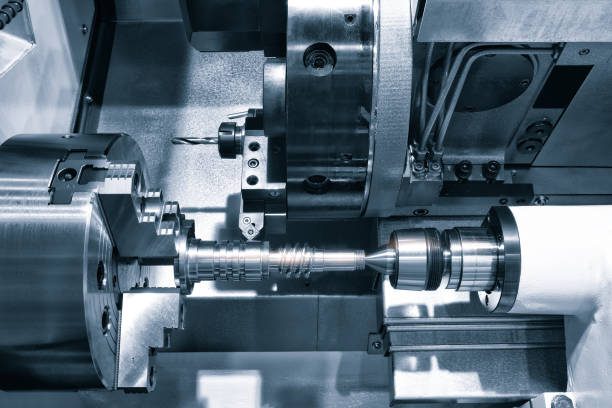
A live tooling turret (also called a driven tool turret) incorporates an internal motor drive system that powers rotating cutting tools—such as end mills, drills, taps, and reamers—directly inside the turret disk.
Integrating Milling into a Turning Platform
Standard static turrets only hold single-point turning inserts. Conversely, live tool turrets enable dynamic spindle speeds (often ranging from 4,000 RPM to over 12,000 RPM at individual stations). Combined with precise C-axis spindle indexing on both main and sub-spindles, live tooling turns a conventional lathe into a multi-tasking turn-mill center.
Synergy Between Y-Axis and Live Tooling
While a live tool turret provides the rotational power to drive mills and drills, the Y-axis provides the necessary 3D spatial positioning. Together, they allow tools to interpolate smoothly across the workpiece surface, producing accurate keyways, off-center bolt hole circles, and smooth interpolated profiles without tool deflection or chatter.
3. Structural Comparison: Standard Lathe vs. Y-Axis Turn-Mill Center
The table below contrasts standard 2-axis/3-axis dual-spindle lathes with fully configured Y-axis live tooling turning centers across core machining parameters:
| Feature & Operational Metric | Standard Dual-Spindle Lathe (X, Z, C Axes) | Y-Axis Turn-Mill Center (X, Y, Z, C Axes) |
| Off-Center Feature Machining | Restricted to centerline features (requires secondary VMC) | Full off-center milling, drilling, and tapping |
| Tool Motion Plane | 2D plane (X and Z motion) | True 3D spatial positioning (X, Y, and Z motion) |
| Live Tool Integration | Basic radial/axial driven tools on the centerline | Full live tooling turret with multi-axis interpolation |
| Machining Accuracy & Quality | Lower overall accuracy due to multiple part re-clamping | High precision; single-setup eliminates re-clamping errors |
| Cycle Time & Hand-Off Efficiency | Slower; manual transfer required between lathe and mill | Ultra-fast; automatic main-to-sub spindle hand-off |
| Work-in-Progress (WIP) Floor Area | Higher WIP accumulation between machine operations | Lean production: raw bar stock to finished part |
4. How to Select the Right Machine Configuration for Your Shop
Choosing between a standard turning machine and a fully configured Y-axis CNC lathe with a live tooling turret requires matching machine specifications to your target component portfolio.
Scenario A: Simple Axisymmetric Part Production
-
Machine Choice: Standard Dual-Spindle Lathe (without Y-axis).
-
Target Part Geometry: Cylindrical shafts, simple bushings, threaded fittings, and basic turned parts requiring face drilling or basic center-line cross tapping.
-
Economic Advantage: Lower initial machine investment, reduced programming complexity, and straightforward operator training.
Scenario B: Complex Multi-Tasking Component Production
-
Machine Choice: Dual-Spindle Turning Center with Y-Axis and Live Tooling Turret.
-
Target Part Geometry: Complex hydraulic blocks, aerospace fittings, medical implants, valve bodies, and eccentric turned parts with multi-sided flats or off-center porting.
-
Economic Advantage: Complete turn-mill complete machining in a single cycle. Eliminates secondary mill fixtures, frees up shop floor space, lowers labor costs, and yields higher overall part accuracy.
5. Procurement Guidelines for CNC Machine Tool Buyers
Procurement managers, shop owners, and manufacturing engineers can maximize return on investment (ROI) by following three key machine specification protocols:
-
Verify Y-Axis Structural Design (Slanted Wedge vs. Interpolated Motion): Prioritize turning centers engineered with a true physical slanted-bed Y-axis wedge slide over virtual software-interpolated Y-axis motion. Physical Y-axis slides provide superior rigidity, higher thermal stability, and heavier milling cut capacities.
-
Evaluate Live Tool Turret Drive Interfaces (BMT vs. VDI): Choose Bolt-On Machine Tool (BMT) drive interfaces (such as BMT55 or BMT65) over standard VDI tool holders for heavy milling and tapping tasks. BMT turrets offer higher clamping rigidity, exceptional tool alignment, and resistance to twisting under heavy loads.
-
Assess Sub-Spindle Power and Transfer Automation: Ensure the sub-spindle matches the main spindle’s power, torque, and C-axis resolution. Pair the dual-spindle machine with an automatic parts catcher, unloader, or bar feeder to enable lights-out, unmanned manufacturing.
Technical Summary
Specifying a Y-axis CNC lathe equipped with a high-rigidity live tooling turret transitions machine shop operations from basic turning to efficient turn-mill complete machining. While standard 2-axis or 3-axis dual-spindle lathes suit simple turned parts, adding Y-axis capabilities allows shops to complete complex, off-center features in a single setup. Eliminating secondary machining operations dramatically lowers cycle times, guarantees tight geometric tolerances, and maximizes overall shop productivity.
CHANSIN supplies high-precision CNC turning centers, multi-axis turn-mill machines, and automated manufacturing equipment engineered to satisfy demanding global metalworking standards.