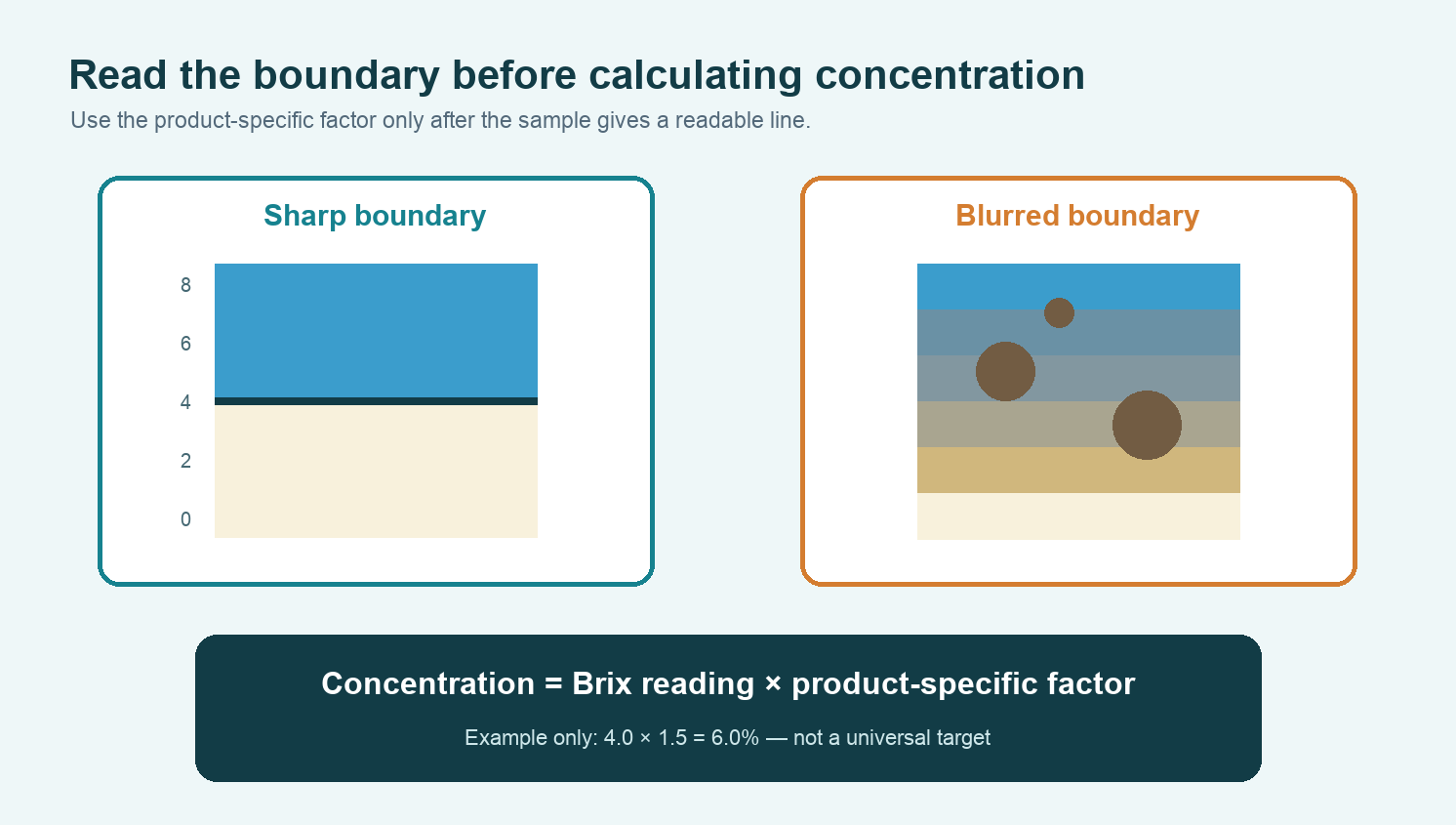
A refractometer reading of 4.0 does not automatically mean that a metalworking-fluid sump is at 4.0% concentration. For many water-miscible coolants, the Brix-scale reading must be multiplied by a product-specific refractometer factor. The number is useful only after the instrument is zeroed correctly and the sample produces a readable boundary.
This distinction prevents two common errors: dosing from the raw number when the coolant factor is not 1.0, and calculating a precise-looking concentration from a blurred line caused by contamination. The first is a conversion problem. The second is a measurement-quality problem.
What the refractometer actually reports
A handheld refractometer measures how the sample changes the direction of light and presents that optical response on a scale, commonly labelled Brix. The instrument does not directly identify every component in a used coolant. A fresh mix may have a stable empirical relationship between its optical reading and concentration, but sump fluid also contains dissolved salts, tramp oil, fines and products of use.
That is why the coolant manufacturer supplies a refractometer index or factor. Castrol’s coolant reference material gives the practical relationship:
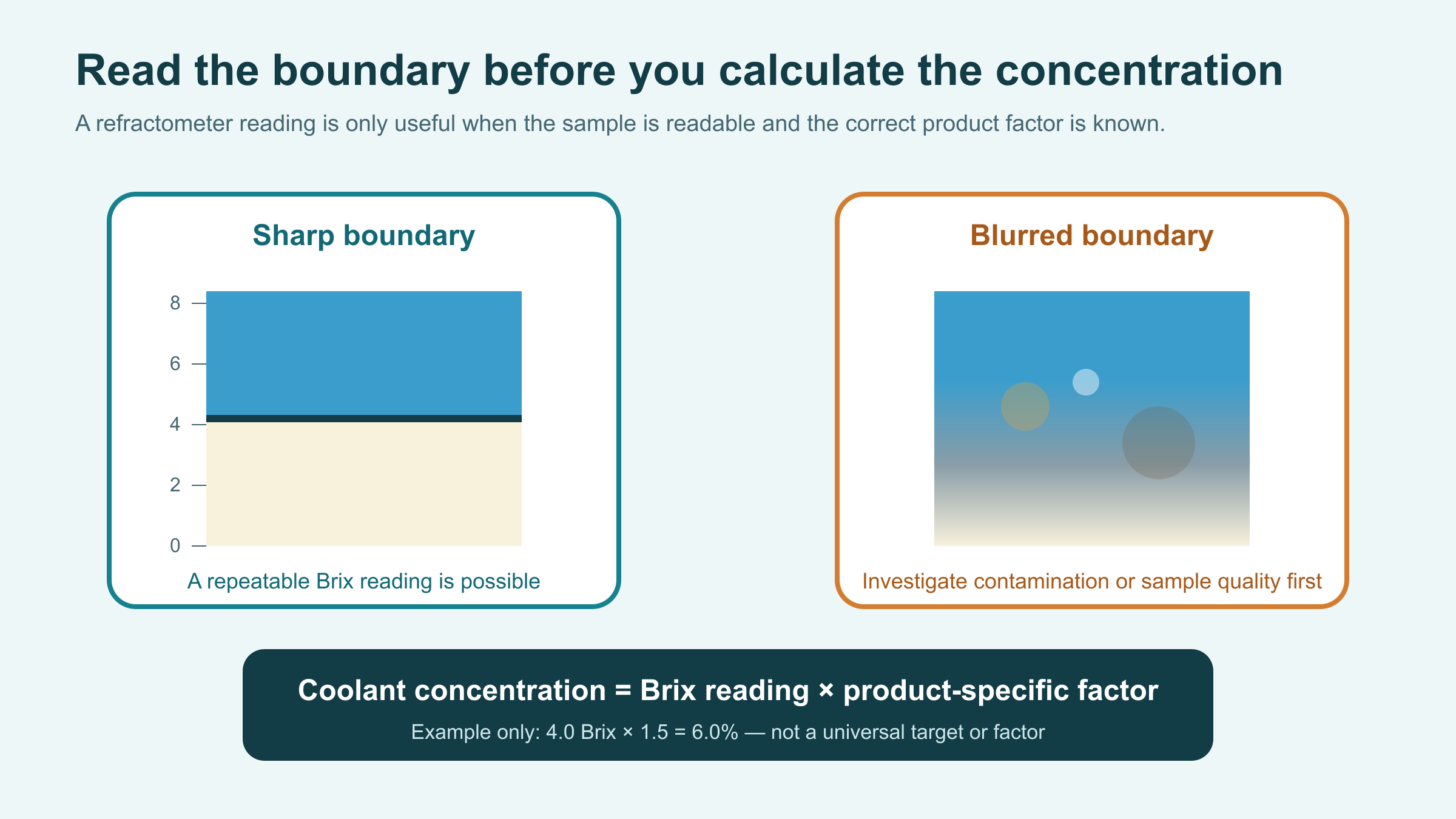
Coolant concentration = Brix reading × refractometer factor
The factor belongs to the specific product and method. Do not copy it from another coolant, assume it from color, or treat a number printed on an old shop card as current without checking the product information.
An illustrative conversion
Suppose a clean sample gives a Brix reading of 4.0 and the current product sheet specifies a factor of 1.5:
4.0 × 1.5 = 6.0%
This is an example only. Neither 1.5 nor 6.0% is a recommended value for an unspecified coolant. A different product may use a factor of 1.0, a different factor, or another approved test method. Always use the factor and operating range for the fluid actually in the machine.
Read the boundary before reading the number
A sharp light-dark boundary allows two operators to read approximately the same point. A broad, streaked or double boundary makes the result subjective. Rhenus and FUCHS both note that contaminants, especially tramp oil, can blur the indicator line and make refractometer readings inaccurate. Fines, dirt, debris and foam can also skew the reading.
| Observation | What to do before dosing | Why |
|---|---|---|
| Sharp boundary and repeatable reading | Apply the verified product factor and compare with its specified range | The optical measurement is interpretable |
| Blurred or streaked boundary | Resample, check the prism, foam, tramp oil and suspended contamination | A multiplication factor cannot repair an uncertain raw reading |
| Reading changes widely between samples | Confirm sampling location, circulation and mixing condition | The sump may not be homogeneous at the chosen point |
| Reading looks normal but odor, corrosion or foam is worsening | Check pH, water quality, contamination and biological condition | Concentration is not a complete fluid-health test |
If the line remains unreadable, use the alternative method approved by the coolant supplier. FUCHS notes that titration can sometimes improve concentration determination when tramp oil blurs a refractometer line. The correct fallback depends on the product chemistry; it is not a universal titration recipe.
Zero with the right water and control the sample
Clean the prism with a soft lint-free material and zero the refractometer using the same water source used to mix the coolant, following the instrument and coolant supplier’s instructions. Temperature compensation does not remove the need for correct zeroing, a clean prism and a representative sample.
Take the sample from a defined, well-circulated location rather than from a floating oil layer, dead zone or foamy return. Let gross bubbles settle if the approved procedure calls for it. Record the raw Brix reading, factor, calculated concentration, sampling point and time. Keeping raw and calculated values separate makes an incorrect factor easier to spot.
Make fluid checks part of a repeatable maintenance routine rather than an isolated correction after machining problems appear. This broader CNC machining-center preventive maintenance guide shows how coolant checks fit alongside lubrication, chips, filters and machine condition.
Concentration is not the whole coolant condition
Low concentration can reduce lubricity, corrosion protection and product stability. Excessive concentration can increase foaming, misting, residue and skin or respiratory irritation. Those effects are product- and condition-dependent, which is why the operating range comes from the product information sheet.
A concentration inside range does not prove the fluid is healthy. pH, water hardness, biological activity, tramp oil and metal fines can each create problems while the refractometer value appears unchanged. STLE’s fluid-life guidance likewise treats concentration control, tramp-oil removal, filtration and aeration or circulation as separate parts of fluid management.
Do not dose blindly from a doubtful reading
Adding concentrate to every low-looking reading can push the sump progressively high if the factor is wrong or the sample is contaminated. Adding plain water to every high-looking reading can also disturb corrosion protection and emulsion stability. First establish whether the raw reading is valid, then compare the calculated concentration with the current product range and correct the fluid according to the supplier’s mixing procedure.
Engineering conclusion
Separate measurement from calculation. Zero the instrument correctly, collect a representative sample and decide whether the boundary is readable. Then multiply the Brix reading by the verified factor for that coolant. If contamination makes the line uncertain, investigate the sample or use an approved alternative method before changing the sump. Finally, remember that concentration is one condition indicator, not a complete coolant diagnosis.
Frequently asked questions
When does Brix equal coolant concentration?
Only when the coolant’s approved refractometer factor is 1.0 or the instrument has been configured to display the product’s concentration directly. Confirm this in the current product data.
Can tramp oil make the reading look high?
It can distort or blur the optical boundary, but the direction and size of the error depend on the contamination and fluid. Treat a blurred line as an unreliable measurement rather than applying a universal correction.
Should coolant be added directly to correct concentration?
Follow the fluid manufacturer’s make-up and mixing procedure. Properly premixed make-up fluid is commonly used to control concentration without destabilizing the emulsion, but the required mixture depends on the product and sump condition.
Sources and Method
- Castrol, Quick Tips for Maintaining Coolant, 2023 — refractometer procedure, concentration formula, product-specific factor and contamination note.
- FUCHS, Coolant Management Guide — concentration control, refractometer factor, blurred indicator line, titration, pH and biological monitoring.
- Rhenus Lub, “Measuring the Metalworking Fluid Concentration” — supplementary measurement limits and contamination effects.
- STLE, “Extending the Life of Metalworking Fluids” — fluid-management context beyond concentration alone.
The conversion example is hypothetical and is included only to explain the factor. Actual concentration targets, make-up ratios and test methods must come from the coolant product information.