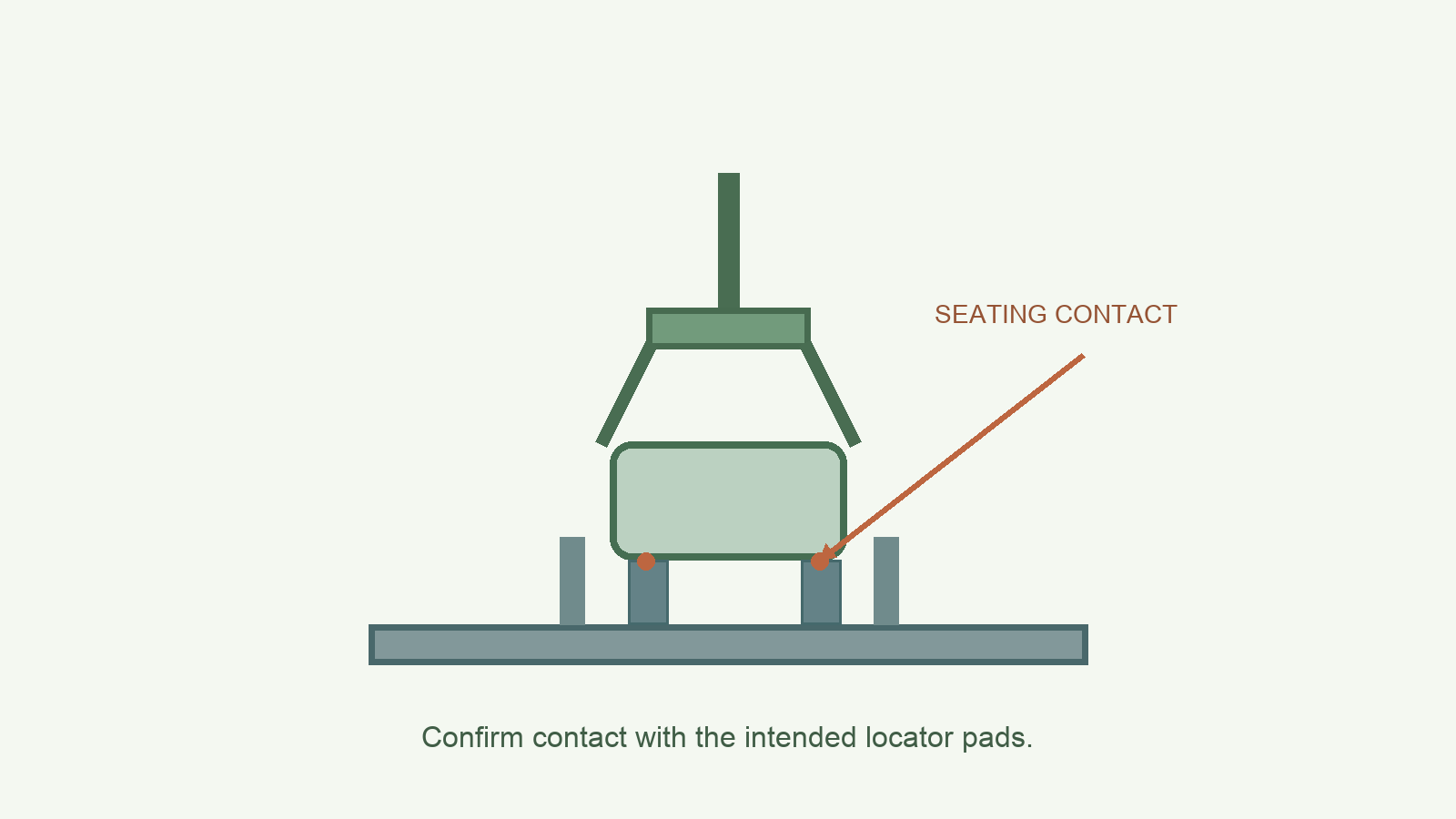
A robot reaching the CNC fixture is not proof that a blank is seated. Before the machining cycle is permitted, the cell must distinguish four conditions: the gripper held the intended part, the part was released into the fixture in the intended position, the fixture clamped it, and the machine received the required permission to start. Each condition needs evidence suited to the actual part and cell. A gripper-closed signal alone proves neither part presence nor seating; a clamp-closed signal alone may prove only actuator travel. The integrator must decide how these states are verified and how the cell stops when a check fails.
First establish that the robot has the part
At pick-up, distinguish the gripper’s commanded action from a detected part. A pneumatic gripper may close against nothing, hold two stacked blanks or grip the wrong feature. A suitable part-present sensor or another validated check can close that information gap. SensoPart’s gripper-sensing examples show separate checks for a part after gripping and an empty gripper after release.
During handoff, confirm that the part leaves the gripper and enters the fixture. If the release is commanded but the part remains attached, the next motion or cycle may be hazardous. Record what evidence distinguishes a successful transfer from a command that merely completed in software.
Then verify the part against the fixture datums
Presence is not the same as position. A blank can be in the fixture pocket but rest on a chip, sit against the wrong locator, or arrive rotated. Choose a check that detects the failure modes the specific fixture can produce. Depending on geometry, this might be a seat sensor, a measured stop, a probing step or an appropriately validated vision check. FANUC’s vision-inspection description lists presence, position and orientation checks as possible functions.
The machine tending planning guide helps frame part presentation and gripper access before cell design. The fixture drawing should then identify which surfaces actually locate the part. A sensor near a pocket may report “present” while the critical datum face remains open. Place the verification question at the datum that matters for cutting, not just at the easiest location for a sensor. A separate fixture review guide covers the datum and access questions in more detail.
Clamp confirmation is another check, not a substitute
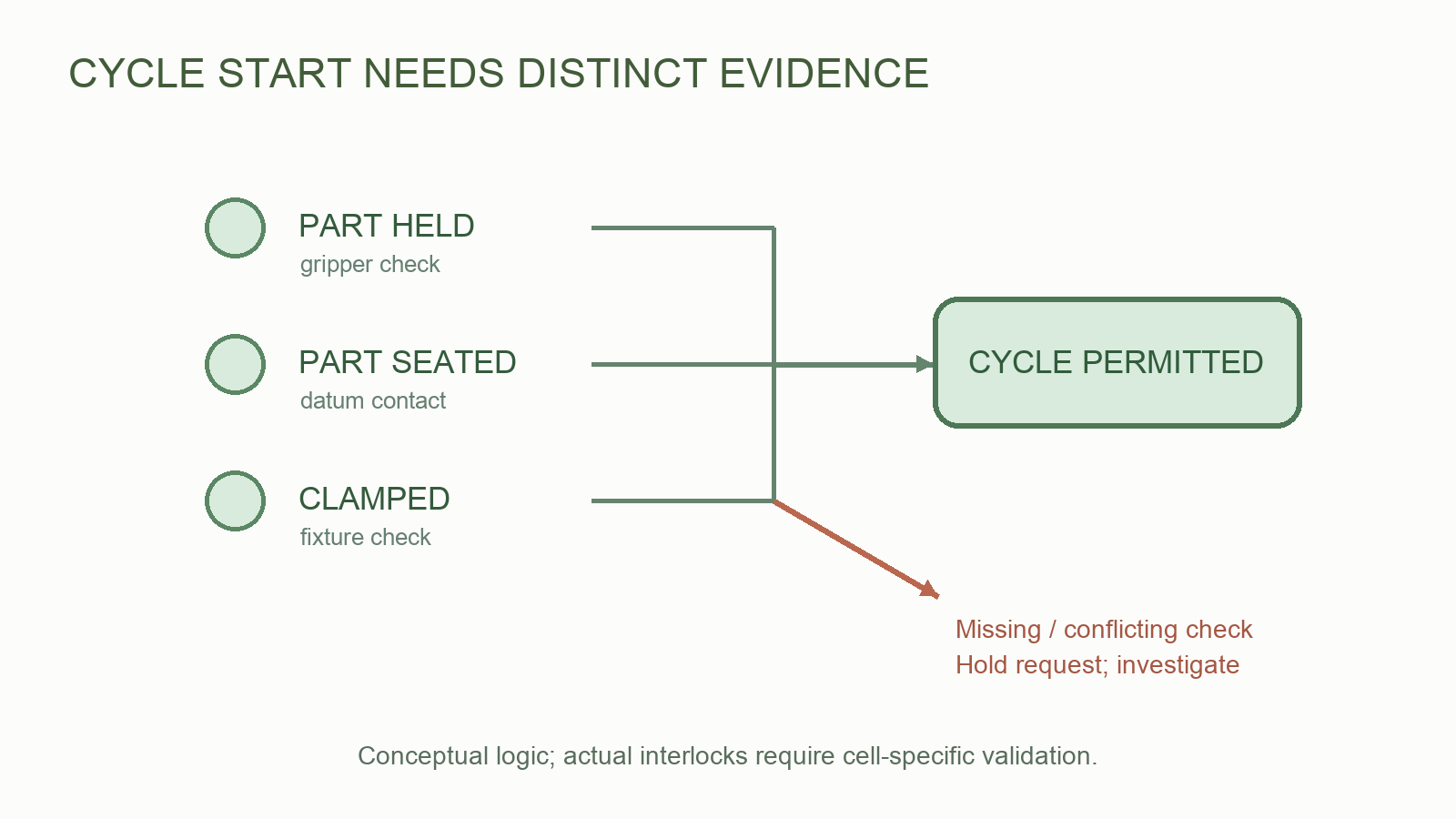
After seating, confirm the clamp reaches its intended state under the cell’s operating conditions. Whether a clamp position signal is enough depends on the fixture: a clamp can travel to its end position while a small or misoriented blank is still wrong. Conversely, a correctly placed blank may prevent a clamp from reaching its expected position because of chips or a mechanical fault. Use the fixture maker’s data and prove the chosen detection method on the actual part variants.
The ABB RobotWare Machine Tending application manual includes part-sensor checks and exception handling within a machine-tending workflow. The cell needs a defined response when a state is missing.
Make cycle permission an explicit outcome
A useful commissioning exercise is to work backward from the CNC cycle-start request. What signals and machine states must be true? What happens if one signal is absent, contradictory or late? The cell integrator should document the response and check it against the site risk assessment, distinguishing production logic, safety functions and machine permissives.
| Injected fault during commissioning | Expected evidence | Expected cell response |
|---|---|---|
| Pick attempted with no blank | Held-part check does not pass | Do not proceed to machine loading |
| Blank released off the intended seat | Seating or orientation check does not pass | Do not clamp or request a machining cycle |
| Clamp fails to reach its confirmed state | Clamp-state check does not pass | Hold the cycle request and flag the fault |
| Old part remains in fixture | Empty-fixture or occupancy check fails | Stop the next load sequence |
Define the response and reset procedure for the robot, CNC, fixture and guarding together. During proving, deliberately test missing and false signals, not just a successful load. When the part family, gripper or fixture changes, recheck the assumptions behind each sensor and state.
Where the chain ends
A cell with a mechanically self-locating part and a well-validated fixture may use fewer sensors than a flexible mixed-part cell. The evidence can differ; the distinction between held, seated, clamped and permitted still matters. The final acceptance test should show that the chosen evidence detects the credible misload cases for that particular job. If it cannot, the cycle should remain unavailable until the integration is corrected.
Sources and method
The gripper and vision examples come from SensoPart and FANUC; the machine-tending exception context comes from the ABB application manual.