A tool change ends with a loud crack from the spindle. A few changes later, the control releases the tool and the BT40 holder doesn't come down. Both get blamed on the drawbar, and the first thing people try is more air pressure or a new set of pull studs.
Sometimes that works, but often it doesn't, because three different faults produce these symptoms: the holder sticking in the taper, the release mechanism not travelling far enough, and clamping force that has dropped over time. Each is checked in a different way, so it pays to work out which one you have first.
Start with what the machine was doing
Stop automatic tool changes before anyone works on the spindle. A holder stuck halfway can drop without warning, so nobody should be pulling on it while the release is being cycled.
Three details narrow things down quickly: whether it's one holder or several, whether it happens on a cold machine or after hours of running, and what the control showed at the time, whether an alarm or a clamped or unclamped state.
If only one holder does it, the cause is usually on that holder: its taper or its pull stud. If several do, look at what they share, which is the spindle taper, the drawbar and the release unit.
| What you see | Where to look first | What to tell your service engineer |
|---|---|---|
| Holder comes out with a crack | Taper condition, or a release that hits too hard | Holder number, photos of both tapers, when it happens |
| Release commanded, holder stays | Release stroke or air supply | Alarm, displayed clamp state, what actually moved |
| Releases fine, but the cut chatters | Clamping force or interface wear | Measured clamping force, holder inspection |
Check the tapers first
The tapers are the first place we look, because a quick inspection there can narrow the problem down before anyone opens up the release mechanism. Once the holder is out, check both the holder taper and the spindle taper for dirt, rust, fretting or small dents.
Any of these can make a holder grab in the spindle and come out with a bang. It helps to photograph the contact marks before cleaning, because the pattern shows how evenly the holder was seating.
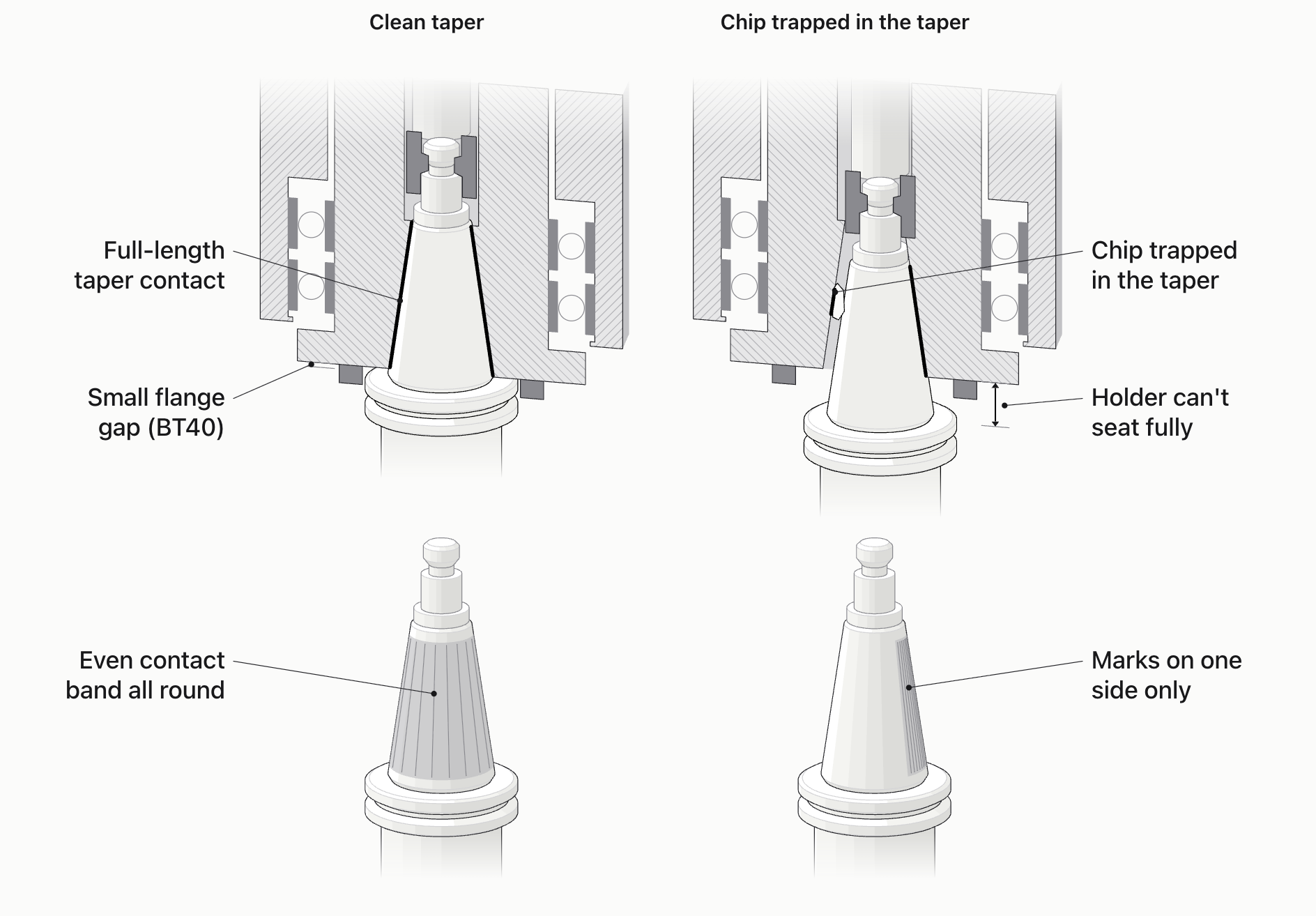
Dirt rarely stays on one holder. BIG DAISHOWA points out that buildup on holders gets transferred into the spindle and wears it, so one neglected holder can end up affecting the whole tool set.

For cleaning, follow your spindle maker's method. Sanding or greasing a taper can hide the marks that show what went wrong, and sanding can damage the contact surface itself.
The control says released, but did the holder move?
The unclamp signal comes from a switch or sensor. It tells you the mechanism reached a position, not that the holder was pushed far enough to come free. If that switch is set too early or has shifted, it can show released while the holder is still held.
Troubleshooting guides for tool-release pistons list the usual causes: low or unsteady air pressure, air leaks, worn parts and a knock-out distance set too small. What service needs to confirm is whether the piston completes its full stroke during an actual release.

Air pressure is often checked with the machine idle, where it can look normal. During the release the demand jumps, and a weak supply or a leak only shows up then. Pressure values and adjustment steps should come from the manual for your spindle; figures from another machine's guide don't transfer.
Clamping force is a separate measurement
A holder can release cleanly and still be held too loosely once it's clamped. The disc springs in a drawbar lose force as they wear, and BIG DAISHOWA notes that low retention force reduces rigidity and causes vibration.
The only way to know is to measure it with a gauge and adapter that fit your spindle interface; OTT-JAKOB's Power-Check is one such device. This reading has nothing to do with release air pressure, so one can't stand in for the other.

Record the reading, the gauge you used and the limit for your spindle together. The figure on the dial in a manufacturer's photo applies to their spindle, not yours.
Spindle or holder?
If only one holder is damaged, deal with that holder and its pull stud first and leave the machine's release settings alone. If several good holders all fail to release properly, the problem is in the machine. It's also worth checking that your pull studs match the spindle specification. BT40 studs come in several angles and lengths, and the wrong one can cause clamping or release problems.

Runout during cutting is a different problem with a different measurement, covered in our toolholder runout guide. It's best kept separate: adjusting the release mechanism won't cure runout, and it can create a release problem you didn't have before.
What helps on the machine side
When you're choosing a Chansin VMC, we can go through the spindle taper, pull-stud interface, release air supply and clamp sensing with you as one system. The CS-V6 and CS-V855 in our VMC range both use BT40 spindles, and we'll check the holders and pull studs you already use against the spindle you order. Problems like these are quicker to sort out when the release unit is easy to reach and the control shows clamp and unclamp states clearly.
If you're choosing a new VMC and want to settle the spindle interface early, send us the holders and pull studs you already use through our product inquiry page.
Sources and Method
- Haas — Spindle Drawbar Troubleshooting, TG0132: taper sticking and retained clamping force.
- Haas — Tool Release Piston Troubleshooting, TG0146: supply, movement and knock-out adjustment.
- BIG DAISHOWA — Simple answers to potentially costly spindle and tool holder issues: buildup transfer and retention force.
- OTT-JAKOB — POWER-CHECK: direct spindle clamping-force measurement.
The scenario at the start is illustrative. Model data are Chansin CNC product data.