Suppose your leak test says the manifold is good, and weeks later a filter downstream catches flakes of aluminum, or a quick disconnect starts to stick. Both results can be right. They just measured different things.
Erik Anderson, who runs a hydraulic manifold shop in Wisconsin, put it plainly in Cutting Tool Engineering: a burr isn’t a problem until it becomes a loose piece of metal, and once it works loose it can cut seals and block valves. He called it generally the single biggest failure mode for any hydraulic system.
A liquid-cooling loop has the same weakness. The Open Compute Project’s cold plate requirements warn that particles can foul the fins of microchannel cold plates, heat exchanger gaps and quick disconnects, leading to lost performance, leaks or system failure.
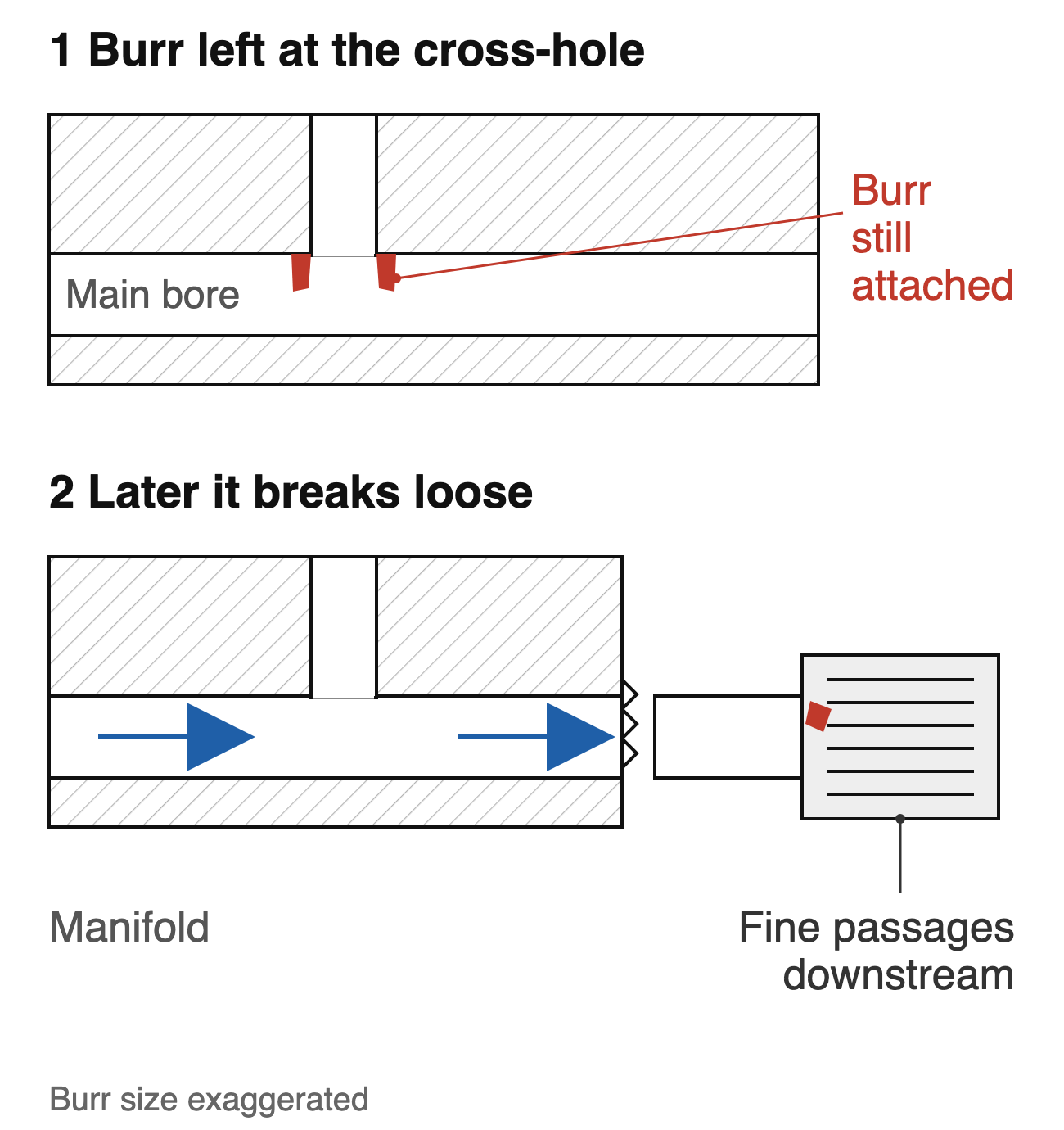
A leak test checks for leakage. It can’t see a burr still attached to the wall at a cross-hole. To stop those burrs reaching the loop, look at where the intersection forms, deal with it in the same setup, and get the chips out before the part leaves the machine.
First, sort the problem
- It leaks under the test pressure. That’s the pressure boundary: a porous wall, a bad thread or seal face. Not a cross-hole burr question.
- It passes, but metal shows up downstream later. Check for loose burrs and retained chips, starting at the cross-hole intersections.
- It passes, but flow or pressure drop is off. A burr or chip may be restricting a passage, or the passage itself is undersized. Check both.
1. Look at how each intersection forms
When the second hole breaks into the first, the drill exits through a curved wall, unevenly supported around its edge, and leaves its exit burr inside the first passage. Drill the holes in the other order and the burr ends up in the other passage. So your drilling order decides where each burr lives, and whether you can reach it.
A study of cross-hole drilling by Ohshima, Maekawa and Murata found that the burr depends on the difference between the two hole diameters and on the feed at the end of the cut, and that drilling direction matters too. Commercial aluminum made bigger burrs than free-cutting steel, and ball burnishing removed less of them afterward.
In your program, start by testing a reduced feed as each cross hole breaks through, check the result at the intersection, and pick the drilling direction on purpose.
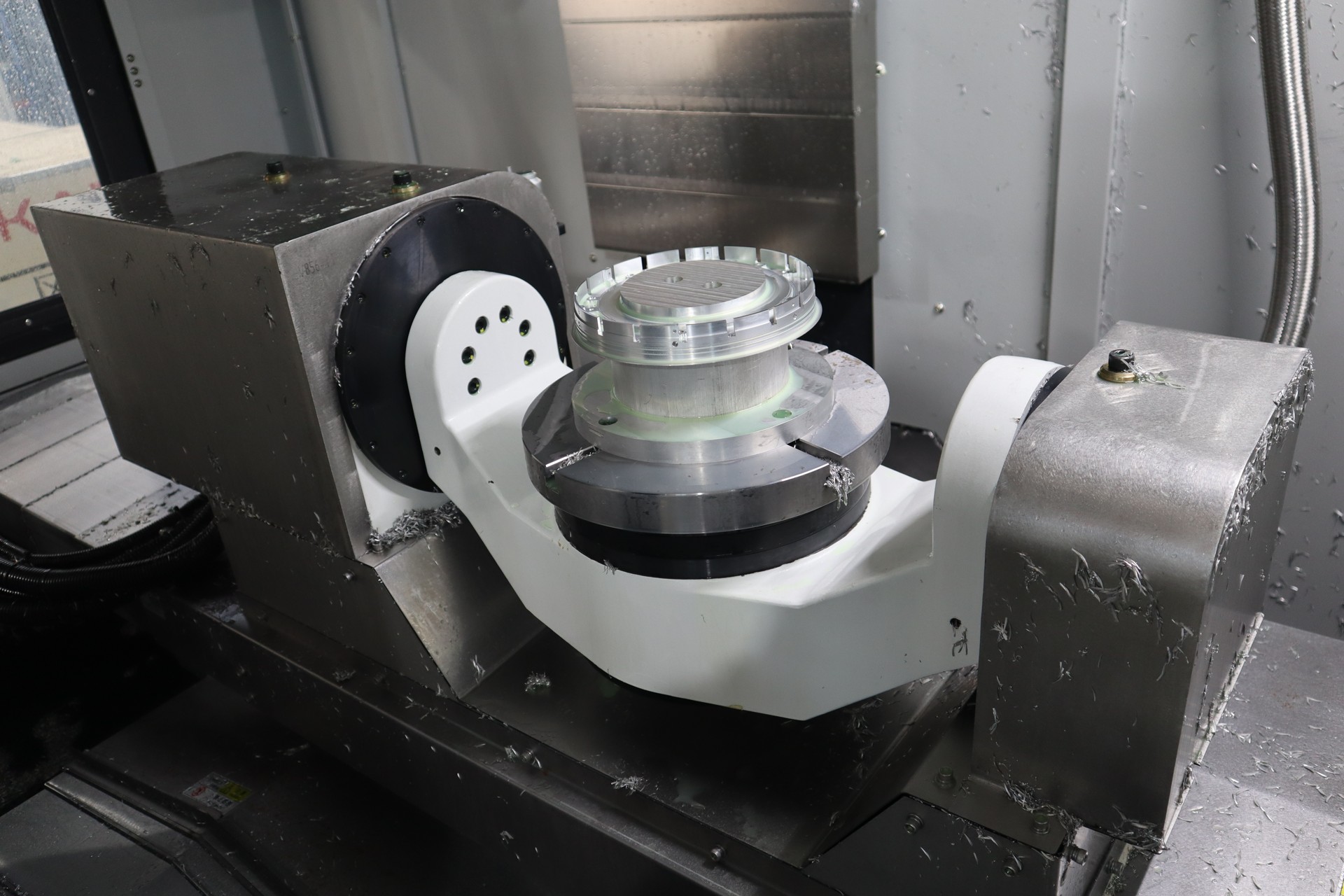
Doing all of that is much easier if the part stays in one setup. A horizontal machining center with an indexing table, or a five-axis machine, can bring several faces into reach, so their drilling order is set in one program instead of split across fixtures.
2. Deburr the intersection in the same setup
Thermal deburring burns burrs off in a closed chamber, as a separate process off the machine. One RV-industry supplier described by HEULE had an aluminum manifold where a 9.93 mm bore met two valve cavity ports at a 1:1 diameter ratio. It had always gone out for thermal deburring.
Once cross-hole deburring tools were added to the program on a vertical machining center, both the thermal deburring and the manual deburring before it were dropped, and the customer planned to add more tools until the part came off the machine finished.
What matters for the machine is reach: the program has to get the deburring tool to each intersection from the side its burr is on. Our article on hidden burrs in battery tray profiles covers tool pockets and the same idea on hollow extrusions.
3. Get the chips out before the part leaves
A chip left in a blind passage is the same problem as a loose burr. Through-spindle coolant pushes chips out of the hole while the drill is still in it, and higher pressure helps in deep, small passages. Our comparison of through-spindle and flood coolant covers when the pressure is worth paying for. After machining, a flush through the part and a look at what the filter catches tells you more than the leak test can.
What to check, and how often
- Every part: the leak test, for the pressure boundary.
- First part after any program, tool or drilling-order change: look at every intersection with a borescope, or section a sample part.
- Every batch: flush a sample part through a filter and record what it catches.
- When the filter catch changes: compare it with the last good batch, then check tool condition, flushing, and any change to the drilling order or breakthrough feed.
What you find tells you where to look next. A burr still rooted at an intersection points to the drilling order or a deburring tool that can’t reach that side. Loose chips with clean intersections point to the flushing route.
Most of this is process, not the machine. Look at the machine when the coolant reaching the tool is weaker than it should be, or when holes drilled after an index don’t meet where the program says they should.
How we’d set up machines for manifold work
We’ve worked with customers machining liquid-cooling manifolds, CDU components and hydraulic valve blocks. For parts with passages on several faces, we’d look at an LW-series horizontal machining center with an indexing table, or our CS-U480 five-axis machine for smaller blocks, so we can plan the drilling order across the reachable faces in one setup.
For your manifolds we’d set the machine up with through-spindle coolant, at a pressure level between 20 and 120 bar chosen for your passages, and a magazine big enough for the deburring tools as well as the drills.
Send us the manifold drawing, the passage layout and your cleanliness requirement through our inquiry form, and we’ll suggest the machine and the setup. For the cold plates these manifolds feed, see what the machine needs for cold plate machining.
Sources
- Alan Richter, Explosive deburring ideal for complex parts, Cutting Tool Engineering, August 2017
- Open Compute Project, ACS Liquid Cooling Cold Plate Requirements, Rev. 1.0, section 5.1.2 (filtering)
- I. Ohshima, K. Maekawa and R. Murata, Burr formation and deburring in drilling cross holes, Journal of the Japan Society for Precision Engineering 59(1), 1993
- HEULE, Manifold application
- CHANSIN CNC LW-series and CS-U480 specifications
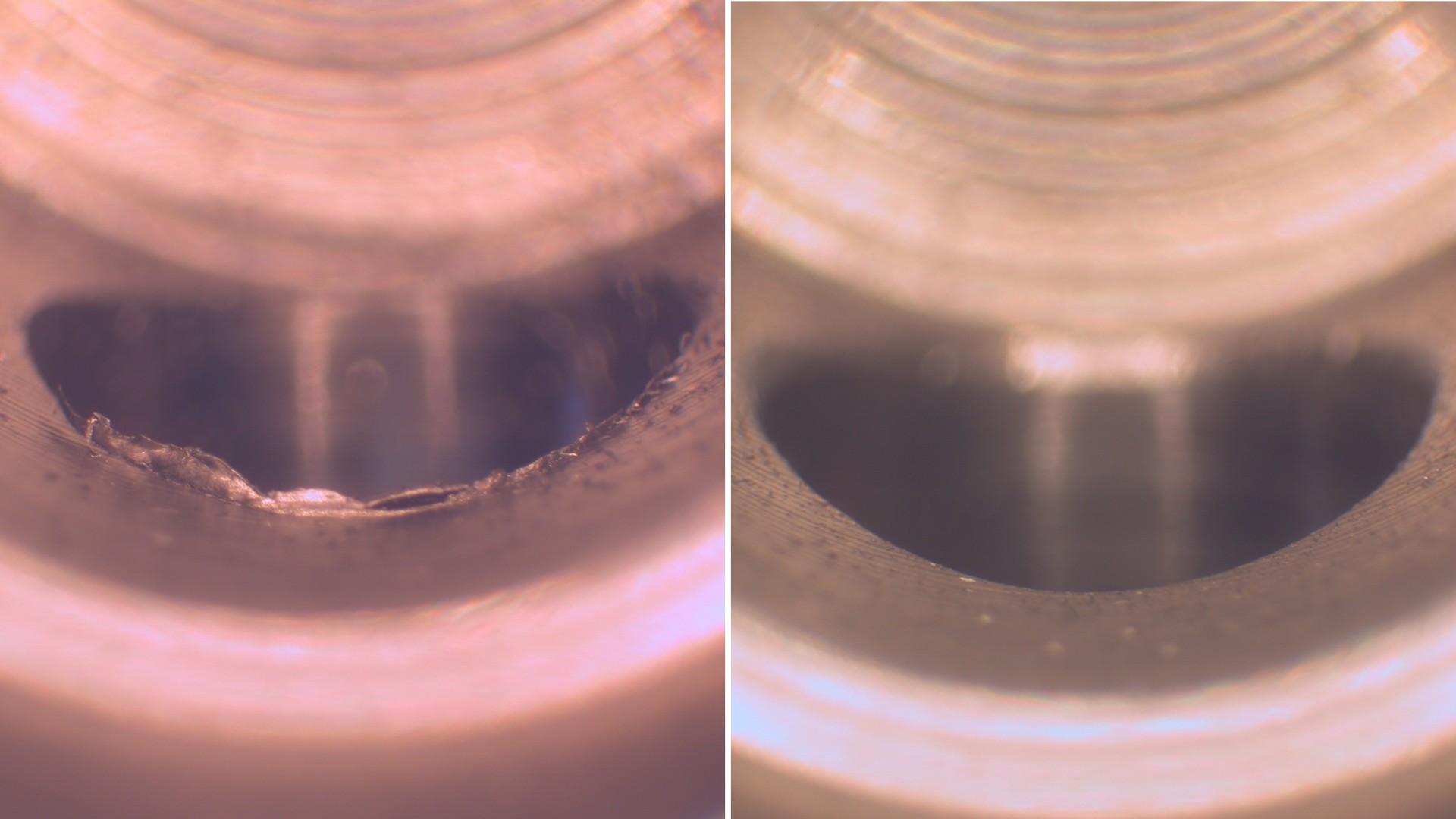
- Featured image: cross-hole burr before and after deburring, J.W. Done, cropped